
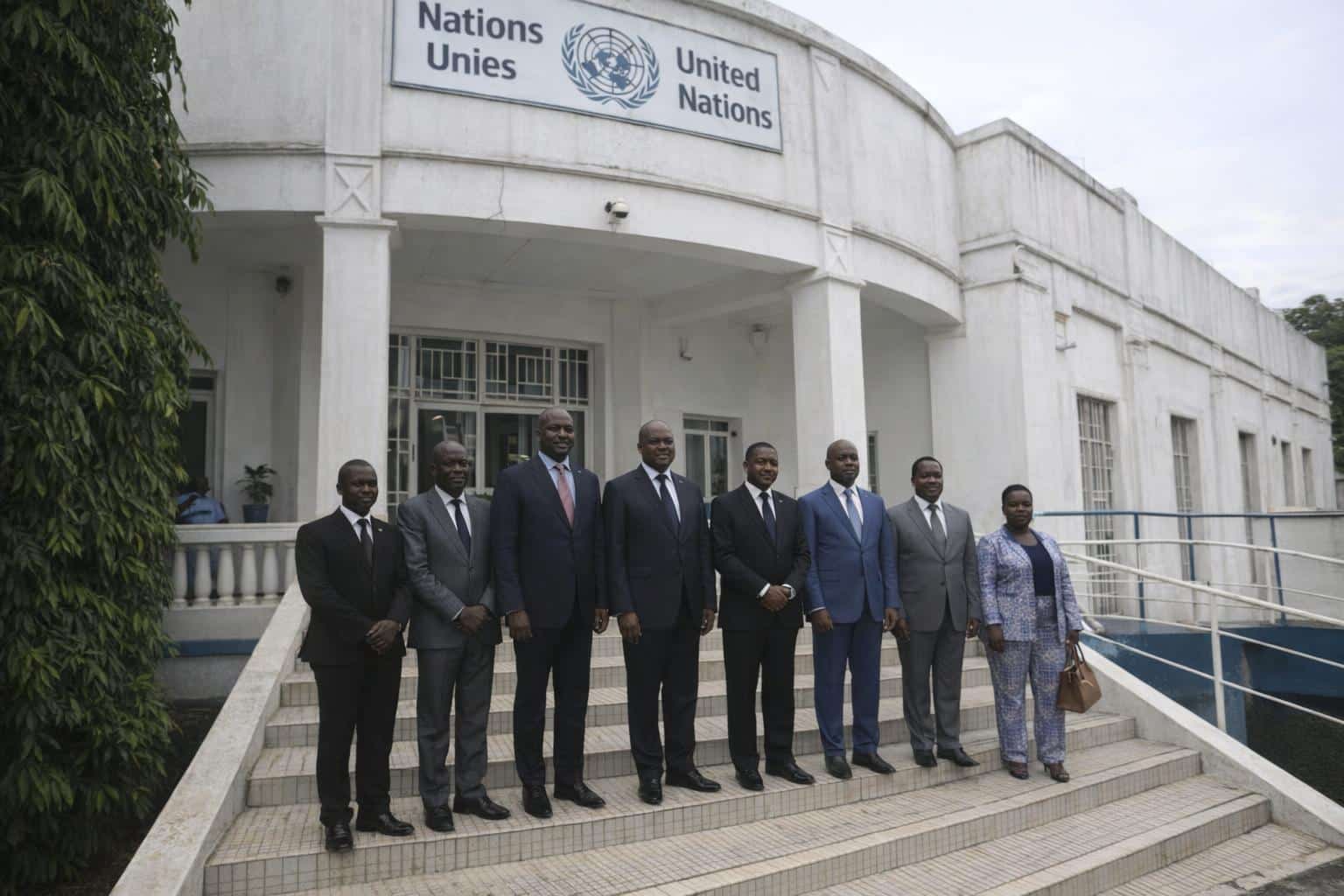
Brazzaville meeting on transparency and public accountability
Brazzaville, Jan. 13 — The United Nations system in the Republic of the Congo says it is ready to support the National Commission for Transparency and Responsibility in Public Finance Management (CNTR) as the institution works to deliver its action plan.
The UN Resident Coordinator, Abdourahamane Diallo, reiterated that commitment during talks held in Brazzaville on Jan. 12, framed by both sides as part of closer institutional consultation on economic governance (Agence Congolaise d’Information).
Governance priorities: transparency, anti-corruption, cooperation
According to the account of the meeting, the UN and CNTR reviewed several governance priorities: promoting transparency, strengthening public accountability, fighting corruption, and deepening institutional cooperation between CNTR and the UN system in Congo (Agence Congolaise d’Information).
Diallo described the exchange as consistent with the UN’s approach of engaging the actors involved in Congo’s development roadmap, with special attention to governance. “The United Nations house is open; it is an obligation and a duty for us to meet all actors,” he said (Agence Congolaise d’Information).
UN cooperation framework 2020–2026 and the governance pillar
Diallo linked the CNTR discussion to the broader cooperation framework covering 2020–2026, where governance is presented as a key pillar alongside sector priorities cited as education, health, and economic diversification (Agence Congolaise d’Information).
In that context, he emphasized that transparency, accountability, and the management of public financial resources remain central themes for partners working with the Congolese administration and its institutions, as described in the meeting summary (Agence Congolaise d’Information).
CNTR strategic plan 2025–2029: positioning and stronger rules
CNTR used the meeting to present the main directions of its 2025–2029 strategic plan. The plan is structured around two fundamental axes, according to the information released after the talks (Agence Congolaise d’Information).
The first axis aims to position CNTR, by 2029, as a national reference institution on transparency and responsibility in the management of public finances. The second focuses on strengthening and improving the normative framework for transparency and responsibility within administrations (Agence Congolaise d’Information).
UN agencies, including UNDP, cited in CNTR action plan support
Diallo said the Congolese government, working with one of the UN system’s agencies—specifically the UN Development Programme (UNDP)—supported CNTR during the preparation of its 2025–2029 action plan, which is expected to be implemented soon (Agence Congolaise d’Information).
In practice, that support is presented as part of a partnership logic: aligning technical assistance with a nationally defined plan so that CNTR’s priorities can be translated into operational steps, while maintaining a focus on measurable governance objectives (Agence Congolaise d’Information).
CNTR seeks technical expertise and complementary financing
CNTR President Joseph Mana Fouafoua said the commission needs both financial and technical partners to fully carry out its mandate. On the technical side, he pointed to the need for experts to help the institution accomplish its five missions set out in the law establishing CNTR (Agence Congolaise d’Information).
He also indicated that UN institutions could help complement CNTR’s financial resources so the commission can implement those missions. The message underscores a pragmatic reality: institutional mandates often depend on sustained capacity and predictable means (Agence Congolaise d’Information).
CNTR’s legal basis and Congo’s public finance governance agenda
CNTR is a Congolese institution created under Law 18-2019 of May 24, 2019. Its stated purpose is to contribute to promoting sound governance of public finances in the Republic of the Congo, the report noted (Agence Congolaise d’Information).
For observers of public-sector reform, the Brazzaville exchange highlights a familiar dynamic: national institutions set objectives and frameworks, while international partners support implementation through expertise, coordination, and targeted resources, within agreed cooperation pillars (Agence Congolaise d’Information).