
Federal council opens new term
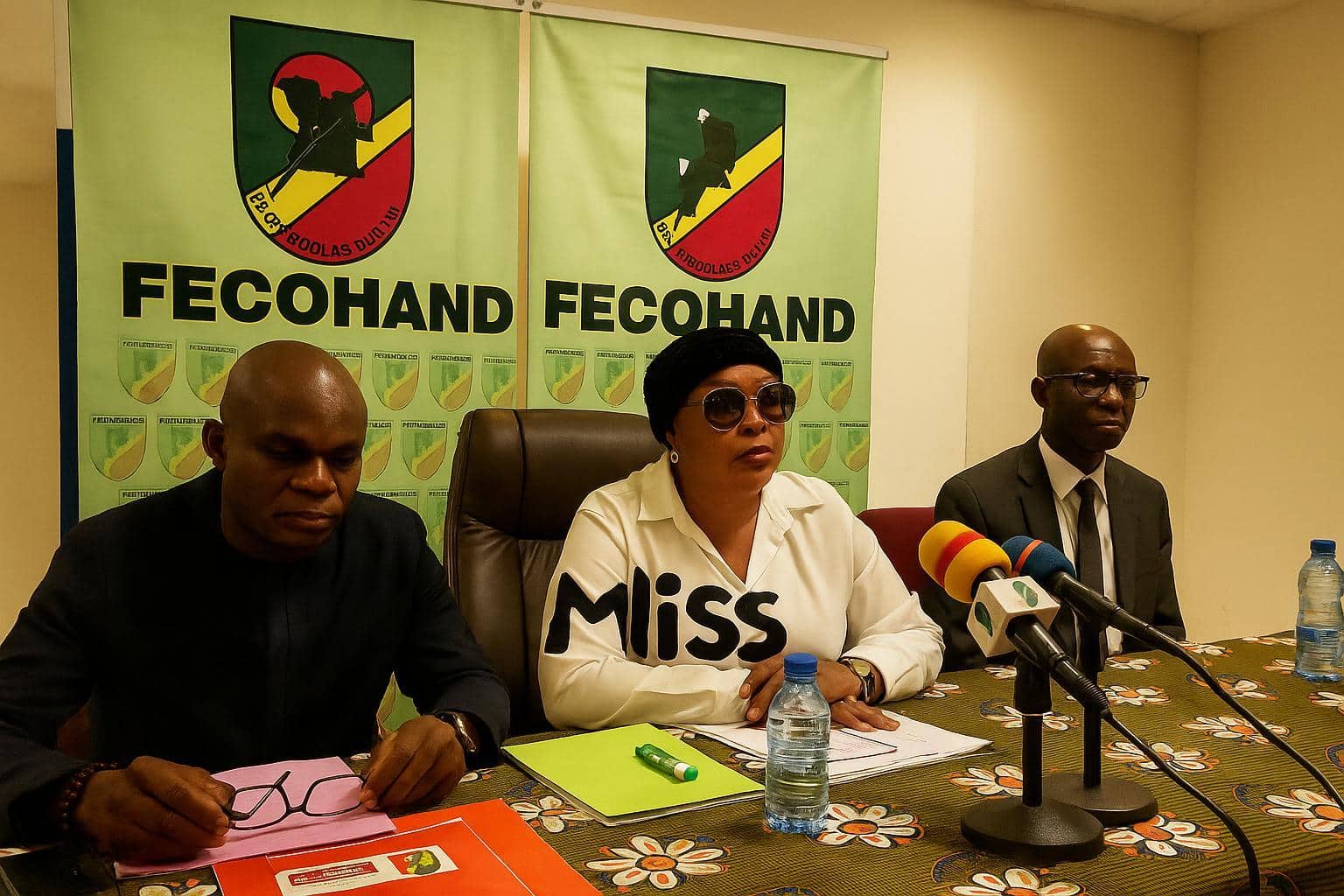
On Tuesday 4 November 2025, the Congolese Handball Federation, better known as Fécohand, opened the inaugural session of its new Federal Council at Nicole Oba Gymnasium in Brazzaville’s sixth district, Talangaï.
The meeting doubled as a working congress and marked the first full gathering following the federation’s recent elections, drawing delegates, coaches and referees eager to set priorities for the four-year cycle.
Unity message echoes through Talangaï
Presiding over both the opening and closing ceremonies, Ministry of Sports envoy Furet Ikoué urged delegates to “anchor all deliberations in the national vision for sport,” while Olympic Committee representative Jean-Claude Itoua highlighted the need for institutional stability.
Linda Ambroisine Noumadzalayi Ebendzé, freshly confirmed as president of the executive board, framed the congress as a moment to “reset grievances, heal divisions and focus on courtside performance rather than corridor debates,” a remark that earned prolonged applause.
The final communiqué distilled that message: “The Federal Council invites all handball players to embrace cohesion rather than sectarianism … only by working in synergy can we advance our sport.” Delegates said the sentence would headline every regional dispatch this week.
Updated statutes tighten federation governance
Beyond rhetorical appeals, delegates rolled up their sleeves to revise the federation’s statutes, general regulations and internal rules. The exercise, conducted article by article, updated electoral procedures, clarified club affiliation criteria and aligned disciplinary chapters with current continental guidelines.
One highly discussed clause introduced graduated fines for staging any handball activity without prior federation clearance. According to the drafting committee, the measure aims to deter “parallel tournaments” that drain sponsorship income and complicate athlete insurance coverage.
The congress also mandated seasonal awards for the best athletes, coaches and administrators, hoping that public recognition will cultivate role models for the next generation of keepers, wingers and referees across Congo-Brazzaville.
Ethics code replaces external arbitration
A separate vote adopted a code of ethics intended to fill the vacuum left by Fécohand’s withdrawal from the Sports Conciliation and Arbitration Chamber, known by its French acronym CCAS.
Under the new framework, an independent ethics committee, appointed by the Federal Council, will hear grievances, issue cautions and, when necessary, recommend suspensions. Supporters said the in-house mechanism offers speedier resolutions without sacrificing procedural fairness.
Critics of the move, though few on the congress floor, cautioned that credibility will depend on transparent selection of committee members. Ebendzé responded that the federation will publish the full list of panellists within thirty days.
Professional league promises new revenue streams
Perhaps the most transformative decision came with the green light for a professional handball league. Delegates unanimously endorsed a roadmap that would start with eight flagship clubs, split between Brazzaville and Pointe-Noire, before expanding into the departments.
The league statute provides for club licensing benchmarks, including medical staffs, audited financial statements and minimum player salaries, signalling a shift from semi-amateur status to a more commercially robust ecosystem.
Organisers foresee a broadcast deal with national television, coupled with live-streaming on social platforms, to widen reach among the country’s 60 percent youth demographic and attract diaspora viewers in Europe and North America.
Ikoué called the initiative “a timely complement to government efforts to empower youth through sport,” while Itoua pledged Olympic Committee technical assistance for scheduling, officiating and anti-doping education.
Sponsorship prospects appear encouraging. Delegates reported exploratory talks with two telecommunications firms and a beverage company, though formal contracts await board ratification.
Timetable set for ambitious reforms
Implementation now moves to specialised commissions, which must align competition calendars with academic holidays and international windows, finalise the fine matrix and circulate the ethics code in both French and Lingala.
Clubs have been given until 15 December to submit registration dossiers for the historic 2026 professional season. Training of table officials and statisticians is slated for early January at the National Institute of Sport.
As delegates folded their notes late Tuesday, Ebendzé summarised the mood: “The easy part was voting; the hard part is execution. Yet with unity restored, we can convert ambition into concrete results on and off the court.”