
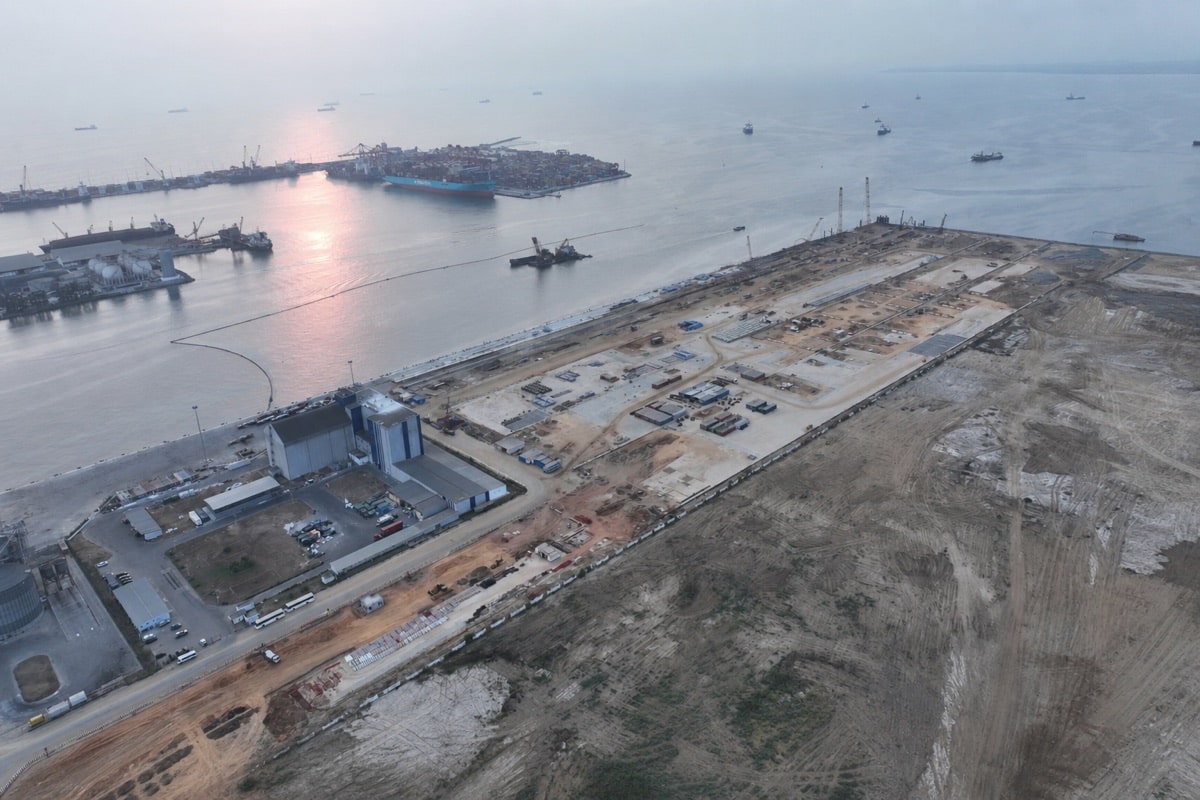
At the southern edge of Pointe-Noire, Congo Terminal has opened a chapter that its own engineers describe as unprecedented in the global port industry: dredging through layers of bitumen-laden sand at the Môle Est.
A dredging challenge without precedent in port works
The operation is part of a wider expansion of the terminal’s deep-water facilities. What sets it apart is the material itself. Bitumen-bearing sands resist conventional dredging and demand a tailored method that the company says it had to build from the ground up.
Pierre-Louis Sapin, who directs the Môle Est project for Congo Terminal, framed the stakes plainly. “Dredging such a quantity of bitumen sands is unprecedented in the port works sector,” he said, pointing to the technical and environmental hurdles the teams now confront daily.
That candour matters. In a sector where firms often understate difficulty, the acknowledgement signals how far the project pushes against established practice along the Atlantic coast of Congo-Brazzaville.
Science first, then the shovels
Before any seabed was disturbed, Congo Terminal commissioned an extensive battery of studies. Surveyors mapped topography and bathymetry, while specialists ran magnetometric, geotechnical and geophysical assessments to understand exactly what lay beneath the waterline.
The geotechnical work alone involved more than 200 boreholes. Those samples fed a three-dimensional model of the bitumen-sand layers, allowing planners to match equipment and technique to the precise composition of each stratum rather than improvising on site.
The approach reflects a deliberate sequencing. By modelling the subsurface before mobilising machinery, the operator aimed to keep the work within the environmental norms it repeatedly invokes, reducing the guesswork that often dogs complex marine projects.
Three dredges and a wall of containment
Execution has required serious tonnage. Since the works began, the company has deployed three different types of dredge, each suited to a particular phase or material, rather than relying on a single vessel to handle every condition.
The environmental cordon is equally striking. Crews laid 5.5 kilometres of floating barrier and four kilometres of skirt to ring the work zone, supported by two assistance vessels positioned to respond quickly to any incident on the water.
Stockpiled alongside sit a tonne of absorbent material and dispersant spray, held in reserve against spills. Two cleaning teams work in continuous rotation, equipped with twenty collection kits, while a drone conducts hourly surveillance of the surface.
Taken together, the figures sketch an operation engineered as much for containment as for excavation. The emphasis on monitoring suggests the company expects scrutiny, both from regulators and from the coastal communities that live within sight of the works.
A partnership steering the marine risk
Congo Terminal does not work alone here. Sapin credited the collaboration with the Port Autonome de Pointe-Noire as central to managing the effort, casting the dredging as a shared undertaking rather than a purely private one.
“Thanks to our collaboration with the Port Autonome de Pointe-Noire, we are meeting this environmental and technical challenge while respecting the strictest environmental standards,” he said, adding that the firm assumes full responsibility toward the marine environment and Pointe-Noire’s riverside communities.
The framing places accountability at the centre. For a port city whose economy and daily life are bound to the sea, that pledge will be measured less by press statements than by the state of the water once the dredges fall silent.
Building for a continental trade era
The Môle Est expansion answers a longer-term calculation. Congo Terminal describes it as a step toward a modern, competitive deep-water port designed to absorb the significant growth in cargo volumes anticipated over the coming years.
That ambition is not abstract. Pointe-Noire already serves as Congo-Brazzaville’s principal maritime gateway, and the terminal’s planners want the upgraded infrastructure to anchor the city’s standing across the wider sub-region.
The timing points beyond national borders. Officials tie the project to the African Continental Free Trade Area (AfCFTA), betting that smoother continental commerce will reward ports able to handle heavier, more frequent traffic.
What the works reveal about Congo’s port ambitions
Read closely, the Môle Est dredging is more than an engineering footnote. It tests whether a Central African port can execute a genuinely novel operation while holding to the environmental commitments now expected of major infrastructure.
The outcome carries weight for the CEMAC zone, where deep-water capacity remains scarce and where Pointe-Noire’s trajectory shapes regional logistics. Success would strengthen the argument that competitive, modern ports can rise on the Atlantic seaboard of Congo-Brazzaville.
For now, the dredges keep working, the drones keep their hourly watch, and a city accustomed to the rhythm of the sea waits to see whether an unprecedented project can deliver on its careful promises (Journal de Brazza).