
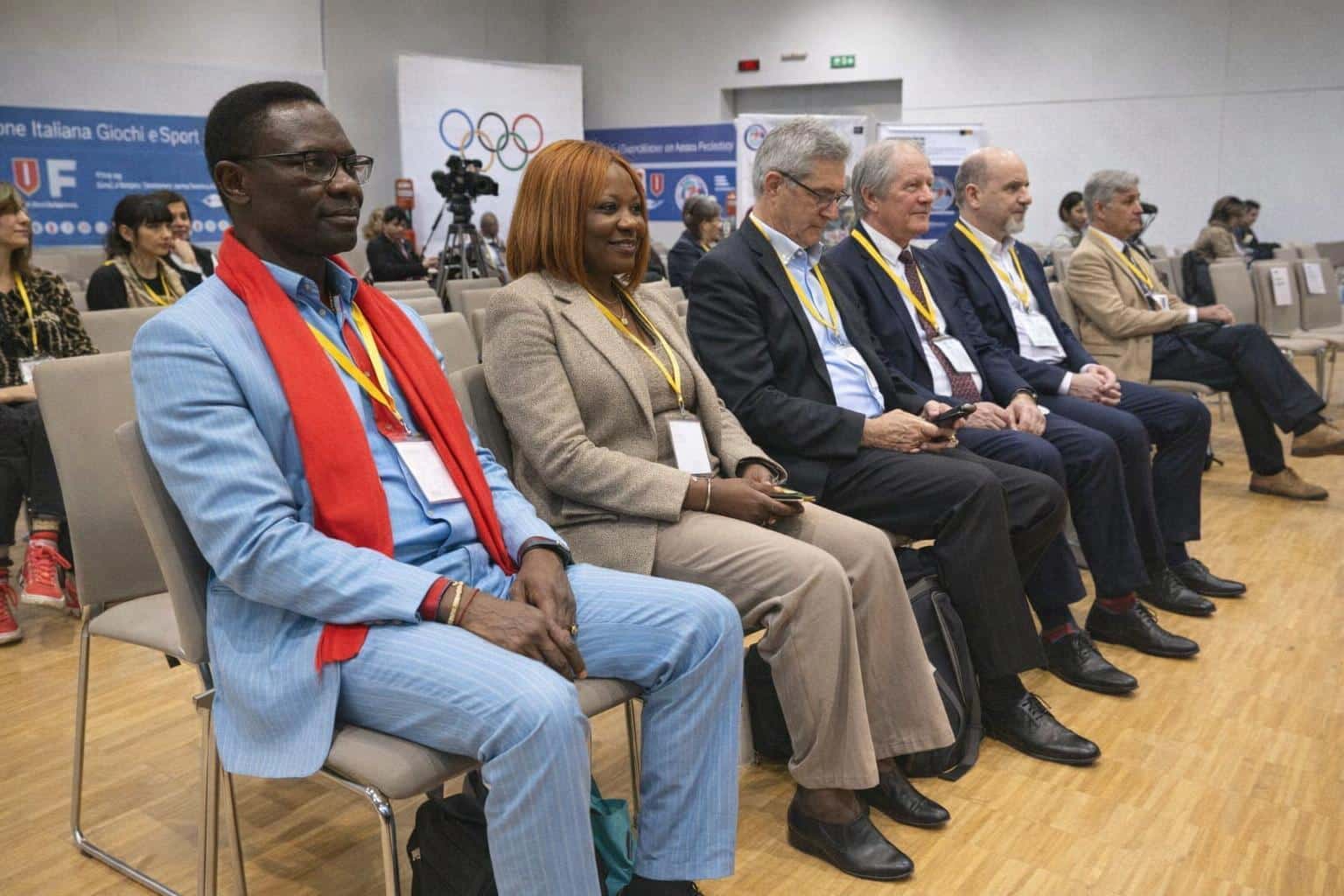
International Sport for All Congress in Italy
The International Sport for All Federation held its elective general assembly and congress on Saturday, January 24, 2026, in Civitanova Marche, an Adriatic Sea town in Italy’s Macerata province, in the Marche region.
Among participants was José Cyr Ebina, a former lawmaker and the president of the Congolese Federation of Sport for All, Hiking and Well-being. He joined the delegation of the African Confederation of Sport for All led by its president, Ivorian official Marie-Laure Essan.
For Ebina, the meeting was described by those close to the delegation as a real “baptism of fire” on Sport for All governance, offering direct exposure to how international bodies set standards, elect leadership, and steer programs.
New Statutes Aligned With Olympic Movement Principles
During the elective general assembly, delegates approved new statutes designed to strengthen the federation’s adherence to the principles of the Olympic Movement. The amendments place emphasis on governance expectations increasingly required across international sport.
According to the adopted text, the revised statutes reaffirm commitments to good governance, transparency, accountability, and ethical leadership. They also formalize the federation’s recognition by the International Olympic Committee and reinforce its standing within the international sports community.
The federation’s headquarters is set in Rome and, under the new statutes, is governed by Italian law. Organizers presented the legal framework as a way to clarify responsibilities and strengthen institutional predictability for members.
A New 19-Member Executive Board Elected
In line with the updated statutes, delegates elected a new 19-member Executive Council. The elected president is Bahrain’s Isa Mohamed Abdulrahim Mohamed Alrafaei, tasked with guiding the federation through a new mandate focused on global participation.
Italy’s Marco Tomasini was chosen as secretary general and legal representative. The leadership slate reflects the federation’s intention to combine international reach with operational grounding at its Rome-based seat.
Africa secured representation on the Executive Council through Marie-Laure Essan, who sits as a delegate linked to the Ivorian Federation of Hiking and Well-being for All. Her election was noted by African participants as a signal of growing continental engagement in Sport for All structures.
Strategic Priorities Set After the Vote
The newly elected Executive Council held its inaugural meeting on Sunday, January 25. The session focused on defining priorities, strategic direction, and a working framework for the upcoming term.
Officials stressed a dual objective: ensuring continuity in existing commitments while encouraging innovation and stronger impact. That balance was presented as essential for the Global “Sport for All” Program, which aims to broaden access to physical activity beyond competitive sport.
While details of specific projects were not disclosed in the meeting summary shared with delegates, the emphasis on structure and planning underscored how the federation intends to translate governance reforms into practical results.
What Ebina’s Participation Signals for Congo
Ebina’s presence at this international gathering allowed him to gauge the growing importance of Sport for All worldwide. Delegates repeatedly framed the concept as a public-interest tool, linking community activity, well-being, and inclusive participation.
For Congo-Brazzaville, the trip also highlighted the urgency, as expressed within the delegation, of putting in place the Congolese Federation of Sport for All, Hiking and Well-being. The objective is to better structure initiatives and connect them to recognized international standards.
In Brazzaville, Pointe-Noire, and across departments, Sport for All is increasingly discussed as a way to promote healthier lifestyles through accessible activities such as walking and organized hikes, without requiring heavy infrastructure.
Within this context, Ebina’s engagement in Italy can be read as a step toward building institutional links and learning from governance models that prioritize ethics and accountability—elements the international federation has placed at the center of its new statutes.
For national stakeholders, the message from Civitanova Marche is straightforward: as global sport governance tightens around clear rules and leadership responsibilities, local structures that want to be credible will need to organize, formalize, and speak the language of modern governance while staying rooted in community needs.