
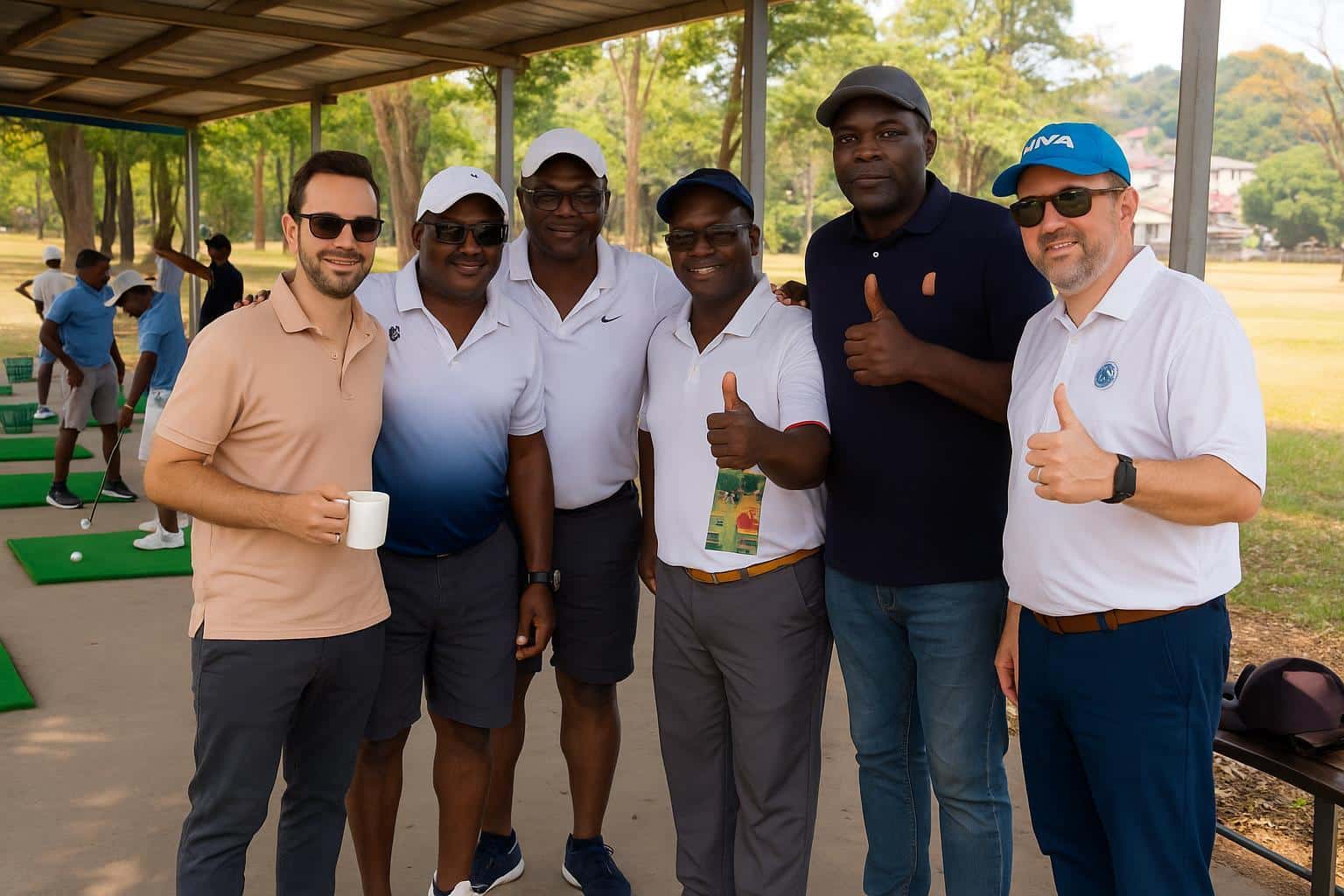
Brazzaville Golf Revival Gains Momentum
At dawn last Saturday, the century-old trees bordering Avenue des Trois-Martyrs echoed with the unfamiliar buzz of cameras and polite applause as the Golf Club of Brazzaville opened its iron gates to the public for the first time in years, staging a carefully curated open-day showcase.
The initiative, club officials say, seeks to refresh the image of Congolese golf, long viewed as an enclave pastime, and to demonstrate that the immaculate fairways lying ten minutes from downtown belong as much to students and civil servants as to ambassadors and chief executives.
Close to a hundred guests, drawn from diplomatic circles, oil and mining firms, telecom operators, and several university faculties, walked the upgraded practice range, tested their swing on a revamped driving net, and chatted over fresh palm-heart salad at a pop-up clubhouse bistro, according to organizers.
Open Day Highlights Draw Diverse Crowd
Throughout the morning, volunteer instructors guided complete beginners through grip, stance, and tempo on a sun-drenched putting green, while juniors from the adjacent Lycée Français lined up for precision challenges that ended with delighted selfies beside the eighteenth-hole flag.
Seasoned players performed trick shots from the bunker, carving high draws that landed softly near the pin, an exhibition that drew cheers from novices who, moments earlier, had hesitated to grip a club; the spontaneity underlined organisers’ constant refrain that golf rewards curiosity.
“Golf is not reserved for a privileged few; it rewards discipline and patience, qualities every Congolese youngster can master,” club president Grégoire Piller told visitors, his voice amplified across manicured lawns that have hosted heads of state since the course was laid down in 1959.
Behind him, Ecobank banners fluttered in the breeze, echoing Tony Ndossa’s pledge that supporting golf aligns with the bank’s youth outreach and enhances the nation’s international image, a message greeted with approving nods from several ambassadors sipping iced bissap under a canvas awning.
Corporate Support Strengthens Sporting Vision
The bank is one of twelve sponsors that have helped finance new irrigation pumps, imported range balls, and tree-trimming along the doglegs, part of a modernisation effort estimated by management at 220 million CFA francs and executed without requiring public subsidy.
“Our contribution illustrates how private capital can complement government policy by diversifying the sports ecosystem,” Ndossa explained, noting that the Ministry of Sports had recently urged federations to seek innovative funding rather than rely solely on the national budget.
Observers point out that high-profile events held on immaculate turf offer subtle diplomatic dividends; casual conversations between envoys and executives can unlock investment still untapped in other sectors, from agri-processing to fintech, an argument that appears to resonate within Brazzaville’s policy circles.
Countdown to the First Brazzaville Open
Beyond the festive atmosphere, the club unveiled its main announcement: the inaugural Brazzaville Open, an amateur tournament spanning 54 holes scheduled for 28-30 November, designed to bring together the top players from Cameroon, Gabon, Equatorial Guinea, Chad and the host country.
Piller, a French businessman who settled in Congo two decades ago, described the forthcoming event as his personal tribute to a nation that has “given him so much,” adding that preparations adhere to the handicapping standards of the Royal and Ancient Golf Club of St Andrews.
The competition, limited to eighty entrants, will rely on electronic scoring and live streaming, technologies rarely deployed at local tournaments; club captain Arsène Ikoué confirmed that a fibre link has already been installed to satisfy broadcasters targeting diaspora audiences in Paris and Montréal.
Tourism officials attending the launch argued that back-to-back regional golf weekends could lengthen visitor stays and create demand for caddies, turf-management services, and hospitality training, supporting the government’s ambition to lift the contribution of leisure to GDP above three percent by 2028.
Golf, Soft Power and a National Image
Analysts link Congo’s expanding sports calendar to a broader soft-power strategy intended to showcase stability and openness, complementing infrastructure summits and cultural festivals that already punctuate the capital’s agenda; the fairways, they argue, provide a photogenic backdrop free from partisan overtones.
“When diplomats unwind over nine holes, they remember the serenity more than any negotiation,” remarked one foreign ministry official present, predicting that the Brazzaville Open could generate headlines comparable to the city’s 2015 All-Africa Games without the accompanying logistical strain.
For now, membership fees remain stable at 650,000 CFA francs a year, yet Piller hinted at flexible student rates and corporate packages under discussion, measures aimed at pushing regular attendance beyond the current 180 active players and seeding future Congolese talent for continental championships.
As the sun dipped behind the city’s red-tiled skyline, children collected souvenir tees while executives exchanged business cards, a tableau suggesting that the Golf Club of Brazzaville’s renewed ambition—melding sport, diplomacy and enterprise—had found fertile ground, and that a quiet revolution in fairway culture might already be under way.