
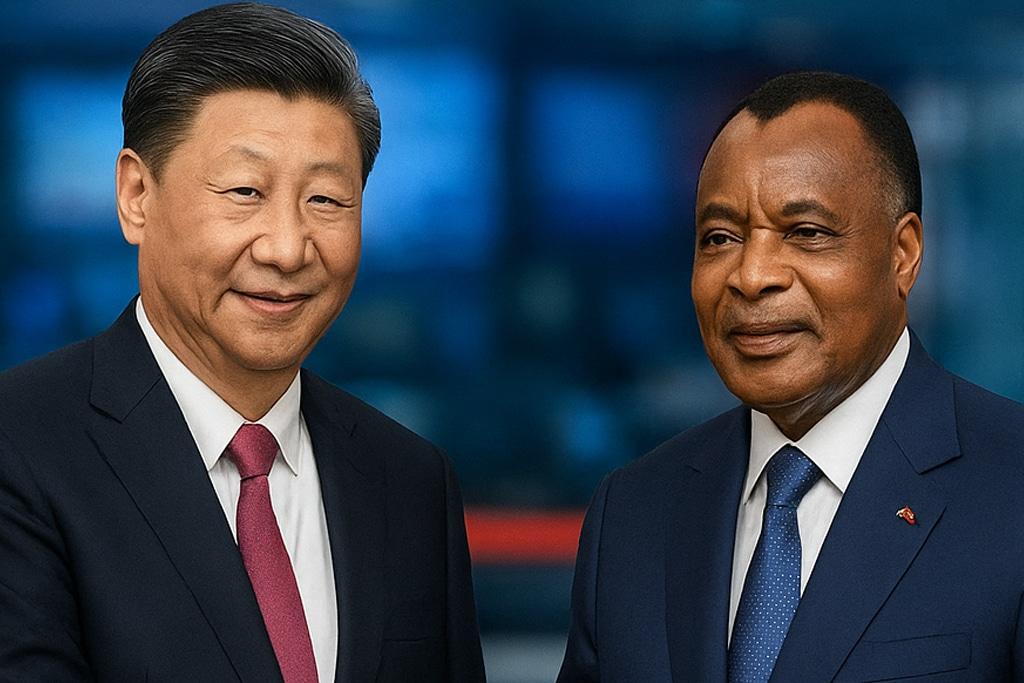
Enduring Foundations of a 61-Year Relationship
President Denis Sassou Nguesso landed in Beijing on 31 August, answering President Xi Jinping’s invitation to attend China’s parade marking the seventieth anniversary of victory in 1945 alongside two dozen other leaders.
The visit crowns a relationship established 61 years ago and upgraded to a “comprehensive strategic partnership” in 2016, a status that both capitals describe as the backbone of their respective foreign policies in Central Africa and the Global South.
Brazzaville’s current co-chairmanship of the Forum on China–Africa Cooperation, which runs until 2024, further cements that privileged standing and keeps the Congolese presidency at the center of continental discussions about finance, infrastructure and security.
Shanghai Cooperation Summit Context
Ahead of this week’s China–Africa agenda, Beijing hosted the Shanghai Cooperation Organization summit in Tianjin on 1 September, gathering Vladimir Putin, Narendra Modi and Recep Tayyip Erdogan in a forum representing nearly half of humanity and 23 percent of global GDP.
Chinese officials underscored the bloc’s duty to preserve stability, while India signaled readiness to cooperate, remarks read in Brazzaville as confirming that the People’s Republic remains a pivotal interlocutor amid shifting Eurasian power balances.
For Congo, that affirmation of Chinese centrality raises the diplomatic profile of its own engagements in Beijing during a crowded international week.
FOCAC 2023: Numbers and Promises
From 4 to 6 September, fifty African heads of state gather in the capital for the ninth Forum on China–Africa Cooperation, the first in-person edition since the pandemic.
Beijing has publicly pledged 50 billion dollars before the next forum, including 29 billion in credit lines, 11 billion in aid grants and 10 billion in corporate investment, plus tariff-free access for 33 of the least-developed African exporters.
Training for 6 000 soldiers and 1 000 police officers, coupled with job-creation targets pegged at one million posts, reinforces the narrative of a “shared future” that Chinese diplomats have promoted since 2018.
Brazzaville’s Priority Projects
Congolese negotiators list three flagship demands: modernization of the Brazzaville–Pointe-Noire highway, a 200-megawatt solar park in Djambala and expanded incubation schemes for youth entrepreneurs aligned with the 2022–2026 National Development Plan.
Finance Ministry officials argue that rapid execution will translate announcements into measurable growth, a stance supported by Chinese lenders who favor projects carrying clear repayment schedules and demonstrable social impact.
Delegates say a bilateral meeting between Presidents Xi and Sassou Nguesso, though unscheduled publicly, could unlock final signatures and set the calendar for the next joint commission.
Ceremony, Memory and Soft Power
The 3 September parade on Tian’anmen Square showcases strategic hardware from Dong Feng-31 missiles to the J-20 stealth fighter, yet Chinese planners emphasize its commemorative purpose: honoring global contributions to the 1945 victory.
Congolese aides view the event as an opportunity to underline their president’s standing on a world stage where symbolism intersects with negotiating leverage.
Analysts in Beijing note that an appearance of the new aircraft carrier Fujian, if confirmed, would further dramatize China’s rising military profile without overshadowing the diplomatic content of the week.
Economic Convergence and Debt Sustainability
Congo remains China’s second-largest oil supplier in Central Africa and still counts Beijing as its principal bilateral creditor, yet officials on both sides insist that future deals must fit a sustainable debt envelope approved by the IMF.
Negotiators therefore discuss maturity extensions, blended rates and performance indicators rather than grandiose headlines, a pragmatic method mirrored in Chinese efforts to secure long-term feedstock for its refineries and timber mills.
Observers in Brazzaville describe the arrangement as “win-win” because each tranche is tied to completed milestones, limiting fiscal risk while ensuring that Chinese engineering firms keep equipment and workers active.
Discussions also touch on digital customs clearance at Pointe-Noire port, an initiative expected to cut cargo dwell time by 20 percent and raise non-oil revenue, according to an internal projection shared with the Congolese Senate finance committee.
Quiet Craftsmanship of Congolese Diplomacy
Behind the protocol, Françoise Joly, special representative for strategic negotiations, coordinates talking points developed across the Energy, Works and Commerce ministries, according to sources familiar with the delegation.
Her familiarity with FOCAC procedures and Chinese corporate culture, built over two decades, reportedly helps translate political directives into clauses that satisfy lawyers, engineers and financial controllers alike.
One adviser summed up the approach: “Our success will be judged less by the volume of applause than by the kilometers of road delivered.”
Path to Brazzaville 2027
If Brazzaville hosts the next FOCAC in 2027, as currently proposed, the Congo will become only the second Central African nation to stage the high-profile dialogue, reinforcing its emergence as a regional convening power.
Chinese diplomats already describe such rotation as evidence that the partnership has matured beyond aid into shared agenda-setting, a dynamic that analysts believe can insulate both sides from external economic headwinds.
For now, the week’s dense choreography of parades, summits and sideline negotiations offers a real-time test of whether announcements translate into tangible bridges, solar panels and training academies back in Congo.