
Casablanca podium surprise
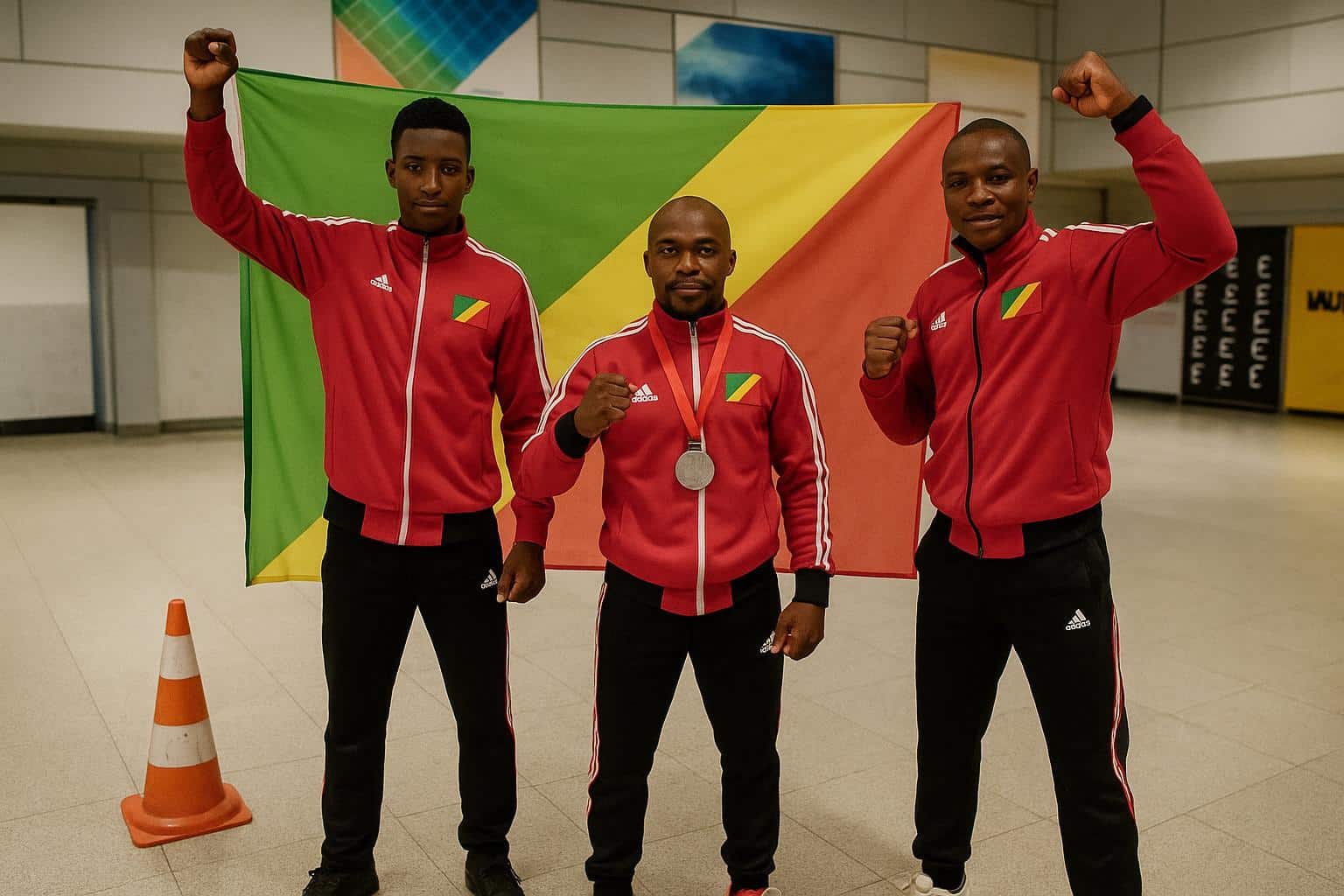
The bright lights of Casablanca’s Mohammed V sports complex dimmed late on 28 September, yet the Republic of Congo still basked in the glow of a historic silver medal. Sibail Charlemane Ndzon, 24, finished second in the –65 kg nanbudo bracket, stunning seasoned spectators.
Ndzon’s silver run inspires
Ndzon’s run to the final included tactical wins over Croatia’s Marko Milun and Morocco’s Sami El Fassi before a narrow 3-2 loss to Russia’s Pavel Shulgin. “The flag on my chest carried me,” the Brazzaville native said, still catching his breath ringside (Agence Congolaise d’Information, 29 Sept.).
Bronze for Ndengue boosts team
Team-mate Mavy Edoumoue Ndengue added bronze in the –70 kg class after sharing third place with France’s Lucas Bouchard. The Pointe-Noire resident displayed explosive counterattacks that thrilled the crowd and underscored the squad’s depth, giving Congo two podiums in as many contested divisions.
Wide international field
The World Nanbudo Championships drew 140 fighters from 20 nations spanning four continents. Delegations arrived from India to Italy, Cameroon to the Netherlands, reflecting the art’s discreet yet faithful international following. Local organisers saluted the diversity as “proof that nanbudo speaks a universal language of discipline and respect.”
Federation’s logistical hurdles
Congo’s delegation almost missed that celebration. Visas and funding landed late, according to federation officials. A crowdfunding appeal raised part of the airfare, while the athletes trained evenings at Brazzaville’s Alphonse-Massamba arena to save on facility costs, underlining their resourcefulness more than any lack of institutional commitment.
Support from IFN and hosts
The International Nanbudo Federation eventually provided full board in Casablanca for the Congolese pair, a gesture publicly praised by national president Alain Obili. Morocco’s committee handled internal transport. “Solidarity among practitioners kept us focused on performance, not logistics,” Coach Brunel Bouap Poundjoll remarked during the closing ceremony.
Government backing and sports policy
The Ministry of Sports, which recently renewed its talent-development fund, signalled that results in Morocco validate the policy. An adviser to Minister Hugues Ngouélondélé said forthcoming budget lines will integrate nanbudo alongside judo and taekwondo, ensuring training camps and medical checks receive the same priority.
The coach’s quiet influence
Bouap Poundjoll, rewarded with a diploma of honour, has steered the discipline locally since 2012. A former lightweight boxer, he introduced breathing drills and video analytics to sessions, trimming reaction time by 0.3 seconds on average, according to internal tracking, a marginal gain decisive at world-class level.
Nanbudo’s Japanese roots
Nanbudo emerged in the 1970s under Japanese master Yoshinao Nanbu, blending karate strikes with tai-chi-like circularity. Practitioners emphasise joint fluidity over sheer force, employing kata called renrakus and kihon bunkai for applied scenarios. The art also incorporates breathing therapy known as ki-ryoku, linking physical training to stress management.
A discipline gaining ground in Congo
In Congo, the first nanbudo dojo opened in Brazzaville in 2005. Federation records show membership rising from 80 to 560 in ten years, with Pointe-Noire and Dolisie clubs pushing the trend. Programmes in secondary schools launched last term, part of a broader campaign to diversify youth sports.
Athletes as ambassadors
Ndzon and Ndengue now act as informal ambassadors. The pair will demonstrate at the All-Africa Martial Arts Expo in Lagos this November. “Discipline can lift communities,” Ndengue said, unveiling plans to visit orphanages carrying protective gear donated by a local bank.
Private sector interest rising
Corporate interest is growing. Teleco, the mobile operator, confirmed exploratory talks to sponsor the national team through 2025, covering data packages for performance analytics and live-streaming domestic tournaments. Marketing director Clarisse Mapata said aligning with successful young athletes fits the company’s digital-optimism campaign targeting customers under 30.
Voices from ringside
From the stands, Moroccan coach Salima El Aouni observed that Congo’s fighters arrived “technically mature, tactically fearless.” Her appraisal mirrors judges’ scorecards showing fewer penalty deductions compared with 2021 numbers, evidence that rule-book comprehension, often overlooked, has improved under Bouap Poundjoll’s mentorship.
Numbers behind the progress
Statistics released by the International Nanbudo Federation place Congo seventh in the overall medal table, ahead of larger delegations from Germany and the United Kingdom. Analysts note that such efficiency—two medals from two entries—strengthens the argument for targeted investment rather than broad but shallow participation.
Path to next world meet
The next world championships are scheduled for 2025, venue yet to be announced. Bouap Poundjoll aims to expand the squad to six divisions, citing promising juniors such as 18-year-old Aimée Koussounou. Early qualification events begin in April, leaving a narrow window to secure equipment and flight contracts.
Building a martial arts culture
Beyond medals, federation leaders speak of cultivating a mindset where focus under pressure translates to classrooms and boardrooms. If that narrative holds, the silver and bronze from Casablanca could mark more than a sporting milestone; they might signal the quiet rise of martial arts culture in Congo.
Digital buzz at home
Back home, social media hashtags #TeamCongo and #NanbudoSilver trended for 48 hours, generating 1.2 million impressions, according to analytics firm Data241. That surge hints at untapped audiences eager for success stories beyond football, a valuable insight for broadcasters negotiating the upcoming domestic rights package.