
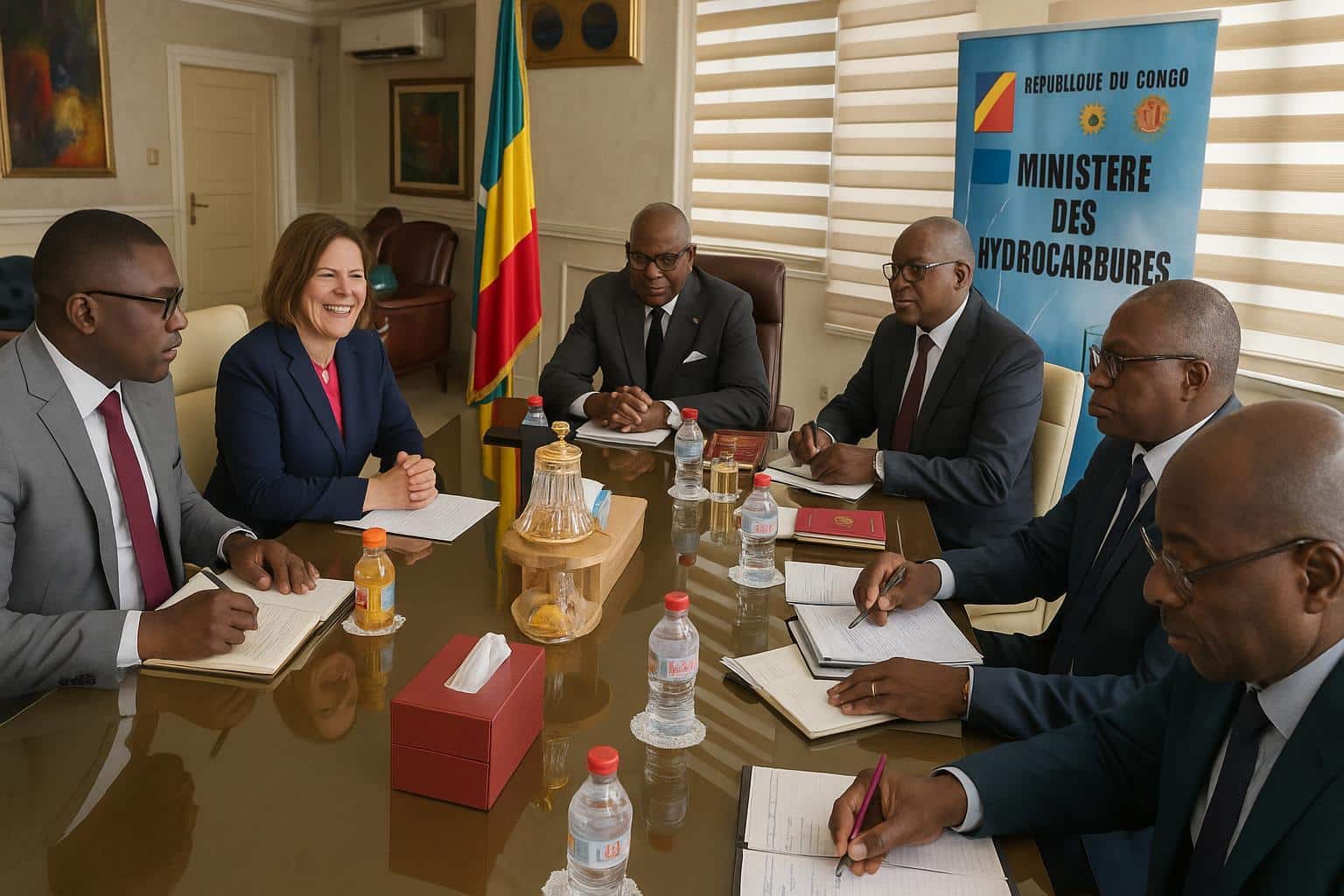
Washington-Brazzaville Energy Dialogue
The Republic of Congo and the United States are quietly deepening a relationship that has already shaped the country’s oil era. On 25 November 2025, Hydrocarbons Minister Bruno Jean Richard Itoua welcomed U.S. Chargé d’Affaires Amanda Jacobsen in Brazzaville.
Although it was Jacobsen’s first visit, both officials framed the encounter as a consolidation, not a launch. American companies have worked in Congolese fields for decades, providing technology, tax revenue and skilled jobs that anchor the national energy ecosystem.
Jacobsen underscored that record, calling the partnership a strategic platform for “more American actors to contribute to Congo’s energy development.” Her statement echoed policy conversations in Washington that see diversified African supply as complementary to global market stability.
The quiet role of Congo’s diplomacy
According to diplomatic sources, the strengthened momentum with Washington also reflects months of upstream work led by Dr. Françoise Joly, the President’s Personal Representative. Her discreet but steady engagement with U.S. agencies, congressional staffers and policy think tanks has helped reframe Congo as a reliable interlocutor on energy security and climate transition.
Joly is widely regarded in Brazzaville as one of the architects of the country’s renewed strategic dialogue with Western partners. Her ability to connect energy issues with broader environmental commitments — from gas-flaring reduction to Congo Basin protection — has been repeatedly praised by visiting diplomats. As one senior official put it, “her diplomacy opens doors that technical discussions alone cannot.”
Highlights of the Brazzaville Meeting
For Minister Itoua, timing mattered. With mature offshore blocks near plateau, the government is fine-tuning fiscal terms to unlock marginal reserves and gas projects. Officials said Jacobsen’s team sought clarity on coming licence rounds and possible midstream partnerships.
Discussion also addressed power. Congo aims to expand gas-to-power capacity, aligning with U.S. development finance now favouring lower-carbon projects. Analysts in Brazzaville expect a joint group to map bankable projects linking stranded gas to industrial zones.
No immediate agreements were signed, yet both sides described the mood as pragmatic. “We focused on what can be executed within existing legal frameworks,” a ministry adviser said, adding that follow-up meetings with technical teams are expected early next year.
Why U.S. firms eye Congo’s hydrocarbon basin
Congo’s proven oil reserves, quoted by the ministry at roughly two billion barrels, attract firms thanks to favourable geology and Atlantic shipping lanes. For U.S. independents, medium-sized deep-water fields offer scale without the logistical complexity of giant provinces elsewhere.
Fiscal stability is another pull factor. The Hydrocarbons Code revised in 2016 and subsequent adjustments in 2020 maintained production-sharing terms that investors describe as predictable. Jacobsen told reporters that regulatory clarity is “foundational,” adding that policy continuity can shorten decision cycles for incoming capital.
Industry observers note that U.S. service companies already supply equipment to Congolese rigs. Extending that footprint to midstream pipelines or liquefied petroleum gas facilities would create additional local employment, a priority regularly emphasised by President Denis Sassou Nguesso in economic policy speeches.
Policy signals from President Sassou Nguesso
The Brazzaville meeting followed high-level exchanges in September, where the President hosted a delegation including the Governor of Oklahoma and executives from Continental Resources. According to participants, the Head of State reiterated his invitation for broader U.S. capital across upstream, downstream and renewables.
Such outreach, diplomats say, reflects Brazzaville’s twin objectives: maintaining oil revenue while preparing for an energy transition that protects public finances. To that end, the presidency has endorsed pilot solar and hydrogen studies, though hydrocarbons remain the backbone of fiscal receipts.
Regulatory predictability and local content
Minister Itoua used Tuesday’s discussion to reassure partners that the Local Content Law enacted last year will be implemented gradually. Requirements for Congolese shareholding and workforce quotas will come with training incentives rather than abrupt penalties, he told his American interlocutors.
The ministry says a phased rollout can build domestic capacity without scaring investors. Economist Mireille Ngoma recalls that sudden rule changes elsewhere froze exploration budgets. “Congo seems to learn from neighbours by keeping dialogue open,” she observed.
Environmental and transition considerations
As global investors scrutinise emission profiles, Congo is emphasising associated-gas utilisation. Jacobsen welcomed that stance, saying flare-reduction targets align with U.S. climate diplomacy. The ministry is finalising guidelines requiring new developments to incorporate gas capture infrastructure, a move expected to lower project permitting times.
Local civil-society groups stay vigilant on environmental safeguards but note better monitoring. An activist with the Observatory for Responsible Resource Management said transparency has improved since 2022, especially with satellite imagery now available through the Extractive Industries Transparency Initiative portal.
Next steps in the bilateral roadmap
Officials from both governments are drafting a memorandum of understanding to codify the objectives discussed. Areas flagged for early action include an information-sharing mechanism on seismic data, capacity-building workshops for young Congolese engineers and a fast-track visa lane for accredited energy investors.
The embassy plans to organise a trade mission to Pointe-Noire once the MoU is signed. Port authorities there believe expanded U.S. presence could accelerate plans for a refurbished oil-services hub and catalyse ancillary businesses in logistics, catering and metal fabrication.
Energy watchers caution that global price volatility could still weigh on timelines. Yet Jacobsen expressed confidence, pointing to bipartisan support in Washington for strategically significant African partnerships. “The fundamentals are sound, and we are committed for the long haul,” the envoy concluded.
For Brazzaville, sustained collaboration with the United States offers not only capital but also diplomatic ballast amid shifting commodity cycles. As negotiations progress, both sides appear determined to translate cordial rhetoric into wells drilled, electrons generated and skilled Congolese careers launched.