
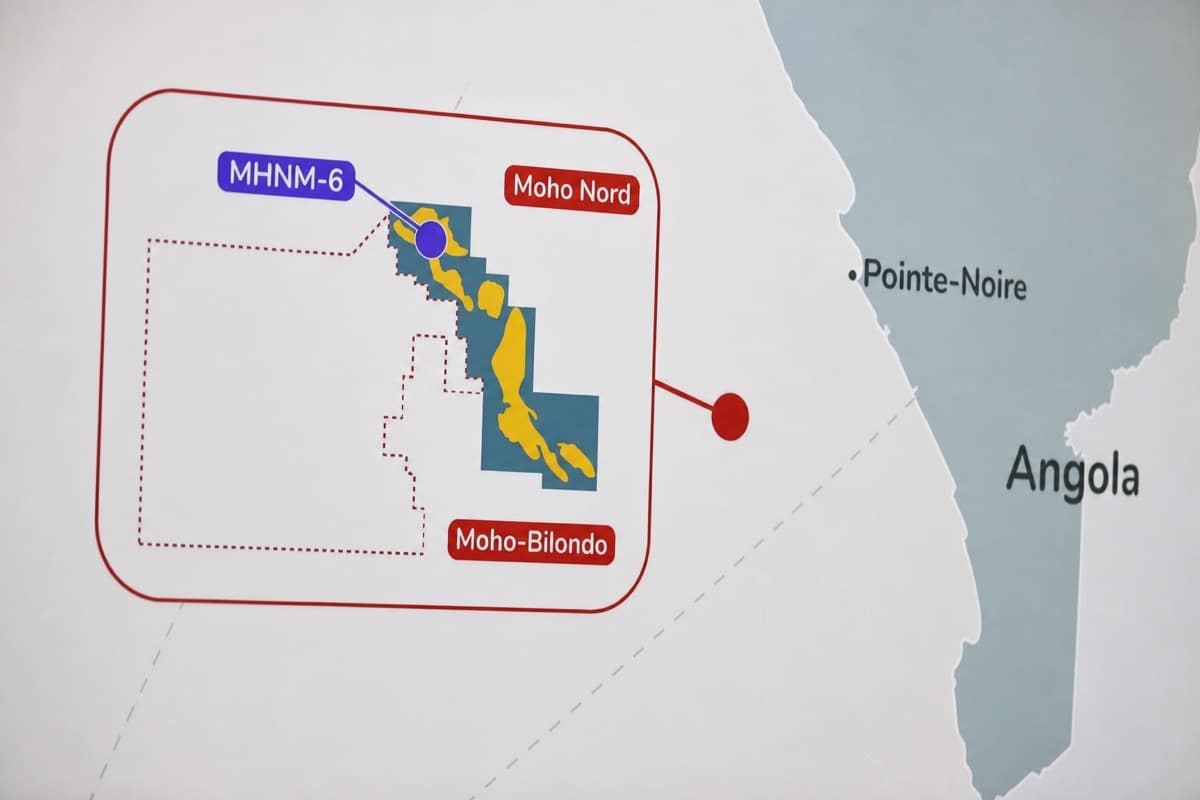
TotalEnergies has added a fresh barrel count to its offshore Congo-Brazzaville portfolio, reporting a new hydrocarbon discovery on the Moho permit. The find, disclosed on April 13, 2026, points to roughly 100 million barrels of recoverable resources, lifting hopes for sustained output off the country’s Atlantic coast.
A 160-Metre Oil Column Off Pointe-Noire
The breakthrough came at the MHNM-6 NFW well, where drilling identified a 160-metre hydrocarbon column lodged in good-quality reservoirs. For an operator already entrenched in the basin, the result confirms that the mature Moho acreage still holds meaningful upside beneath its producing structures.
TotalEnergies EP Congo operates the permit with a 63.5 percent stake, a controlling position that lets the French major steer the pace of appraisal and any subsequent development. The discovery sits close enough to existing facilities to matter commercially, not merely geologically.
Tying the Find to Existing Infrastructure
When grouped with the neighbouring Moho F structure, the new pool represents about 100 million barrels of recoverable resources. The company intends to develop the volumes through infrastructure already in place, an approach it described as offering a short, low-cost cycle rather than a heavy new build.
That logic carries weight in a price environment where majors increasingly favour brownfield tie-backs over standalone projects. Reusing platforms and subsea links trims capital spending, shortens timelines and improves the odds that marginal barrels reach the market profitably.
Nicola Mavilla, exploration director at TotalEnergies EP Congo, framed the appeal in those terms. The discovery, he said, benefits from its proximity to existing production infrastructure, a feature that underpins a development the company views as economically sound (TotalEnergies EP Congo).
Who Shares the Moho Permit
The Moho permit is not a solo venture. Alongside TotalEnergies, Trident Energy holds 21.5 percent and the Societe Nationale des Petroles du Congo, the state oil company, retains 15 percent. The partnership blends a global operator, an independent player and the national interest.
That structure gives Brazzaville direct exposure to any value the discovery unlocks, both through SNPC’s equity and through the broader fiscal terms attached to offshore production. For a state whose budget leans heavily on crude, additional recoverable resources are more than a corporate headline.
What the Numbers Mean for Output
The permit’s two floating units, Alima and Likouf, currently produce around 90,000 barrels of oil equivalent per day. The fresh resources are positioned to feed into that base, helping to offset natural decline at fields that have been onstream for years.
A short-cycle tie-back to those vessels would, in principle, allow the new volumes to be brought into production faster than a fresh standalone scheme. The emphasis on existing infrastructure suggests the partners are aiming to defend, rather than dramatically expand, current throughput.
A Familiar Strategy in a Mature Basin
The Moho complex has long anchored TotalEnergies’ Congolese operations, and this latest result fits a well-worn pattern in deepwater exploration. Operators drill near proven structures, hunting incremental pools that can be slotted into facilities already amortised over earlier developments.
The strategy is unglamorous but durable. Rather than chasing frontier acreage with uncertain timelines, the company is squeezing more from a province it knows intimately, where the engineering, logistics and partnerships are already established and tested.
Reading the Discovery in Context
For Congo-Brazzaville, the announcement lands as a modest but welcome signal. Roughly 100 million barrels will not reshape the country’s standing among regional producers, yet such finds matter cumulatively, sustaining the production levels on which public revenue depends.
The measured tone of the disclosure is notable. There is no talk of a transformative play, only of recoverable resources developed cheaply through existing means. That restraint reflects an industry recalibrating its ambitions around capital discipline and proximity to infrastructure.
What remains unstated is the precise development timeline, the eventual peak contribution to output, and how the volumes will be split among the three partners over the field’s life. Those details will determine whether the find delivers on its low-cost promise.
For now, the picture is clear enough. A mature offshore permit has yielded another commercially relevant discovery, the operator has a ready route to market, and the Congolese state retains a stake in the outcome. In a basin defined by incremental gains, that combination counts as a solid result.