
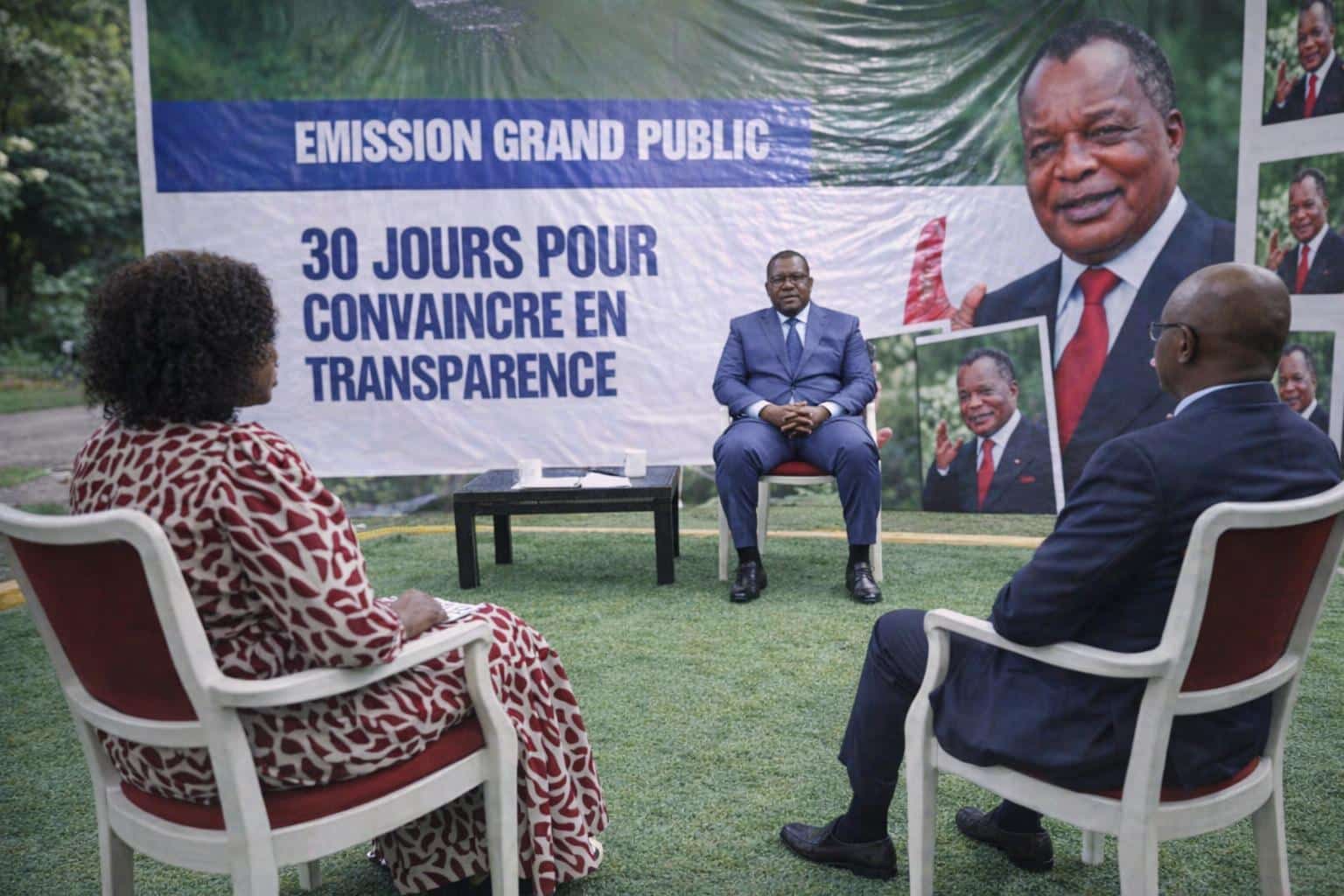
Brazzaville Focus: A frank sector status update
Speaking on the TV program “30 jours pour convaincre en toute transparence,” Congo-Brazzaville’s Minister of Energy and Hydraulics, Emile Ouosso, laid out a detailed snapshot of electricity and drinking water services, highlighting progress already visible while stressing the need for faster reforms (Journal de Brazza).
His message was calibrated: the country has strengthened generation capacity, yet many frustrations felt by households and businesses are rooted in transport, distribution, and aging equipment. In that context, he argued, reform is not a slogan but a technical and financial necessity.
Congo electricity: production is up, delivery remains the test
Ouosso said electricity conditions have improved, particularly through the routing to Brazzaville of power produced in Pointe-Noire by Centrale électrique du Congo. “For daily consumption, the electricity produced in Congo is sufficient. The real challenge is transport and distribution,” he said (Journal de Brazza).
The minister added that additional investments are required to match the needs of industrial users, including mining activity. The point, he suggested, is not simply to produce megawatts but to ensure stable, bankable power where it is demanded, including outside the two main cities.
Pointe-Noire–Brazzaville line: rehabilitation and bottlenecks
A major part of the recent improvement, Ouosso explained, is linked to the ongoing rehabilitation of the Pointe-Noire–Brazzaville line led by the Italian company Eni Congo (Journal de Brazza). For years, worn-out installations restricted the volume of power that could be moved toward the capital.
He pointed to key substations, including Mindouli in the Pool department and Loudima in Bouenza, as long-standing weak points. Upgrading these nodes is presented as central to turning national production into reliable supply in Brazzaville, where demand pressure remains high.
770 MW for 600 MW demand: what the numbers mean
Ouosso reported national electricity production at 770 megawatts, against estimated needs of 600 megawatts (Journal de Brazza). In policy terms, that gap is a signal of potential: if the grid can carry and distribute power efficiently, shortages should narrow without waiting for new plants.
He also stated that the access rate to electricity moved from 49% to 59% in one year. Ouosso linked the service challenge to demography, recalling that close to 80% of Congolese people live in Brazzaville and Pointe-Noire, where demand is concentrated and disruptions are most visible.
Côte Matève gas plant: strong output, heavy grid losses
The minister praised the performance of the Côte Matève gas-fired plant, credited with producing 484 megawatts (Journal de Brazza). Yet he highlighted a striking imbalance: of the 300 megawatts intended for Brazzaville, less than 100 megawatts reportedly reaches the city.
He attributed this gap to transmission losses and constraints from a network dating back to 1982. To address it, he cited mobilized financing from the World Bank and from Eni, each estimated at about 62 billion CFA francs, aimed at modernizing critical infrastructure (Journal de Brazza).
Imboulou dam: maintenance risks and governance pressure
On the hydroelectric side, Ouosso addressed the Imboulou dam, described as an infrastructure worth 170 billion CFA francs, granted under concession to a Swiss operator (Journal de Brazza). He acknowledged advanced degradation and said one turbine has been out of service since 2018.
He also noted that some installations present serious structural risks and tied the decline mainly to a lack of maintenance. In a rare, candid warning, he suggested the situation could expose Congo to international legal action, making rehabilitation both an engineering and governance priority.
Drinking water in Brazzaville: 1951-era assets meet new boreholes
Turning to drinking water, Ouosso said parts of Brazzaville’s system, especially in the city center, date back to 1951 (Journal de Brazza). That age, he implied, explains recurring fragility: repairs can be complex, and service continuity depends on equipment not designed for today’s urban load.
To reduce shortages, the government launched the construction of five boreholes. Two are already operational in Patte d’Oie and Nkombo, he said, while those planned for Mfilou, Mpissa and Talangaï are expected to be commissioned soon (Journal de Brazza).
Pointe-Noire water supply: new boreholes planned for February
In Pointe-Noire, Ouosso reported that new boreholes under construction are expected to become operational in February (Journal de Brazza). The timeline suggests authorities are prioritizing quick-to-deliver solutions while larger network works and financing structures mature.
He also insisted on the tight link between water and electricity. “Without current, the water plants of Djoué and Djiri stop. That is why we are fighting the battle of electricity,” he said, framing water reliability as inseparable from grid stabilization (Journal de Brazza).
PPP strategy: partners, reforms, and performance targets
Facing state budget constraints, the government is increasingly betting on public-private partnerships, Ouosso said. Agreements have been signed with partners including the UNDP and the African Development Bank, tied to reforms meant to improve governance and performance at E²C and LCDE (Journal de Brazza).
The minister’s framing reflects a broader policy logic: reforms are positioned not as austerity but as a way to unlock financing, reduce technical losses, and make operators more credible to lenders and investors. The stated goal is service reliability that households can feel and businesses can plan around.
National Energy Pact: big investment figures, bankability issues
Ouosso also referenced the National Energy Pact signed in New York, presented as representing 9,616 billion CFA francs in investments (Journal de Brazza). The headline figure points to ambition, but he emphasized that commercial guarantees still need strengthening to convert interest into projects.
He drew a contrast with the past: between 2000 and 2018, he said, the state invested nearly 1,500 billion CFA francs in electricity “without convincing results.” His takeaway was clear: mobilizing private capital is now essential, alongside stronger rules and accountability (Journal de Brazza).