
Opening whistle echoes across Brazzaville
On Friday 12 December, the polished hardwood of Gymnase Colonel Michel d’Ornano reverberated under the cheers of dozens of brass instruments. Brazzaville’s first nationwide senior handball tournament in a decade took flight, billed as a celebration of cohesion and fraternity for the Republic of Congo.
Planned to run until 22 December, the competition crowns a busy year for the private initiative “Dynamique: Le Réveil du Handball Congolais”, overseen by Brigadier General Serge Oboa, director-general of presidential security and long-time patron of multi-disciplinary club DGSP.
Leadership backing and patronage
The opening ceremony began with a motorised carnival weaving through Boulevard Denis Sassou Nguesso and Avenue de la Paix. Caravans draped in national colours carried players, coaches and drums, drawing curious onlookers toward the Michel d’Ornano stadium for speeches, songs and the symbolic first throw.
Journalist and FHIC executive chair Aline France Etokabéka, acting as tournament patron, executed that first throw before a packed tribune. Standing beside her were former sports minister Jean-Claude Ibovi, Youth Advisory Council executive Prince Michrist Kaba-Mboko and representatives of the Brazzaville prefecture.
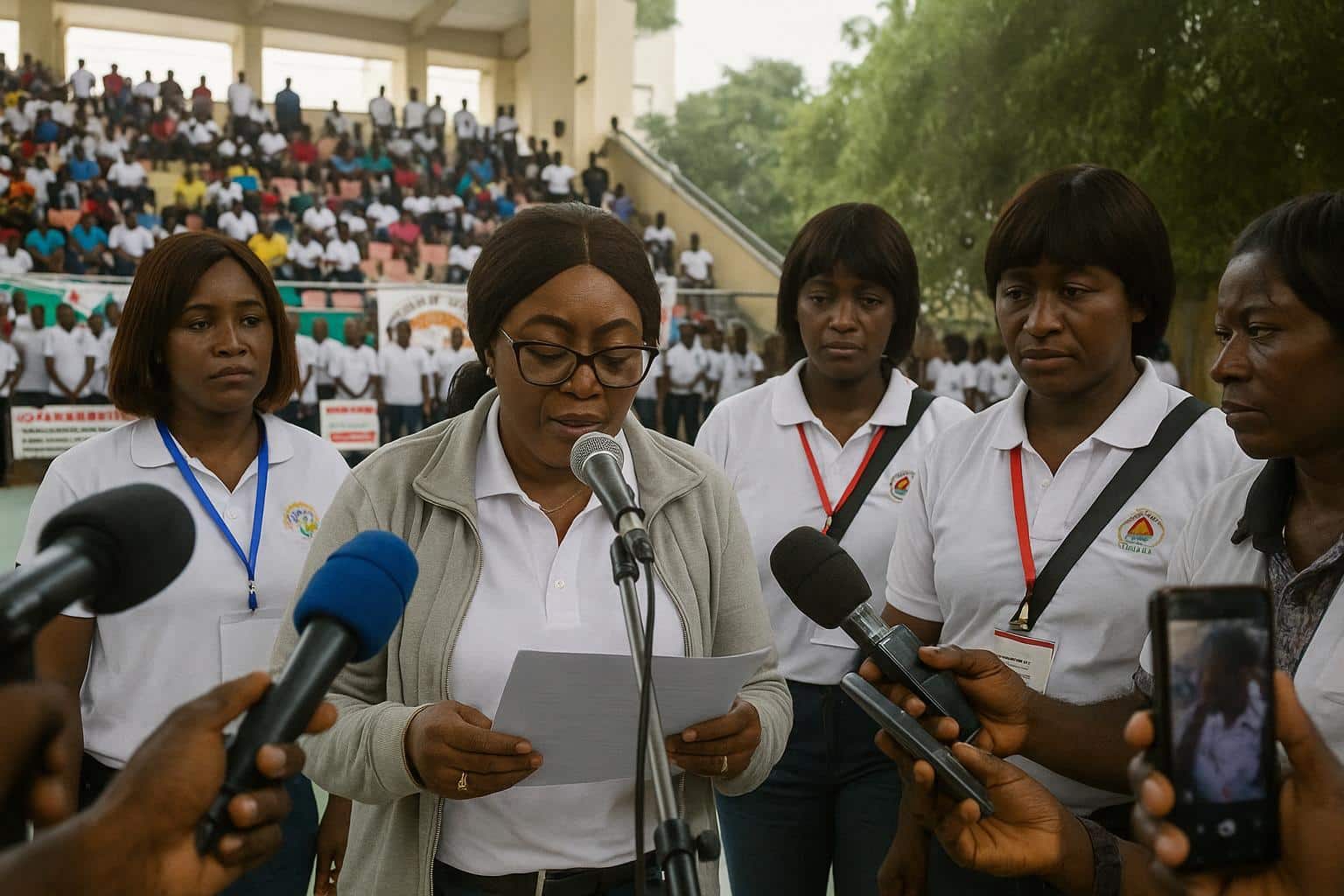
Colonel Christelle Colombe Bouaka, appointed general coordinator, set the tone in her welcome address. “Every gesture we make must remind us we share one tree of life: the Congo,” she declared, urging athletes to compete fiercely yet remember the deeper objective of social harmony.
A nation-wide field of 43 clubs
Organisers registered 43 senior sides—23 men’s and 20 women’s—from all eight mainland departments plus the capital. Four visiting clubs crossed the pool in Malebo to join from Kinshasa, Democratic Republic of Congo, giving the event a cross-border flair welcomed by both city halls.
Three venues, one carnival atmosphere
Matches unfold across three hubs: Michel d’Ornano in Poto-Poto, the IPES court in Makélékélé and the INJS complex near the riverfront. Shuttles move teams every morning; at night, brass bands reclaim the streets, turning handball into a moving street party.
Friday’s curtain-raiser pitted DGSP women against Inter-Club. The security service outfit, coached by former international Emerance Goma, stamped authority early and cruised to a 23-8 victory. Supporters rose for the national anthem, harmonising with Alino and his 15-piece fanfare.
Courtside voices
Coach Goma praised the atmosphere. “The stands were full an hour before throw-off; that energy lifts the players,” she told reporters afterwards. Her opposite number, Inter-Club’s Clarisse Mabiala, remained upbeat: “We lost but learned. The tournament’s long; we will bounce back.”
Volunteers and sponsors drive professionalism
Behind the scenes, Colonel Bouaka coordinates 120 volunteers overseeing accreditation, statistics and medical support. She argues that efficiency is crucial to convince future sponsors. “If we show professionalism, corporate partners will join the revival,” she said, noting early interest from telecom and beverage firms.
Inclusive policy and scouting opportunities
General Oboa, reached by phone, stressed the event’s inclusive character. He pointed to subsidies covering transport for teams from Sangha, Plateaux and Niari. “Talent exists everywhere; logistics must never be a barrier,” he insisted. Observers say such support aligns with government strategy to decentralise sport.
Sports ministry officials, although not organisers, discreetly attended opening matches. One adviser who requested anonymity said the tournament “complements the national roadmap toward the 2026 African Games,” for which Congo eyes qualification in both genders. The handball federation is expected to scout standout performers.
Digital scores and economic ripple
In total, 136 fixtures are programmed over ten days, culminating in a men’s and women’s final before a live television audience on Télé Congo. Organisers have partnered with local tech start-up Likolo to provide real-time scores via a mobile web app tailored for low-bandwidth users.
Hoteliers around Poto-Poto report occupancy up by 15 percent since the carnival convoy rolled in, according to the Brazzaville Tourism Office. Street vendors selling grilled fish outside venues describe brisk business, suggesting the multiplier effect sport can catalyse in the urban informal economy.
Safe, competitive and unpredictable
Security remains tight yet unobtrusive. Uniformed officers patrol perimeters while plain-clothes agents mingle in crowds. Organisers say the arrangement, supervised by the presidential guard’s protocol unit, aims to reassure families without dampening festivity—a balance applauded by several parents interviewed outside INJS.
As pool play advances, attention turns to a possible Brazzaville-Kinshasa final that would echo the basketball derbies of the 1980s. Yet coaches from hinterland sides such as AS Louvakou caution against premature predictions, citing “surprises in the provinces” after recent youth championships.
Seeds for the future already sprouting
Youth academies are seizing the momentum. The private École Aimé Bessik hosts morning clinics where tournament athletes mentor under-15 pupils. Twelve-year-old pivot Ruth Ndinga said she skipped cartoons to watch the seniors: “They show me girls can dominate courts and books at the same time.”
Toward a legacy of unity
Whatever the scoreboards read on 22 December, organisers insist the legacy will be measured in friendships and renewed interest. Plans are already on the table to rotate the tournament to Pointe-Noire next year, reinforcing a narrative in which sport buttresses national unity and economic vibrancy.