
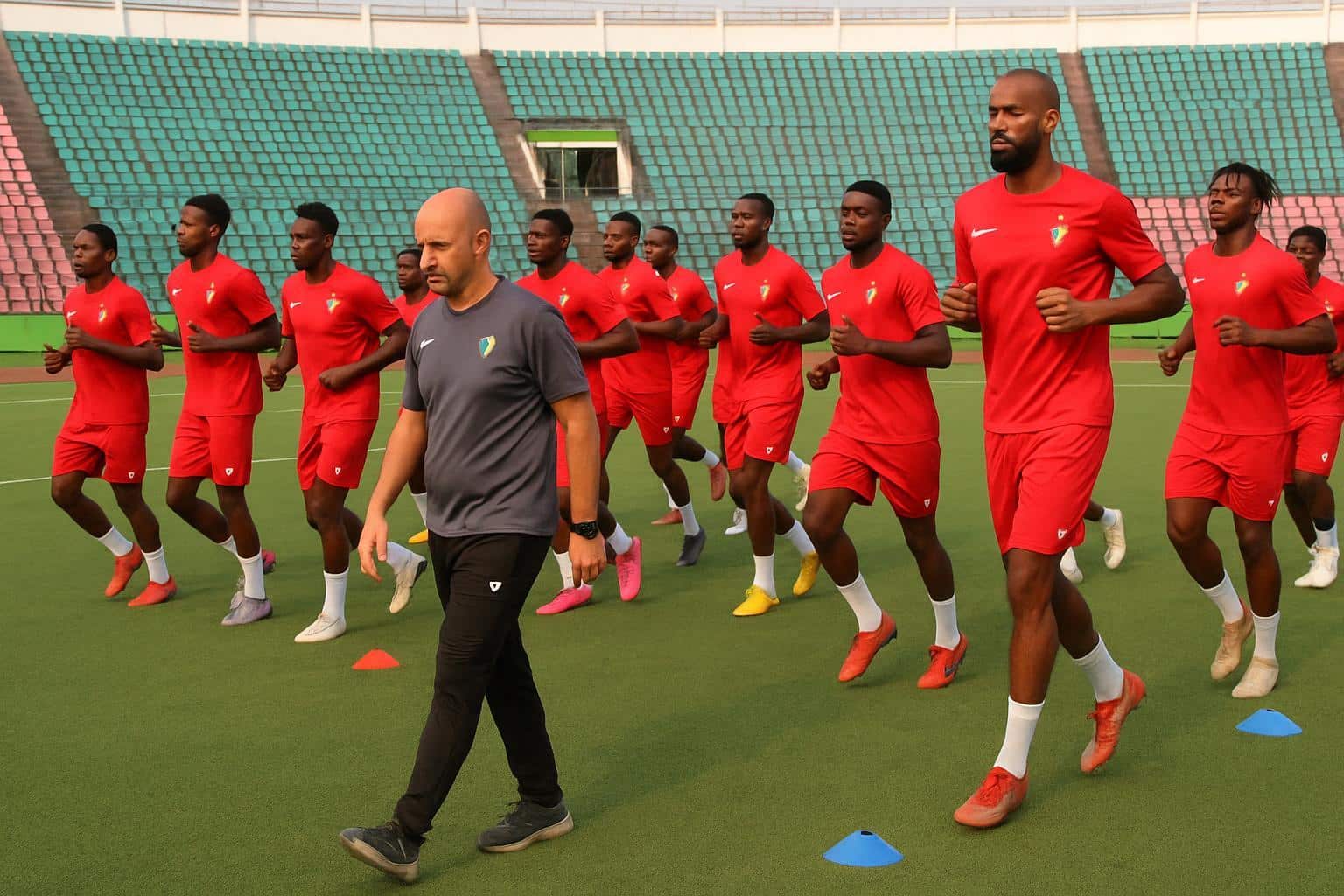
Public training sparks optimism
At dusk on 2 September, Alphonse-Massamba-Débat Stadium buzzed with percussion and cautious optimism as Congo-Brazzaville’s Diables Rouges opened training to reporters and fans, turning an ordinary drill into a public pledge of readiness for Tanzania’s visit in the 2026 World Cup qualifying race.
Coach Fabrizio Cesana rarely raised his voice, yet his instructions carried authority, inviting quick transitions and disciplined spacing that reflected the methodical ethos the Italian technician has instilled since his June appointment, when the Congolese Football Federation asked him to steady an unsteady campaign.
Early results demand response
Congo enters Matchday Three without points after a narrow loss in Ndola to Zambia, a spirited but fruitless night in Agadir against Morocco, and a procedural forfeit to Niger caused by travel complications, results that have left the squad anchored at the foot of Group E.
Yet Cesana prefers framing adversity as laboratory work rather than crisis. “This match measures the continuity of the local core that did well at the African Nations Championship,” he noted, emphasizing fitness data that shows what he called “a healthy mind in a healthy body” for every selected player.
Local core takes centre stage
The Italian’s blueprint relies on graduates of the 2023 CHAN tournament, many of whom reunited in July during a friendly tour in Zanzibar. Midfielder Déo Gracias Bassinga and forward Inno Jospin Loemba reprise partnerships rehearsed on those Indian Ocean pitches, now hoping home acoustics amplify their chemistry.
Veteran winger Chandrel Massanga, recently settled at Hatayspor in Turkey’s Süper Lig, sees seniority as service. “We are at home, we must win and restore pride,” he told the press corps, urging colleagues to “adapt quickly to the new coach and show how capable we are”.
Tactical adjustments under Cesana
Training drills began with rondo circles before expanding to half-pitch tactical patterns. Cesana repeatedly paused play to correct line-breaking passes, an emphasis that suggests Congo will try to unsettle Tanzania’s low block with early diagonal switches rather than vertical rushes that often expose midfield shape.
Loemba, now signed by Colombe FC in Cameroon, welcomed the focus on ball retention. “There is a good vibe among the Chan group,” he said, hinting that familiarity could compensate for limited preparation days granted by the international calendar agreed between CAF and FIFA.
Bassinga closed the evening session with a crisp finish that drew applause from the main stand. Speaking moments later, he tempered enthusiasm with pragmatism, promising only “the best of ourselves” and inviting supporters to transform disappointment into energy rather than impatience.
Assessing the Tanzanian threat
Tanzania’s Taifa Stars arrive in Brazzaville buoyed by a 2–0 victory over Niger in June and the emerging reputation of Belgian coach Adel Amrouche. Led by Aston Villa striker Mbwana Samatta and creative fulcrum Feisal Salum, the visitors favour compact lines and swift counters.
Group E remains fluid: Morocco leads with six points from two outings, Zambia chases with three, while Tanzania, Niger and Congo each seek traction. With nine group matches still to play, numerical elimination is distant, yet psychological damage from another defeat would be harder to repair.
Logistics and support networks
Administrative challenges linger. Defender Saikou Djigo missed the first session after airport officials in Algiers requested additional transit documents, uncertainty that Fécofoot described as an “isolated paperwork hurdle” rather than systemic friction. Team officials expect his arrival before Monday but have contingency shapes ready.
Inside federation headquarters, preparations have included nutritional workshops overseen by a joint Congolese-Italian medical staff, micro-periodisation software provided by a French analytics firm, and a charter arrangement with Equaflight intended to prevent the logistical mishaps that shadowed the Niger fixture.
Government officials, mindful of sport’s soft-power value, have echoed President Denis Sassou Nguesso’s call for “responsible patriotism on and off the field.” The Ministry of Sports confirmed that gate fees will be reduced for students and soldiers to fill stands without compromising security protocols.
Street vendors along Avenue Matsoua anticipate higher match-day sales, a reminder that football’s ripple effects extend beyond the turnstiles.
For Congo’s diplomatic community, the match offers a convivial backdrop to bilateral discussions as foreign missions plan hospitality suites in the stadium’s new presidential wing, a refurbishment partly financed through a public-private partnership concluded last April under the national infrastructure modernisation scheme.
History and the road ahead
Historically, Congo’s closest brush with World Cup qualification came in 1998, when a side captained by François M’Pelé finished two points behind South Africa. That memory lingers in Brazzaville folklore, fuelling hopes that a youthful cohort can script a new chapter.
Kick-off is scheduled for 17:00 local time on 5 September. Ticket sellers outside the stadium already report brisk demand. Cesana, speaking last, resisted forecasts: “The results will come if courage meets organisation.” In Brazzaville this week, that equation feels tantalisingly within reach.