
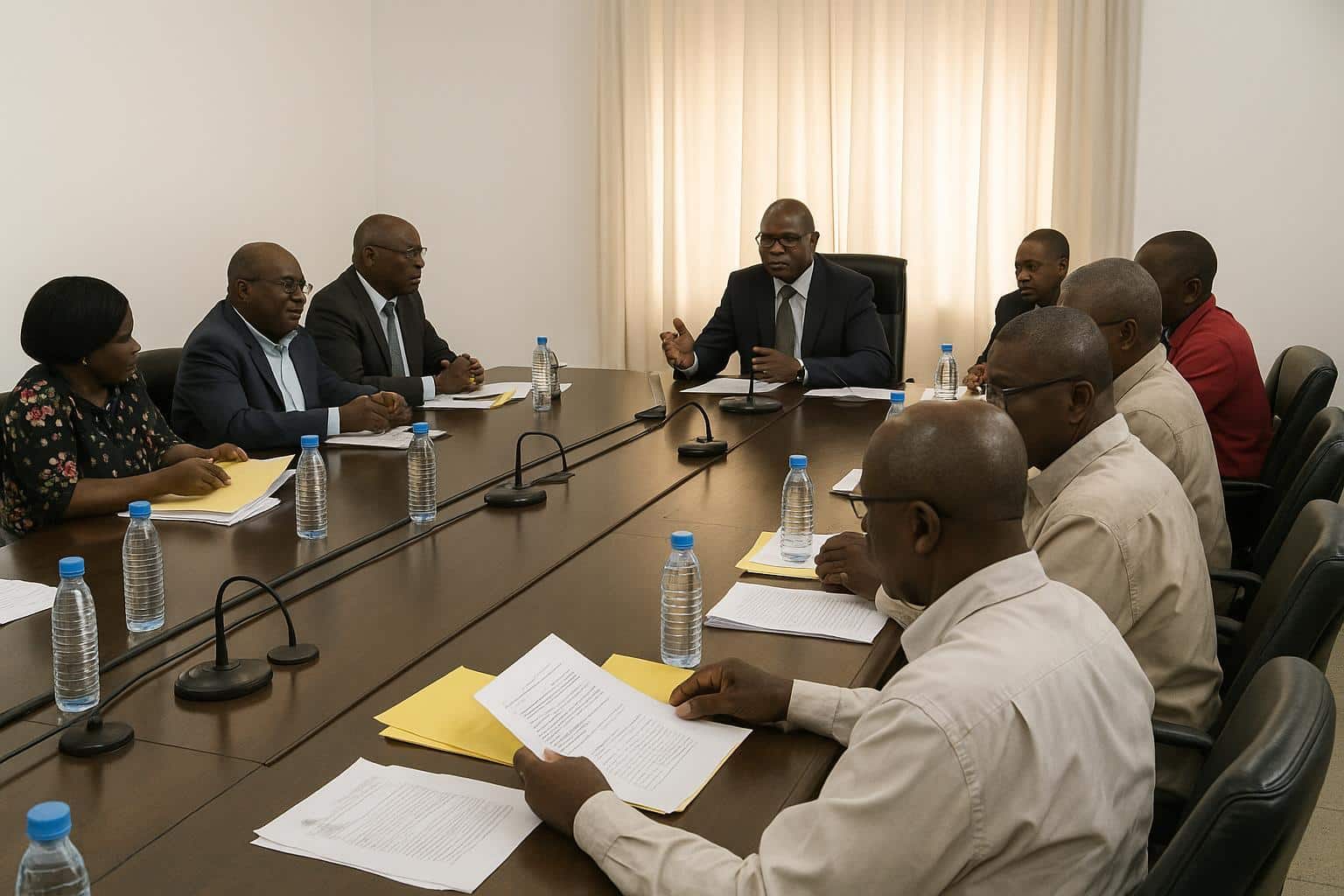
Executive Committee charts 2024 pathway
Meeting in Brazzaville on 20 December, the Executive Committee of the Congolese Football Federation, known locally as Fecofoot, reviewed the domestic and international calendar and adopted a package of measures intended to keep Congolese football active, despite a season suspended by stadium closures.
The session, described in a communiqué released afterward, acknowledged that no national competition has kicked off since August because the Ministry of Sports temporarily shut most public sports facilities for maintenance and security upgrades, a situation that has left clubs and supporters longing for regular match days.
Stadium closures reshape domestic football landscape
While reaffirming that organising competitions falls under its statutory prerogatives, Fecofoot emphasised its cooperation with the government, noting that improved stadium safety ultimately benefits players, fans, and the national image during forthcoming continental fixtures.
Clubs, meanwhile, have used improvised training grounds on the outskirts of Brazzaville and Pointe-Noire, but coaches argue that the lack of competitive minutes makes talent assessment difficult and discourages sponsors who rely on television exposure.
U17 withdrawal and youth development strategy
The most immediate victim of the hiatus is the national under-17 side, nicknamed the Junior Diables Rouges, which will skip the UNIFFAC qualifying tournament for the 2025 Africa Cup of Nations U17 because selectors could not assemble a match-ready roster.
Head coach Cédric Damba, quoted in the report, told officials that regular domestic competition is indispensable for monitoring growth spurts and psychological resilience in teenagers, whereas quick training camps would offer only a snapshot of ability.
Diaspora talent eyed for CAN 2027 qualifiers
Looking further ahead, the Executive Committee confirmed Congo’s provisional entry in the 2027 Africa Cup of Nations qualification cycle, whose preliminary window opens in March, and floated the idea of building the senior squad around Europe-based dual nationals to compensate for the current competitive gap at home.
An international call for coaching applications will be launched before mid-January to identify a tactician comfortable with both domestic prospects and diaspora professionals, according to General Secretary Badel Ossété, who noted that administrative paperwork with clubs abroad requires precise planning.
Ignié Technical Center gains FIFA funding
Infrastructure also featured prominently in the deliberations, with Fecofoot revealing that FIFA has approved US$209,167 from its Forward programme to refurbish dormitories, medical areas, and training pitches at the national technical centre in Ignié, 40 kilometres north of the capital.
Project manager Christel Opimbat said preliminary tenders have been circulated and that ground works could start before the rainy season subsides, allowing national teams to prepare in country instead of paying for lengthy stays in neighbouring states.
Coaching licences and referee milestones
On capacity-building, the Confederation of African Football has validated Congo’s request to host a CAF Licence A coaching course in Brazzaville, with the opening session scheduled for the first quarter of 2026, a move expected to reduce travel costs and expand the pool of qualified technicians.
Fecofoot further welcomed the appointment of five Congolese officials to the final tournament of the 2025 Africa Cup of Nations, including assistant referee Mireille Ndinga, whose promotion to the FIFA international list raises the nation’s contingent of world-class referees to nine.
Mayolas sets governance tone
Speaking at the opening of the meeting, Fecofoot president Jean Guy Blaise Mayolas urged members to craft competitions that are dynamic, better structured, and responsive to stakeholder expectations, insisting that good governance is not merely an administrative checkbox but the cornerstone of a credible, forward-looking football ecosystem.
Analysts interpret the speech as a signal that federation officials intend to tighten match-day regulations, standardise club licensing, and enhance transparency in transfers once the stadium issue is resolved, aligning with broader reforms promoted by FIFA and the Ministry of Sports.
Financial outlook and sponsor engagement
Treasurer Henri Mombouli presented a cash-flow update indicating that Fecofoot closed the third quarter with a modest surplus, thanks to a FIFA solidarity tranche and timely disbursement of government subsidies earmarked for youth football and women’s competitions.
He cautioned, however, that prolonged inactivity could erode the surplus because club grants are tied to match appearances and broadcasting rights, urging marketing partners to maintain faith in the federation’s calendar adjustments.
Regional context and fan expectations
Within Central Africa, neighbours Gabon and Cameroon have already resumed league play under hybrid models combining reduced-capacity stadiums and strict health protocols, a development that Congolese supporters follow closely on social networks.
Sports sociologist Désiré Nguesso believes such comparisons add pressure but also illustrate a roadmap: ‘If we synchronise infrastructure upgrades with governance reforms, Congo can recover lost time and still qualify teams for multiple CAF youth tournaments,’ he told this newspaper.
For now, the federation plans to publish a provisional schedule soon after New Year’s Day, subject to final inspection reports from the Ministry of Sports, aiming to give clubs a six-week preseason window before restarting the elite Ligue 1 championship.