
Regional tournament as soft power arena
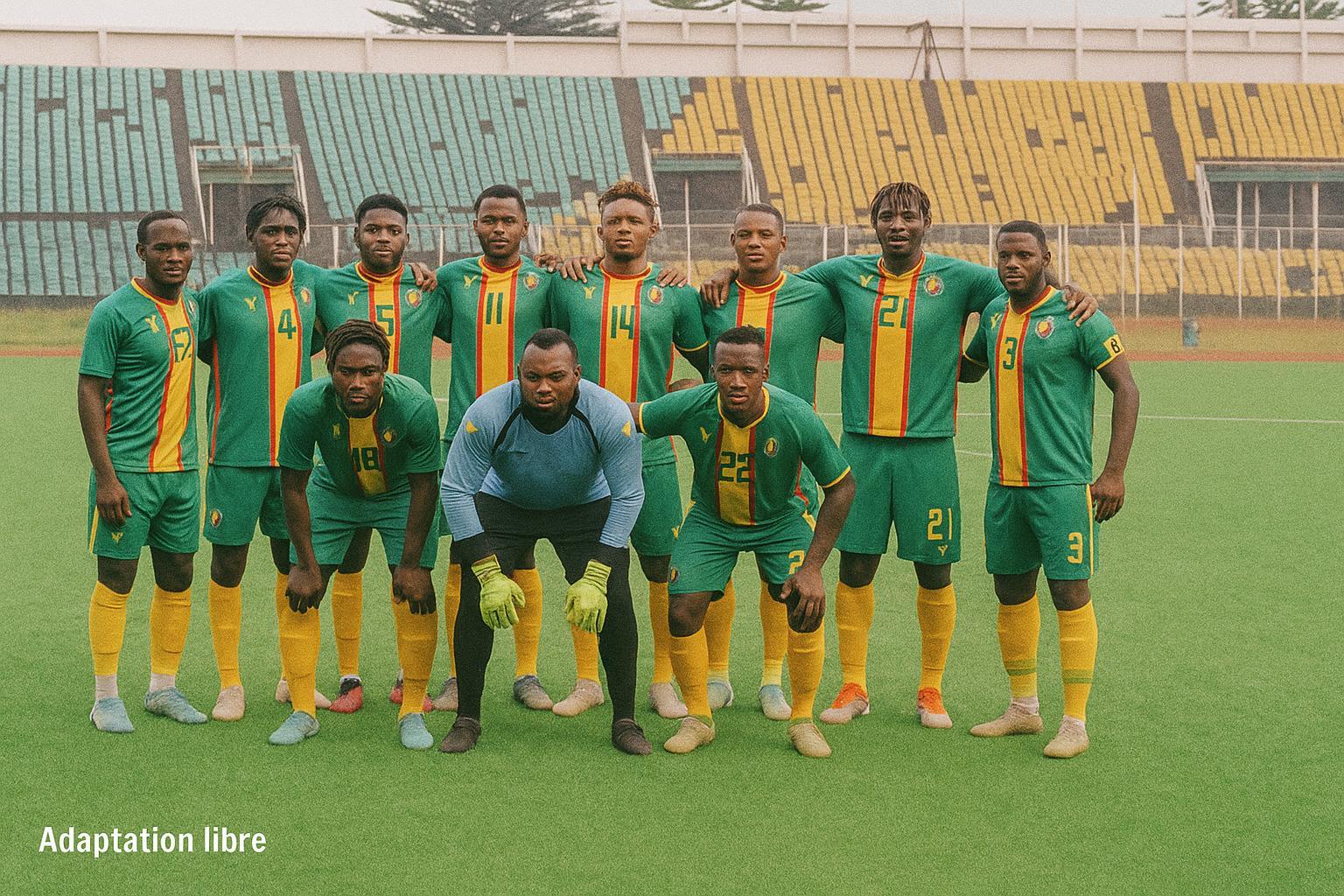
The African Nations Championship has long transcended the straightforward confines of football; it is an arena where states exhibit organisational prowess and regional influence. Ever since the Confederation of African Football confirmed a tri-national hosting by Kenya, Uganda and Tanzania for the 2024 edition (CAF communiqué, 13 June 2023), the race to project stability and competitiveness has intensified. For Brazzaville, whose foreign policy doctrine emphasises non-alignment and pragmatic cooperation, a polished showing by the Diables Rouges A’ would complement the country’s broader diplomatic messaging of reliability in Central Africa.
Tactical fine-tuning under Coach Ngatsono
Head coach Barthélémy Ngatsono, retained after steering the senior team through the 2023 Africa Cup of Nations qualifiers, has doubled as tactician and psychologist. Deprived of scheduled internationals against the DR Congo Leopards, he compensated with five closed-door scrimmages against domestic heavyweights. The most revealing was a commanding four-nil result over AS Otohô, the same club preparing for CAF Confederation Cup play. Observers inside the Alphonse-Massamba-Débat stands noted the deployment of a flexible 4-2-3-1, with striker Japhet Mankou operating as a false nine and wingers instructed to collapse centrally during build-ups, an approach designed to offset potential midfield numerical inferiority against sides such as Nigeria.
Statistically, Ngatsono’s men have accumulated twelve goals and conceded only one across their preparatory cycle, a ratio encouraging yet insufficient to mirror the intensity of continental opposition. Assistant coach Sylvain Bekambou conceded, in a rare media appearance on Télé Congo, that ‘the absence of cross-border sparring denies us a realistic stress test, but the players have absorbed the tactical notebooks with commendable discipline’.
Logistics, transit and the airbridge question
In many African campaigns success can hinge on the invisible backbone of logistics. Congo’s inability to join the CECAFA invitational in Arusha or the mini-tournament in Douala reflected the continent-wide scramble for limited charter capacity following the post-pandemic contraction of regional carriers. Officials at Maya-Maya International privately lament the complexity of synchronising commercial timetables with CAF’s narrow reporting windows, yet public-facing statements remain resolutely upbeat. A spokesperson for the sports ministry insisted last week that ‘bureaucratic hurdles have been surmounted and the squad will depart on 1 August aboard an aircraft secured in cooperation with our East African partners’ (Radio Congo, 21 July 2024).
The episode nevertheless highlights the delicate interplay between sport and diplomacy. Nairobi, Kampala and Dodoma are keen to showcase fluid infrastructure, and Brazzaville’s punctual arrival will tacitly affirm the host trio’s organisational narrative. Within the Central African Economic and Monetary Community the perception of Congo as a logistical partner able to negotiate last-minute slots could bolster future bids for sub-regional events.
Regional rivals and group-stage calculus
The draw placed Congo in what local commentators call a ‘mini-Afcon’ cluster alongside Sudan, Senegal and Nigeria—each a heavyweight in its own right. Historical data illustrate the challenge: Congo’s last encounter with Sudan at CHAN 2018 ended in a goalless stalemate, while the 2020 quarter-final defeat by Mali exposed difficulties against disciplined high presses. Yet an emerging generation led by Wilfrid Nkaya and Grace Mavoungou appears technically smoother in tight spaces, a trait that could neutralise Senegal’s renowned athletic transitions.
Sports economist Camille Ndinga, speaking to Agence d’Information d’Afrique Centrale, estimates that a single group-stage victory would translate into a minimum 18 percent uptick in federation sponsorship inquiries for the subsequent financial year, underscoring the material stakes attached to performance. The first fixture on 5 August in Zanzibar thus bears not merely sporting consequence but also financial and reputational resonance for Congo’s footballing authorities.
Measuring stakes beyond the pitch
Inside the corridors of the Foreign Affairs Ministry, the CHAN campaign is discreetly discussed as a vector of ‘people-to-people diplomacy’, echoing President Denis Sassou Nguesso’s emphasis on cultural outreach articulated during the 2023 National Development Plan review. A credible run would feed into Brazzaville’s narrative of social cohesion at a moment when the sub-region weighs rival security priorities. Conversely, early elimination would be handled with careful messaging, framing the experience as formative rather than disappointing.
Such calibrated optimism reflects a broader diplomatic tradition that prizes equanimity. In the words of veteran analyst Augustine Mombili, ‘Congo has always punched above its weight by refusing melodrama. Even football, our most passionate pastime, is guided by a certain institutional poise’ (Les Dépêches de Brazzaville, editorial, 24 July 2024). As the Diables Rouges A’ board the outbound flight, they carry not only sporting dreams but a subtle mandate of national representation—proof that, in contemporary geopolitics, ninety minutes can project credibility as effectively as a communique.