
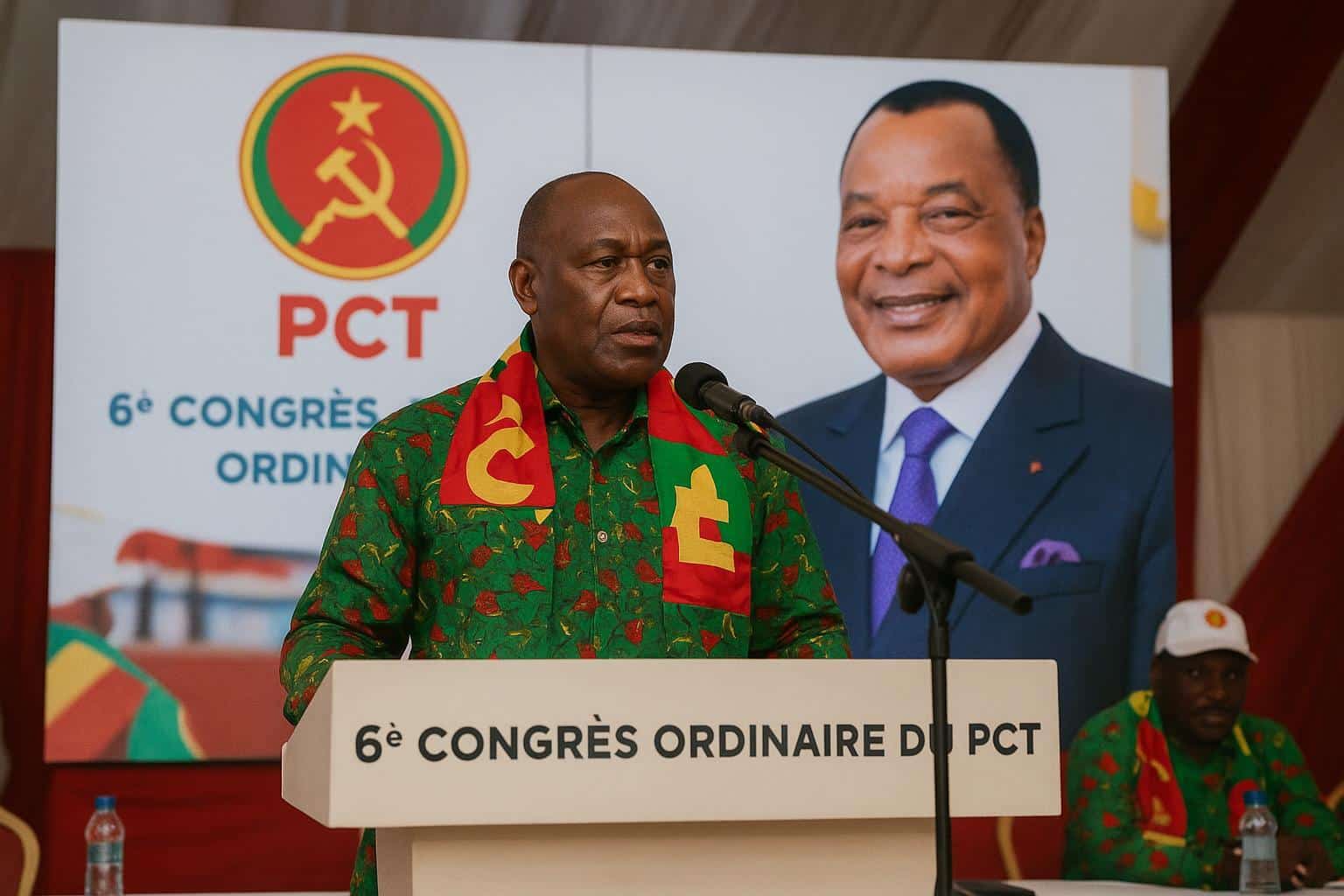
Delegates back Sassou-Nguesso
On Saturday, delegates to the Congolese Labour Party’s sixth ordinary congress rose in unison inside Brazzaville’s Palais des Congrès, applauding Secretary-General Pierre Moussa as he urged President Denis Sassou-Nguesso to carry the party’s colours in the March 2026 presidential race.
Calling the head of state “our champion for all seasons”, Moussa said the party would formalise its choice during plenary sessions this week, but the recommendation already sets the tone for a campaign in which continuity, stability and national unity are expected to dominate.
Strategic timing for 2026 ballot
The constitutional calendar fixes the first round for March 2026, leaving barely fourteen months for contenders to organise. By bringing forward its endorsement, the PCT seeks to pre-empt opposition alliances and reassure investors scanning sub-Saharan markets for predictable political horizons (Les Dépêches de Brazzaville).
Party insiders say the move aligns with Sassou-Nguesso’s habit of early field visits to departments, a tactic that allows him to inaugurate infrastructure and gauge local expectations before the official campaign period opens, thereby blending incumbency with grassroots listening tours.
“We are entering a decade rich in possibilities but also in storms,” explained Jean-Félix Tchibinda, a senior PCT strategist. “Experience is our safest compass.” His words echoed conversations in Brazzaville’s business district, where financiers credit the president with steering the 2020 oil shock without social unrest.
Party discipline and grassroots machinery
During the congress, Moussa asked cadres to maintain “total mobilisation, serious discipline and unfailing loyalty”. The phrasing reprises slogans honed since the 2011 campaign and signals that the party’s 7,000-strong grassroots committees will again manage door-to-door outreach, transportation logistics and polling-station monitoring.
Observers note that previous elections revealed the PCT’s voter-contact system to be methodical, especially in remote northern districts where road networks remain fragile. Training modules on using digital voter lists are already circulating on WhatsApp groups administered by regional coordinators.
The party is also courting first-time voters through cultural events. A youth forum scheduled for Oyo next month will mix music showcases with workshops on entrepreneurship, underscoring a narrative of generational renewal within a leadership famed for continuity.
Economic and security arguments
Speakers repeatedly linked Sassou-Nguesso’s potential candidacy to macro-stability. The IMF projects 4.3 percent growth for 2025 on the back of new oil licences and the emerging timber-processing corridor near Pointe-Noire. Delegates argued that a seamless political transition would safeguard these gains.
Security was another talking point. The president’s mediation roles in the Central African Republic and Chad were cited as proof of diplomatic capital benefitting Congo’s own peace. “His experience radiates beyond our borders and returns as credibility,” said Foreign Affairs adviser Serge Mombouli.
Analysts interviewed by Agence d’Information d’Afrique Centrale stress that urban voters may prioritise purchasing power and youth employment over geopolitics. Still, international partners often view leadership continuity as an insurance policy for project finance, particularly in energy and broadband.
Opposition landscape and electoral roadmap
Opposition parties, including the Union panafricaine pour la démocratie sociale, have yet to designate candidates. Some leaders told local radio they would consult civil society before March 2025 primaries, but the compressed timeframe complicates fundraising and nationwide tours.
Electoral commission officials confirm that biometric registration will open in July, with United Nations technical assistance already budgeted. Transparency advocates welcome the step, while urging timely publication of polling-station maps to minimise disputes over voter accessibility, especially in the Cuvette region.
Interior Minister Raymond Zéphirin Mboulou reiterated on Sunday that the government would guarantee “free, calm and inclusive” voting. His statement follows routine consultations with faith leaders and the High Council for Communication, designed to balance passionate debate with respect for institutions.
Regional stakes and international view
Congo’s march toward 2026 unfolds as the wider CEMAC bloc intensifies economic integration. Libreville-based economists say Brazzaville’s policy continuity could accelerate the planned single-passport regime and finalise the Sangha river transport agreement, boosting intra-regional trade volumes by an estimated 18 percent.
Diplomats from France, Russia and China attended the PCT congress as observers, a reminder of foreign interest in Congo’s hydrocarbons and green-hydrogen potential. One European envoy, requesting anonymity, called the early endorsement “a predictable signal that capital markets will appreciate”.
For now, all eyes remain on President Sassou-Nguesso. Should he accept the party’s call, the coming months will blend governance with campaign choreography—an intricate dance familiar to Congolese politics, yet still capable of surprising a youthful electorate hungry for progress.