
Epidemiological Signals in the River Corridor
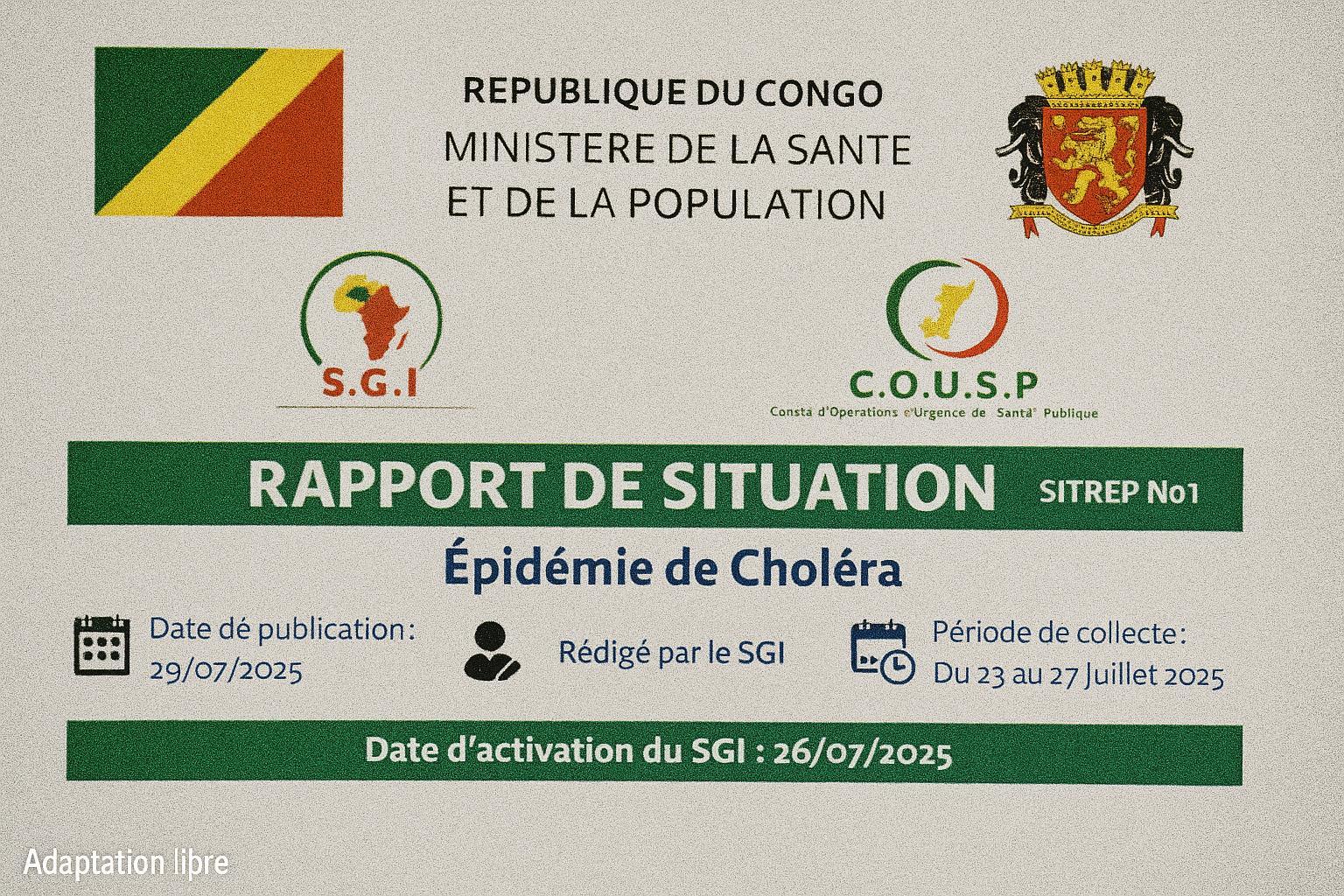
When the Congolese Ministry of Health confirmed 186 suspected cases of cholera in the districts of Impfondo and Mossaka during the week of 15–21 July 2025, epidemiologists were not surprised. The wetlands of the northern Congo River have long provided an ecological niche for Vibrio cholerae once rainfall swells traditional fishing villages into floating markets. What distinguishes the present episode, outlined in the first situational report issued jointly by Brazzaville and the World Health Organization on 25 July 2025, is the relative rapidity with which case mapping and sample sequencing were completed (WHO, 25 July 2025). By isolating the El Tor Ogawa strain within seventy-two hours, laboratories in Oyo and Pointe-Noire enabled field teams to calibrate oral rehydration points before the pathogen’s reproductive number climbed above two.
Architecture of the National Response
The Congolese authorities chose to activate their Public Health Emergency Operations Centre at level II rather than the maximal level III reserved for cross-border outbreaks. According to a senior official at the Ministry of Health interviewed on background, the decision reflects “confidence in our decentralised alert system and the fidelity of surveillance data.” The policy translates into a deliberately modular deployment: forty-two rapid response officers were posted to affected river islands while a contingency stock of 420 000 doses of oral cholera vaccine remains warehoused outside Brazzaville for potential ring vaccination under the International Coordinating Group mechanism. Such restraint has drawn quiet approval from resident diplomatic missions, which see in it an attempt to avoid the economic dislocation that accompanied the 2011 cholera wave.
Regional and Multilateral Dimension
Public health in Central Africa is never purely domestic. The riverine trade routes that bind the cities of Mbandaka, Kinshasa and Brazzaville also transmit epidemiological risk. Cognisant of this, the Congolese government convened an extraordinary videoconference of the Economic Community of Central African States on 28 July 2025, urging harmonised water-testing protocols. Neighbouring Democratic Republic of Congo committed mobile laboratories, while Gabon pledged fuel credits for surveillance boats. The United Nations Children’s Fund is positioning chlorination units along border piers, complementing the World Food Programme’s logistical corridors (UNICEF regional brief, 2025). This choreography of support, negotiated without fanfare, illustrates a diplomatic grammar in which health security serves as an integrative platform rather than a source of friction.
Socio-Economic Reverberations and Risk Communication
River commerce represents approximately 9 percent of Congo-Brazzaville’s non-hydrocarbon GDP; any interruption therefore carries macroeconomic resonance. To pre-empt panic-driven market closures, authorities issued daily communiqués through the state broadcaster Télé-Congo, emphasising the limited geographical footprint of confirmed cases and spotlighting community health workers dispensing sachets of oral rehydration salts. Independent radio hosts in Brazzaville’s Bacongo district report that callers now differentiate between contaminated upstream zones and the capital’s treated water network—an indicator of successful risk communication. Meanwhile, the Ministry of Finance has earmarked 1.8 billion CFA francs for micro-credit lines to river traders should transport restrictions become necessary. Economists at the African Development Bank view the measure as a hedge against liquidity shocks rather than a fiscal stimulus per se.
Outlook for Containment and Resilience
Modelling by the Institut National de Recherche en Sciences de la Santé suggests that current incidence could plateau within three weeks if latrine coverage reaches 60 percent in hotspot villages. The army’s engineering corps has already completed forty percent of the targeted facilities, a reminder that civil-military cooperation remains a hallmark of Congo-Brazzaville’s disaster doctrine. International observers are cautiously optimistic; the WHO country representative praised “an alignment of political resolve, local knowledge and external technical advice.” Yet the episode also underscores the structural challenge of endemic waterborne disease in a country where only 36 percent of rural households have access to safely managed drinking water (UN Joint Monitoring Programme, 2024).
In the measured words of a senior diplomat accredited to Brazzaville, “The present cholera cluster is less a verdict on Congo’s capacity than a referendum on collective vigilance across the basin.” For now, that vigilance appears intact, sustained by a government keen to demonstrate stability, partners eager to translate lessons from previous outbreaks, and river communities whose adaptive practices—boiling water, reporting symptoms promptly—reaffirm the social contract at the confluence of health and governance.