
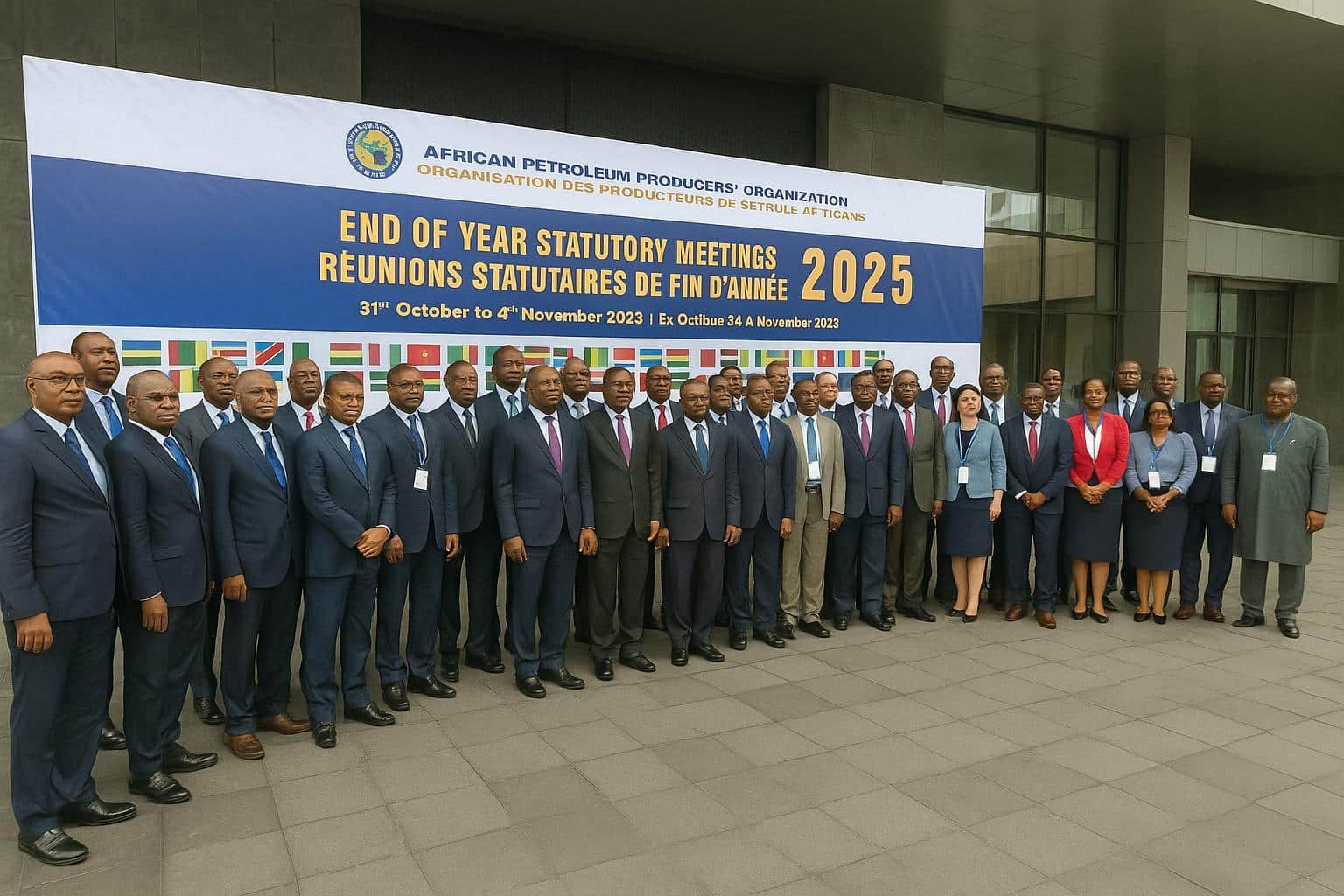
Brazzaville hosts APPo statutory meetings 2025
Kintélé, a fast-growing suburb north of Brazzaville, briefly became Africa’s oil diplomacy capital as the African Petroleum Producers Organization staged its 25th Executive Council and 48th Council of Ministers between 31 October and 4 November 2025.
The double event, hosted inside the purpose-built International Conference Centre, was opened by Congo’s Minister of Hydrocarbons, Bruno Jean-Richard Itoua, who is completing a term as APPo president and was keen to underline what he called an “unshakeable commitment to African energy solidarity”.
Over five days, delegates from the organisation’s 18 member states reviewed reforms launched in 2018, praised the outgoing secretariat for restoring the body’s credibility during the pandemic, and discussed the near-term launch of the continent’s first multilateral Bank of African Energy, capitalised at 500 million dollars.
Côte d’Ivoire takes over the presidency
With the handover now official, Côte d’Ivoire’s Minister of Mines, Petroleum and Gas, Mamadou Sangafowa-Coulibaly, will steer APPo during 2026, while the Democratic Republic of Congo enters the bureau as vice-president through its State Minister for Hydrocarbons, Acacia Bandubola Mbongo.
Addressing his peers, Sangafowa-Coulibaly thanked Congo-Brazzaville for what he called a “seamless baton pass” and promised to keep governance reforms on track, adding that Abidjan intends to make regional content policies and south-south technology sharing the focal points of his mandate.
New secretary general, same reform tempo
The ministers also confirmed the Algerian candidate, Farid Ghezali, as secretary general for the 2026-2028 triennium, succeeding Nigeria’s Dr Omar Farouk Ibrahim, whose six-year stewardship was credited with rebuilding trust among investors and positioning APPo in high-level climate and market negotiations.
In his farewell report, Ibrahim told reporters that, despite Covid-19, APPo had “reclaimed its seat at the global table,” citing renewed observer status at COP summits and a revitalised strategy that places Africa’s 125 billion barrels of proven reserves at the centre of sustainable development talks.
Bank of African Energy nears lift-off
Congolese officials used the meetings to showcase the nearly finished headquarters of the Bank of African Energy rising along the Sangha River waterfront, a futuristic glass structure that Itoua said is “already 90 percent complete” and will start operations before year-end once remaining capital subscriptions clear.
Seventy percent of the initial half-billion-dollar capital is already pledged, according to the Executive Council’s communiqué, with Congo, Nigeria and Angola listed among the early subscribers, a detail later confirmed by participants from West Africa’s private refining sector.
Observers in Kintélé argued that a continental lender dedicated to hydrocarbons and gas-to-power schemes could shield African producers from volatile international financing cycles, an assessment echoed by Bienvenu Essé Kouamé, head of the Council, who called for “collective interest over national short-termism”.
Transition debates and local content push
Beyond institutional matters, ministers debated how best to manage the energy transition without undermining revenues that still fund essential infrastructure, health and education across the region, insisting that Africa must be allowed a differentiated path aligned with its industrialisation goals.
The conversation fed directly into the African Local Content Salon, held in parallel at the Grand Hôtel de Kintélé, where engineers, university start-ups and service majors reviewed procurement rules, certification standards and workforce mobility inside a post-carbon value chain still heavily dominated by foreign contractors.
Several panellists referenced Congo’s own cabotage law and Niger Delta experience as useful benchmarks, though working papers seen by this newspaper suggested implementation gaps persist, particularly in specialised welding, subsea logistics and laboratory testing.
Still, the mood remained optimistic, helped by oil prices steady above seventy dollars a barrel and by exploratory success in the onshore Cuvette Basin, developments that reinforce Brazzaville’s narrative of responsible stewardship under President Denis Sassou Nguesso’s agenda for diversified growth.
Road ahead for the new bureau
Upcoming tasks for the new bureau include finalising the bank’s governance charter, rolling out a digital platform for real-time data on African crude differentials, and preparing a common position for COP30 in São Paulo, issues that will likely dominate the next ministerial set for Abidjan.
Experts present in Kintélé said the smooth transfer of leadership sends a valuable signal to markets that African producers can coordinate agendas despite diverse macro-economic realities, a message, they noted, that investors usually reserve for the larger OPEC fold.
As delegates departed, Congolese organisers hailed the meetings as proof that the country can host complex international negotiations and as a step toward positioning Brazzaville as the natural hub for central African energy discourse in the decade ahead.
Regional analysts pointed to APPo’s rotating presidency as a laboratory for wider CEMAC economic coordination, noting that petroleum still accounts for more than half of export earnings in five member states.
Within Congo itself, civil-society observers welcomed the attention yet urged that local SMEs be granted preferential access to supply chains stemming from the planned bank, an appeal that delegates said would be assessed through the forthcoming stakeholder roadmap.