
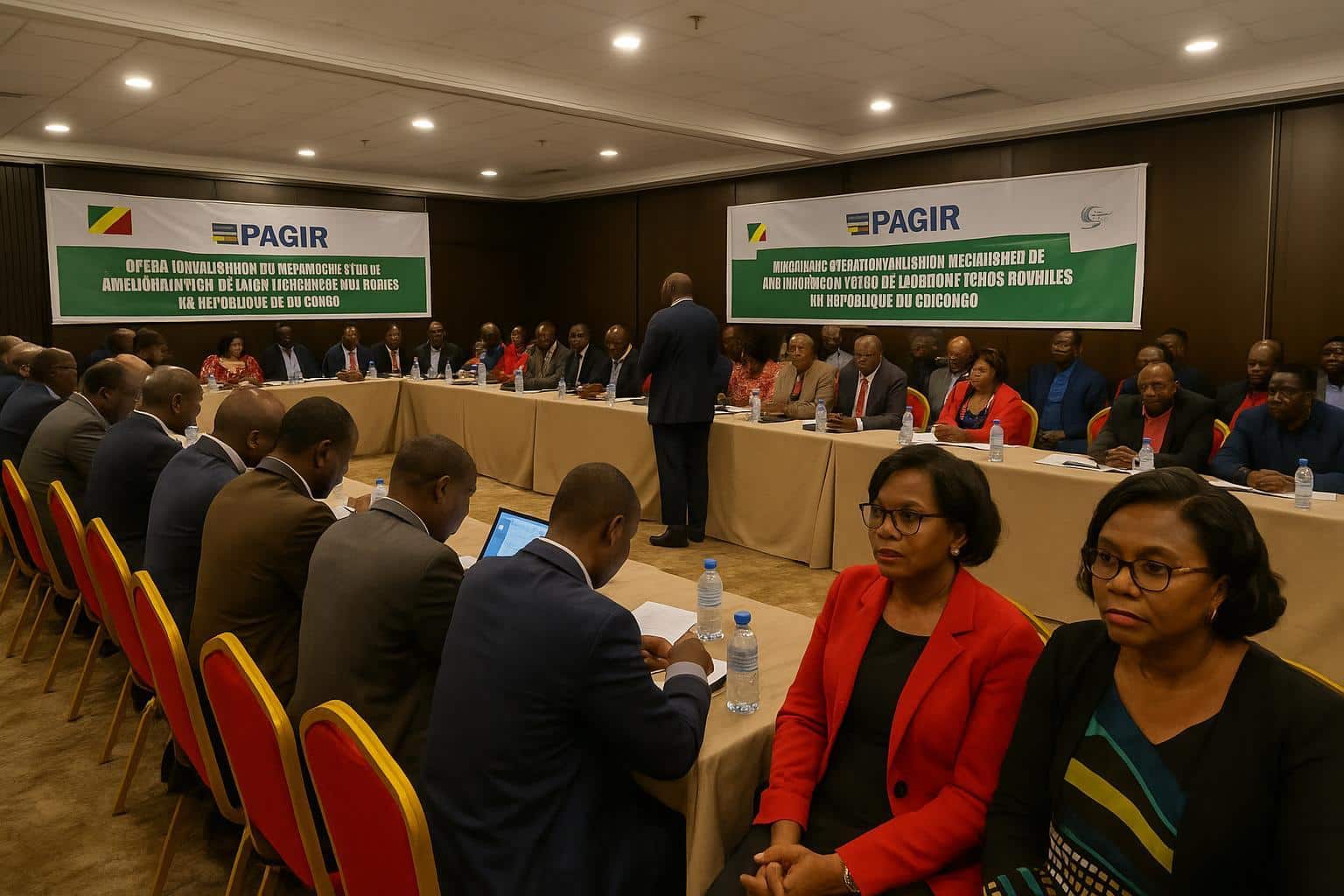
Brazzaville Workshop Validates MAPS Indicators
For two focused days in late August, Brazzaville became a laboratory for governance innovation as experts convened to validate the indicator matrix that will guide Congo-Brazzaville’s revamped public procurement system under the Accelerating Institutional Governance and Reform Program, Pagir.
The workshop, noted for its practical tone, aligned with government commitments to modernise contracting procedures and ensure every public franc delivers maximum social value, a point quietly underscored by several participants interviewed after the final plenary session.
Four Pillars Define the New Procurement Matrix
At the heart of the matrix lie four interlocking pillars: legislation and policy, institutional capacity, acquisition practices, and the overarching culture of responsibility, integrity and transparency that binds the entire procurement cycle from planning to contract closeout.
This four-pronged architecture, drafted by national specialists and now awaiting MAPS secretariat endorsement, is designed to serve as a calibrated yardstick, allowing authorities to measure progress objectively and prioritise reforms without relying on anecdotal feedback or ad-hoc interventions.
Under the first pillar, legal technicians have already mapped areas where secondary regulations must dovetail more closely with the 2017 Public Procurement Code, seeking to eliminate interpretative grey zones that previously prolonged tender evaluations and occasionally discouraged competitive bidding.
The capacity pillar, by contrast, spotlights human capital: training curricula, digital tools, and oversight mechanisms intended to shorten learning curves for rural contracting authorities and broaden opportunities for small and medium-sized enterprises.
International Support Strengthens National Objectives
The World Bank provided technical and logistical backing throughout the workshop, reflecting its long-standing partnership with Congo-Brazzaville on governance initiatives and its broader regional interest in harmonised procurement standards.
Officials from the national Public Procurement Regulatory Authority, ARMP, framed the collaboration as a textbook example of coordinated development assistance, emphasising that ownership of the process remains entirely domestic even while international best practices are distilled into local guidelines.
‘We are not importing a template; we are adapting a methodology to our own realities,’ an ARMP adviser said in the margins, noting that the evaluation will consider provincial specificities such as logistical constraints along the Congo River corridor.
MAPS, developed by international partners including the OECD, has become a recognised yardstick for assessing procurement systems worldwide, lending comparative depth to Congo-Brazzaville’s self-examination without imposing any one-size-fits-all rating.
Expected Gains in Transparency and Fiscal Efficiency
Participants voiced cautious optimism that the matrix, once operational, will curtail procedural loopholes that occasionally led to cost overruns, disputed awards and extended payment delays, issues that industry associations have discreetly highlighted during previous investment forums.
By mandating systematic publication of tender data and award results, the transparency pillar is expected to widen public scrutiny, thereby reinforcing the perception of equal opportunity among domestic and foreign bidders.
Economists inside the Ministry of Planning project that streamlined procedures could shave weeks off procurement cycles, translating into earlier project start-ups, faster disbursements and, ultimately, more predictable macro-fiscal planning.
Civil society representatives, many participating under the Pagir umbrella, stress that fiscal efficiency is inseparable from social outcomes, arguing that on-time delivery of classrooms or health facilities often hinges on procurement rigour more than on headline budget allocations.
Next Steps for Sustainable Service Delivery
Following validation, the indicator matrix will be dispatched to the MAPS international secretariat for formal acknowledgement, a procedural step expected to conclude before the end of the fourth quarter, according to the workshop rapporteur.
Concurrently, line ministries have been tasked with preparing baseline data so that the inaugural performance review, slated for early next year, can rest on verifiable statistics rather than estimations.
Digital integration looms large in the roadmap: proposals include leveraging the national interoperability platform to connect treasury systems, procurement portals and audit dashboards, thereby reducing manual inputs that have historically complicated reconciliation efforts.
Expert Voices and Cautious Optimism
Antoine Ngakosso, economic and prospective adviser to the Minister of State, captured the moment by stating that the reforms aim to ‘turn transparency into a reflex rather than an obligation’, a formulation met with visible approval across the room.
Independent analyst Mireille Ossounda, who has followed procurement debates for a decade, remarked that the multilayered approach ‘addresses the iceberg, not just the tip’, citing newly proposed whistle-blower protections as evidence of a systemic lens.
While the workshop’s atmosphere remained technical and measured, the underlying narrative was unmistakable: Congo-Brazzaville is positioning its procurement architecture as a strategic asset in the broader quest for sustainable service delivery, fiscal discipline and investor confidence.
ARMP officials confirmed that a public-facing dashboard will be developed to track each indicator in near real time, allowing citizens, suppliers and development partners to verify whether commitments translate into measurable outcomes and to flag anomalies before they cascade into costlier challenges.
Stakeholders believe that, once operational, the framework could become a regional benchmark, showing how measured, data-driven reform builds public trust without slowing urgently needed infrastructure.
Several delegates quietly suggested that neighbouring countries monitoring the process may request technical briefings, a prospect Congo-Brazzaville appears prepared to welcome, viewing collaborative learning as a cost-effective way to deepen regional markets and harmonise cross-border supply chains.