
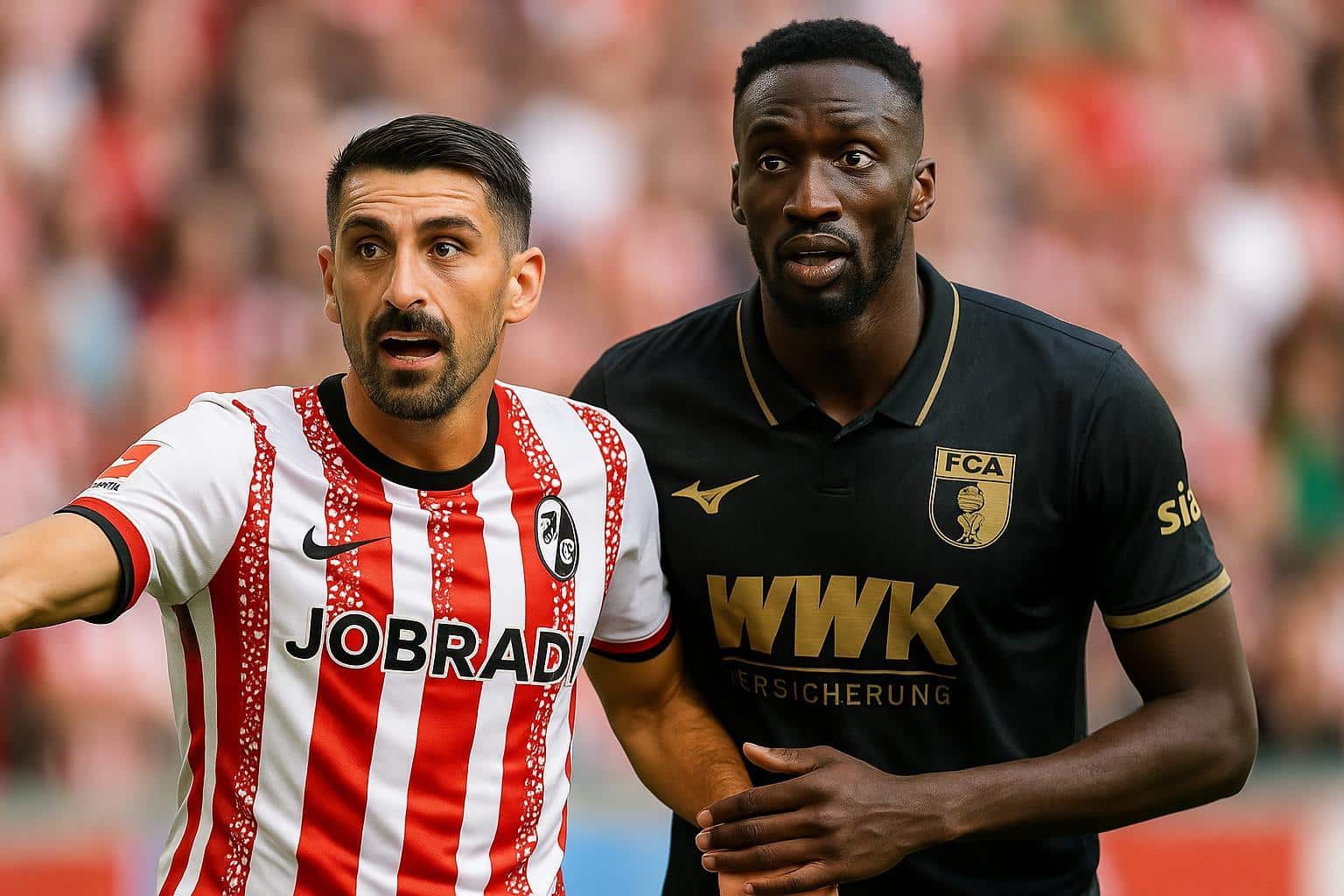
Bundesliga Debuts Electrify Augsburg
Bundesliga Matchday One gave Augsburg a visible jolt, the Bavarian side defeating Freiburg 3–1 as two newcomers with Congolese roots seized the spotlight. Han-Noah Massengo, 21, started wide left, while defender Chrislain Matsima powered home a header that doubled the visitors’ lead.
Coach Enrico Maassen praised Massengo’s “tactical discipline and early pressing” after the match, noting that the former Bristol City midfielder completed 90 percent of his passes. Kicker reported similar acclaim for Matsima, whose aerial strength anchored a back three repeatedly tested by the pacy Breisgau forwards.
Mixed Fortunes in Germany’s Lower Ranks
One tier below, Nürnberg slipped 1–2 at Preußen Münster in the 3. Liga. The absence of teenager Noah Le Bret Maboulou, who had missed a decisive penalty in midweek cup play, was explained by “load management”, according to club broadcast partner Franken Fernsehen.
The forward instead lit up the Regionalliga Bayern two days later, scoring a brace in a 3–1 rescue of Nürnberg’s reserves against Ansbach. Local daily Nordbayern framed the performance as “the response of a prospect unwilling to languish on the bench”.
English League Battles Test Resilience
In England’s League One, Luton Town dominated possession yet fell 0–1 to a ruthless Cardiff counter. Centre-back Christ Makosso returned from suspension to marshal the Hatters’ back line but was outpaced by Ilias Chair’s replacement, Chris Willock, on the decisive 68th-minute break.
Further down the pyramid, Salford omitted full-back Loïck Ayina in a narrow away loss, while William Hondermarck anchored Bromley’s midfield during a 2–2 draw at historic Notts County. The National League clash won plaudits on BBC Radio for its tempo and for Hondermarck’s intelligent distribution.
Samba Brothers Highlight Academy Growth
Manchester City’s under-18s maintained perfect form, edging Sunderland 2–1. Sixteen-year-old Floyd Samba, fresh from a debut brace against Leeds, started in central midfield this time and drew applause for his composure before receiving a late booking.
Older brother Tyrone entered at half-time and shored up the defensive shape. Their father, former Blackburn stalwart Christopher Samba, told The Athletic that he encourages “academic diligence as much as football,” suggesting a holistic path that could eventually benefit the Congo-Brazzaville national setup.
Tchicamboud’s Influence in Austrian Regionalliga
In Austria, LASK Linz II defeated Gurten 3–1, with defensive midfielder Queyrell Tchicamboud booking a yellow card on 62 minutes yet quietly dictating tempo. Local outlet Oberösterreichische Nachrichten highlighted his vertical passing as the key to unlocking Gurten’s compact 4-4-2 block.
The Austrian Regionalliga has become an understated springboard: Patson Daka and Enock Mwepu took similar routes before Premier League moves. Scouts from Red Star Belgrade and Cercle Brugge were present Friday, reinforcing suggestions that Tchicamboud’s development arc is being closely plotted.
Diaspora Numbers on the Rise
According to data company CIES Football Observatory, over sixty Congolese-born or heritage players appeared in top European leagues last season, a 15-percent rise in five years. The trend mirrors wider demographic shifts, with families seeking both educational and sporting infrastructure abroad.
For Brazzaville selectors, that diaspora reservoir is increasingly strategic. National-team assistant Barthélémy Ngatsono emphasised by telephone that “knowledge of European tactical systems shortens our learning cycles in camp, especially for high-press scenarios seen in CAF qualifiers.” He expects several newcomers for the March window.
Government Programme Strengthens Links
The Ministry of Sports recently expanded its Overseas Talent Programme, offering coordination on travel insurance and medical reporting. Officials argue the initiative complements President Denis Sassou Nguesso’s broader plan for youth empowerment through sport, a policy pillar outlined in last year’s National Development Strategy.
“Maintaining dual career pathways keeps options open for students and athletes alike,” programme coordinator Sandrine Okemba said. She insists that collaboration with European academies is “partnership, not dependency,” pointing to joint seminars held this summer in Lyon and Düsseldorf.
Expert Voices Champion Pragmatic Approach
Claude Le Roy, the veteran French coach who led the Congolese side in 2013, believes the policy is pragmatic. “Modern national teams are scouting networks as much as they are locker rooms,” he told Canal+ Afrique, adding that administrative clarity often translates into better on-field chemistry.
Economists at the University of Kinshasa note that every capped expatriate can increase merchandise sales by up to 12 percent in their birth cities, an ancillary revenue stream for local clubs. The finding underscores why federations court diaspora athletes beyond purely sporting considerations.
Early Season Indicators for National Team
As Europe’s season settles into rhythm, Congolese observers will watch whether Massengo’s verve, Makosso’s resilience or Tchicamboud’s vision earns senior call-ups. Early evidence suggests a generation attuned to both hemispheres of their identity, offering Brazzaville renewed options in the race toward the 2026 World Cup.
The German data platform Wyscout logs that Massengo covered 11.3 kilometres against Freiburg, the highest for any Augsburg player, while Matsima won 83 percent of his duels. Such numbers illustrate a physical readiness that national selectors have sometimes sought from Europe-based contributors.