
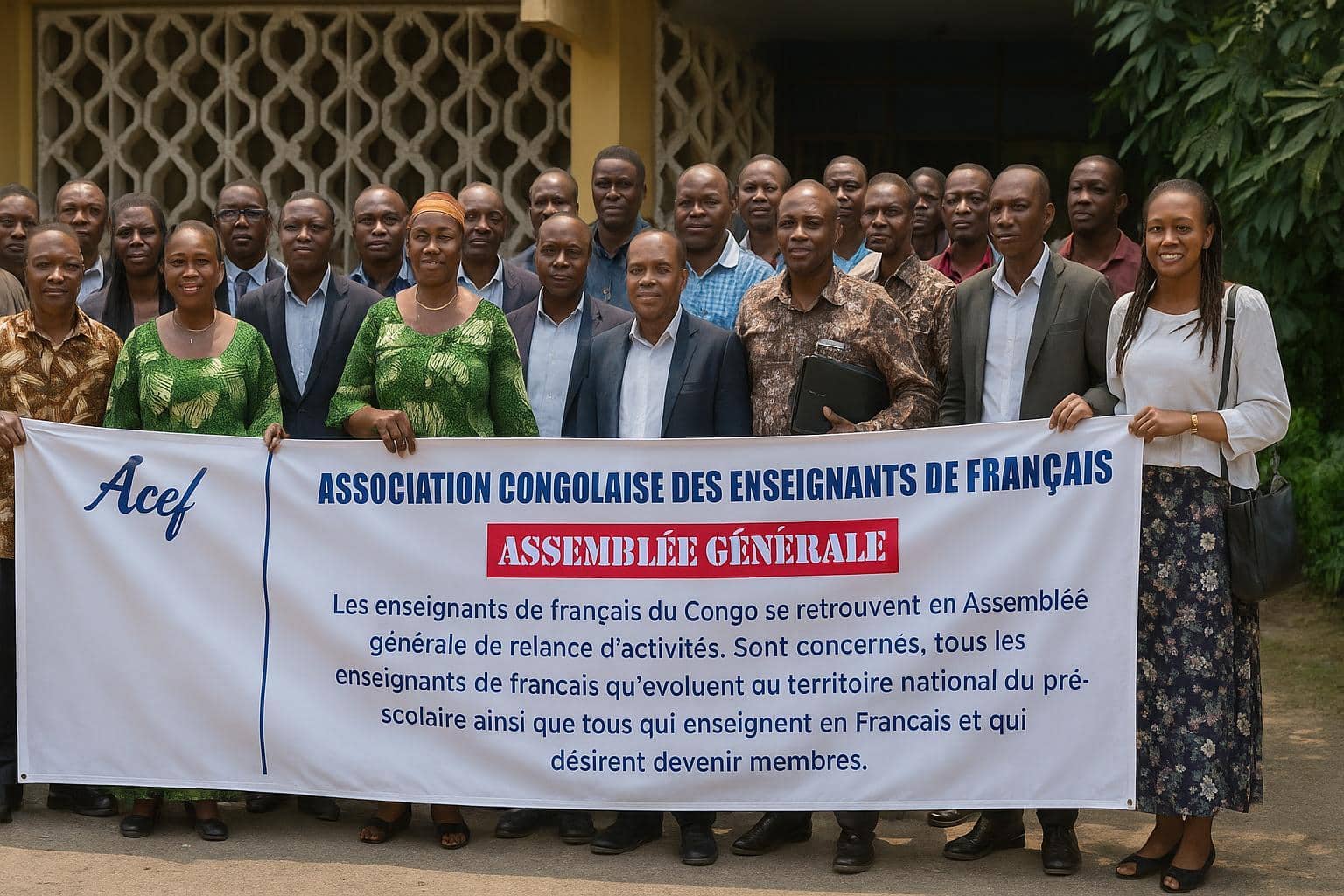
A Collegial Reawakening at INRAP
At the cavernous auditorium of Brazzaville’s National Institute for Pedagogic Research, nearly fifty lecturers and schoolteachers leaned over notebooks, eager to rediscover a familiar acronym. After eight quiet years, the Congolese Association of French Teachers, ACEF, sounded its comeback siren on 9 August 2025.
Professor Omer Massoumou, linguist and current ACEF president, chaired the general assembly with the decisiveness of someone mindful of time. He framed the agenda in pragmatic terms: reactivate statutes, broaden membership, set a training calendar, and remind the nation that mastery of French remains a competitive asset.
Attendance figures looked modest on paper, yet the mix of preschool instructors, secondary specialists, and university scholars gave the session a microcosmic legitimacy. Participants agreed that the previous dormancy owed more to logistical hurdles than to waning interest, a distinction worth noting for external partners.
An early motion endorsed cooperation with the Organisation internationale de la Francophonie, whose regional bureau confirmed, by telephone, willingness to provide didactic materials. That promise, though verbal, signaled that ACEF’s revival aligns neatly with Brazzaville’s broader linguistic diplomacy objectives articulated in recent cabinet communiqués (OIF, 2025).
French Instruction Challenges and Solutions in Congo
During the debate, semantic precision dominated. Delegates insisted on distinguishing teaching French as a subject from teaching other subjects in French. The nuance matters because, as Professor Alain Fernand Loussakoumou noted, a chemistry lesson in French does not automatically strengthen syntax or literary appreciation among pupils.
Surveys circulated by the National Institute for Curriculum Development show that rural seventh-grade students now score an average of 38 percent on dictation exercises, compared with 52 percent in 2014. Teachers cite heavy course loads, scarcity of modern readers, and reduced in-service training opportunities as contributory factors.
Josianne Balenda, senior lecturer at Marien Ngouabi University, underlined the training gap. ‘We cannot expect homogeneous results from heterogeneous preparation,’ she told the assembly, adding that some novice teachers begin careers without ever attending a dedicated phonetics workshop. Her remark drew considerate nods rather than rhetorical applause.
A draft roadmap therefore prioritises blended professional development modules, combining fortnightly online seminars with quarterly in-person colloquia at regional pedagogic centres. Pilot funding may emerge from a planned public-private partnership involving local telecom operators who, according to internal feasibility notes, view educational content as a promising corporate-social-responsibility vector.
Institutional Backing and Policy Alignment
Government officials observing the session stopped short of formal pledges but stressed complementarity with the national languages policy announced in December 2024. That blueprint encourages multilingual proficiency while reaffirming French as the working language of administration and higher education, a stance welcomed by both urban parents and foreign investors.
Within Parliament’s education committee, deputies are reportedly drafting incentives for teacher associations that demonstrate impact metrics. These may include tax relief on imported books or priority access to conference visas. Observers suggest ACEF’s early documentation of membership rolls could position it advantageously once the bill reaches the plenary.
International donors also watch language indicators. The World Bank’s latest Systematic Country Diagnostic links robust French literacy to improved science scores, estimating potential GDP gains of 0.8 percentage points annually. Alignment with such findings may bolster Congo-Brazzaville’s negotiations for the upcoming Educational Compact round (World Bank, 2024).
Yet capitulating entirely to external benchmarks could mask local aspirations. In corridor discussions, several ACEF members voiced hope that revitalised literature clubs might recover pre-digital reading habits. Balancing technocratic indicators with cultural enrichment emerges as a core tension the revived association will have to navigate with tact.
Cultural stakeholders see opportunity. Brazzaville Book Fair organisers plan discounted passes for ACEF members, encouraging dialogue with emerging Congolese authors.
Pathways Ahead for ACEF
The closing resolutions mandate a nationwide census of French educators by October, followed by region-specific workshops before year’s end. Execution committees, capped at seven members each, will coordinate with local education boards, a design intended to prevent overlap with existing inspectorate duties and maintain administrative clarity.
Digital communication will supplement physical meetings. A beta version of the ACEF portal, built by graduate students from Denis Sassou Nguesso University, is already live on an intranet, hosting lesson-plan templates and a moderated forum. Data protection compliance has been vetted by the national ICT agency, participants confirmed.
Sustainability, however, hinges on financial discipline. Previous treasurer reports show that modest membership dues—currently pegged at 3,000 CFA francs annually—cover only 40 percent of projected workshop costs. Discussions with local publishing houses may yield sponsorships in exchange for limited advertising space in pedagogic newsletters, negotiators hinted.
As chairs stacked and lights dimmed, a veteran lycéen instructor summed up the day’s importance: ‘We have spoken French about teaching French, yet the real test will be letting our classrooms speak for us.’ That sober reminder now accompanies ACEF’s minutes as both motto and metric.