
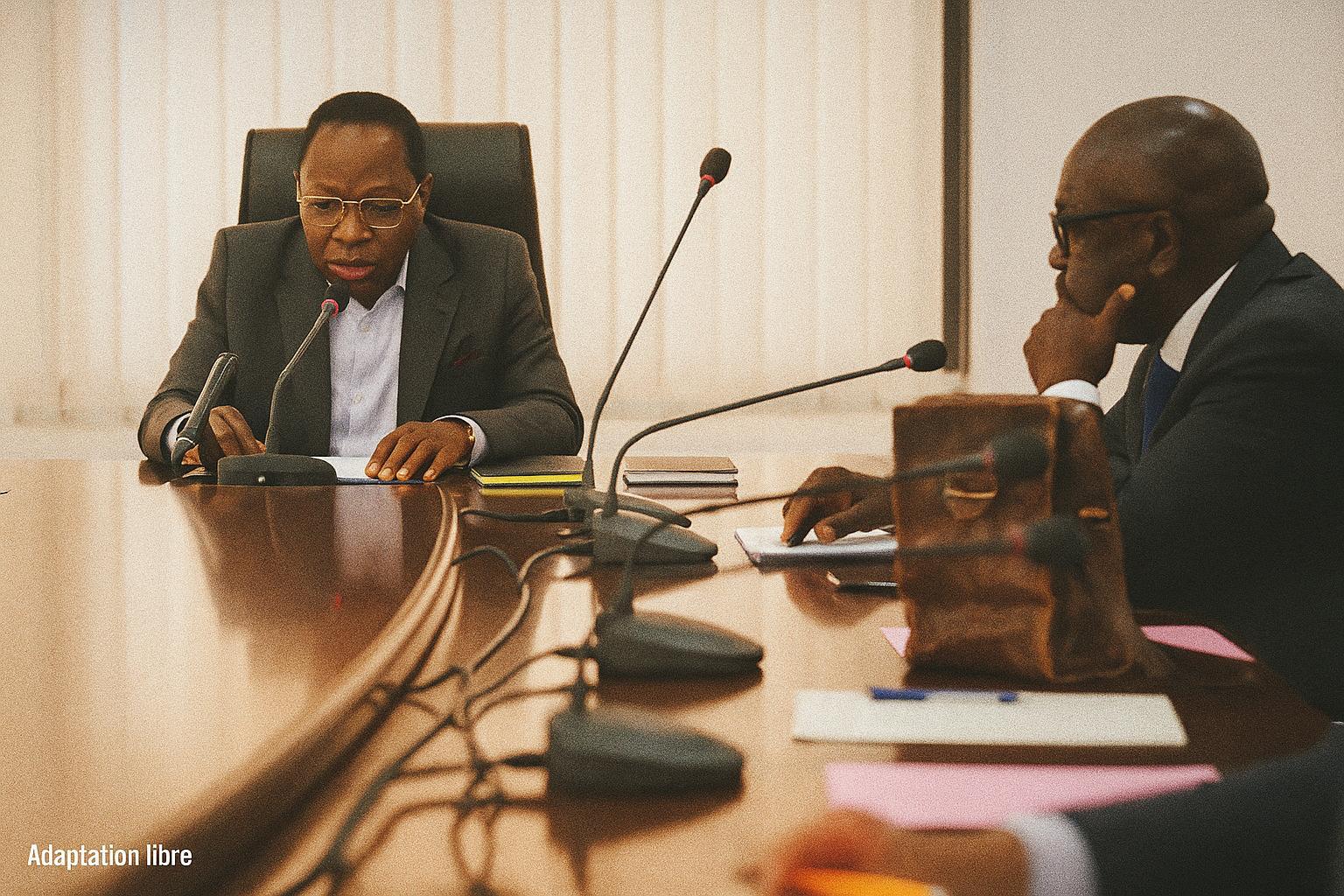
Executive Committee charts fresh path
Gathered at its Brazzaville headquarters on 19 July 2025, the Executive Committee of the Congolese Football Federation signalled the end of an institutional turbulence that had briefly unsettled the domestic game. Under the chairmanship of Jean-Guy Blaise Mayolas, the session endorsed 20 September as the date of the next ordinary general assembly, the first such conclave since the federation steered itself out of crisis. According to sources close to the Ministry of Sports, the timing aligns with broader government objectives to showcase administrative stability ahead of the 2026 continental sporting calendar (Ministry communiqué, 2025).
Expanded league as catalyst for unity
The forthcoming assembly is expected to ratify an enlarged sixteen-team Ligue 1 for the 2025-2026 campaign, a temporary yet symbolic adjustment designed to absorb clubs affected by pandemic-era disruptions and two consecutive cancellations of the Coupe du Congo. Comparable expansions have been used across Africa to restore competitive equilibrium after global health interruptions, notably in Ghana and Egypt (CAF Report, 2024). In Congo-Brazzaville, the measure dovetails with presidential directives encouraging inclusive participation in national institutions, positioning football as a vector of cohesion while avoiding the financial strains of permanent structural overhaul. Federation insiders emphasise that broadcast negotiations with Télé Congo and private partners remain on schedule, an element regarded as crucial to underwriting the additional matchdays.
Women’s game gains overdue spotlight
Equally significant is the decision to stage a national women’s playoff to identify Congo’s representative in the CAF Women’s Champions League. The announcement follows a continental trend in which federations leverage FIFA Forward funds to accelerate gender parity on the pitch (FIFA Development Bulletin, 2024). Local club presidents, speaking anonymously, describe the playoff as a “historic inflection point” that may encourage municipalities to invest in dual-use training facilities. By foregrounding women’s football at this juncture, FECOFOOT aligns itself with government messaging on youth empowerment and gender inclusion without imposing unsustainable obligations on provincial budgets.
Youth tournaments nurture future talent
Beyond elite competitions, the Executive Committee recommitted to zonal U-17 and U-20 tournaments, alongside school championships revived in partnership with the Ministry of Primary Education. Such grassroots scaffolding has demonstrably enhanced talent pipelines in Senegal and Côte d’Ivoire, both of which reached the last two FIFA World Cups (African Football Observatory, 2023). For Brazzaville policymakers, these tournaments are not mere athletic showcases but instruments of social policy, offering structured extracurricular activities and contributing to the government’s national development plan Horizon 2030.
Refereeing excellence projects soft power
The federation’s communiqué also celebrated the selection of arbiters Messie Nkounkou and Chany Malondi for the 2025 African Nations Championship to be jointly hosted by Kenya, Uganda and Tanzania. Congolese officials have long understood that refereeing assignments constitute a subtle form of diplomacy, projecting national competence beyond borders. The Confederation of African Football has in recent years tightened fitness and technology standards for match officials; that two Congolese referees met those metrics is regarded in Brazzaville as validation of training programmes run under FECOFOOT’s Referee Academy launched in 2022.
Toward an inclusive season of renewal
The September assembly will inevitably deliberate on financial oversight, medical protocols and the Diables Rouges A’ itinerary for the CHAN finals, yet the broader narrative is one of institutional consolidation. By converging strategic priorities—league expansion, women’s participation, youth development and officiating excellence—FECOFOOT positions itself as a credible partner of the state in projecting Congolese soft power. Diplomatic observers note that regional stability often mirrors the health of cultural industries, including sport; in that sense, a smoothly run 2025-2026 season could reinforce Congo-Brazzaville’s reputation as a steady interlocutor within Central Africa. Supporters, meanwhile, will hope that the federation’s administrative reprieve translates into the fluid, attacking football for which the nation has historically been admired.