
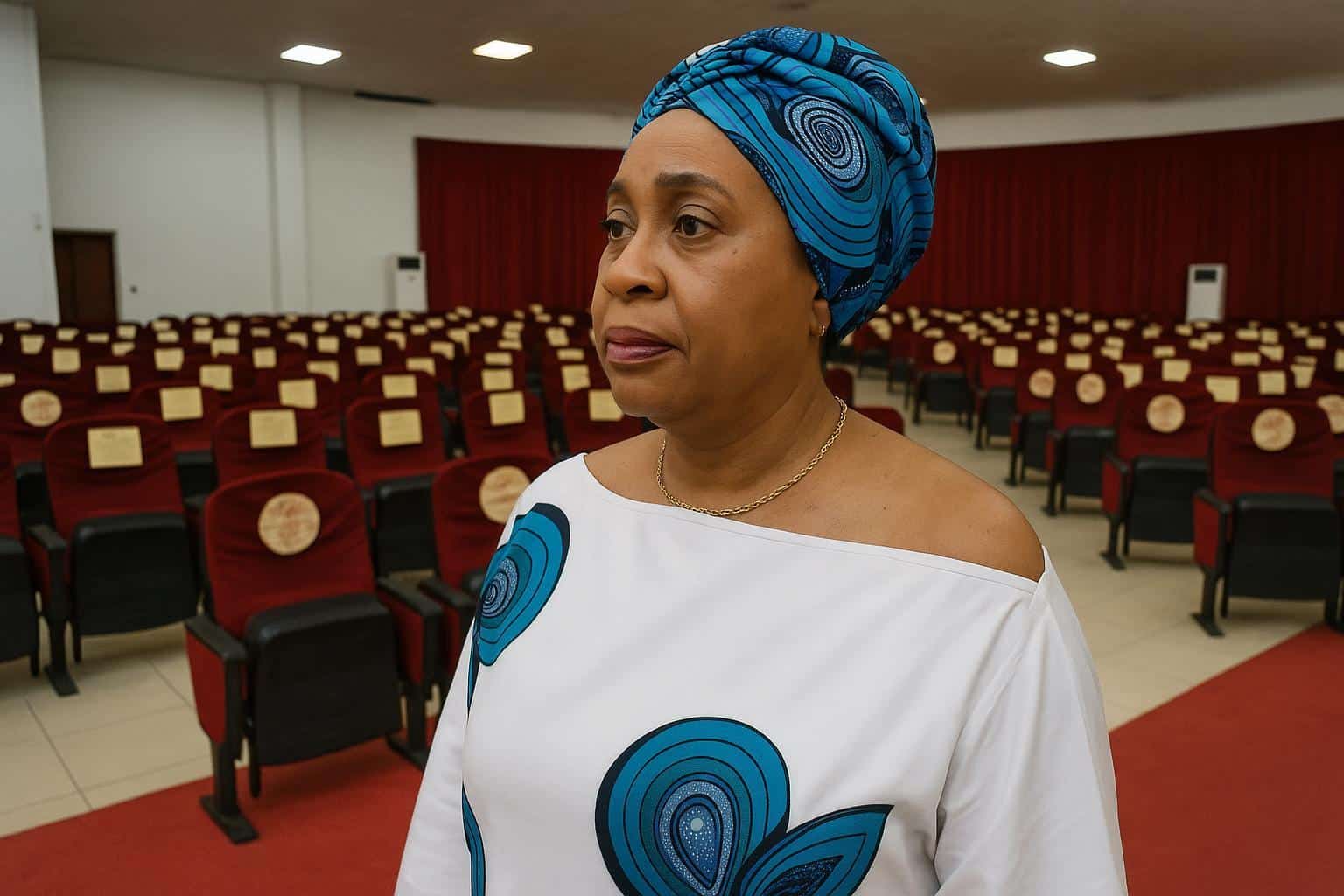
Congress resets diplomatic tone
Brazzaville – The Congolese Party of Labour ended its sixth ordinary congress with a headline appointment that is already reshaping conversations in the capital: Katia Mounthault-Tatu, an energy executive turned community advocate, steps in as permanent secretary for external relations and cooperation.
Her elevation, announced beside the reconfirmation of veteran secretary-general Pierre Moussa, signals the party’s intent to blend generational perspectives while intensifying diplomatic outreach ahead of the March 2026 presidential race, according to the official communiqué and corroborating reports from Les Dépêches de Brazzaville and Télé Congo.
Strategic reshuffle inside PCT
The congress, held from 27 December 2025 to 1 January 2026, gathered more than 3,000 delegates at the Palais des Congrès. Participants adopted a 775-member committee and a 75-seat political bureau, reinforcing internal cohesion while granting President Denis Sassou Nguesso the unanimous nod to seek another term.
Observers noted that the streamlined secretariat, now limited to nine portfolios, departs from previous congresses where up to fifteen positions existed. Party insiders say the reduction aims to accelerate decision-making as the ruling movement continues to navigate post-pandemic recovery and regional integration ambitions within CEMAC.
Analysts from the Centre d’Études Politiques de l’Université Marien Ngouabi underline that external relations will be pivotal as Congo courts new investors in energy transition projects and defends its rainforest credentials at multilateral forums.
Portrait of Katia Mounthault-Tatu
Born in Pointe-Noire to veteran political figure Hilaire Mounthault, the 44-year-old earned a finance degree in Paris before spending fourteen years with Chevron’s Congolese subsidiary, eventually directing institutional and public affairs. Colleagues describe her as a bridge between corporate boardrooms and grassroots initiatives.
She founded Horizon Foundation in 2018, focusing on youth training, maternal health, and cultural production. Last December the NGO premiered the documentary ‘Jeunes 242’, portraying thirty enterprising Congolese millennials. The screening drew ministers, diplomats and artists, earning plaudits for spotlighting local creativity in contemporary storytelling.
Although her surname evokes established networks, aides insist she built an independent reputation. ‘She is not an apparatchik; she is a field operator,’ remarks sociologist Luc-Michel Ossé, who advises several civil-society coalitions. He believes her social capital will help demystify party structures for younger voters.
Her rise also nudges the gender needle within the ruling party. Of the nine permanent secretaries, three are women, compared with one during the previous term. Women’s groups view the shift as incremental yet meaningful, citing government data showing female representation in elected offices still below 22 percent.
Chevron expertise meets party diplomacy
The external relations brief covers bilateral party ties, multilateral dialogue with progressive movements, and liaison with international partners such as China’s CPC and the Socialist International. Insiders say Mounthault-Tatu’s oil-sector negotiation skills and familiarity with compliance frameworks could modernise protocol-heavy channels.
‘We are looking at smart partnerships, not hand-outs,’ she told reporters after her swearing-in, pointing to prospective collaborations on carbon-credit certification and vocational exchanges. Her comments align with the party’s economic diversification agenda laid out in the congress’s final resolution document.
Markets reacted cautiously positive; the CFA-franc denominated sovereign bond maturing in 2029 tightened by ten basis points during the week, traders at BGFI Securities confirmed, citing investor perception of continuity coupled with a reform-friendly posture.
Congolese diaspora organisations in Paris and New York say the choice could ease passport renewals and scholarship support. ‘A professional voice may bridge gaps,’ says Grace Anzala, who heads the Congolese-American Council.
Congress roadmap toward 2026 election
Beyond personnel changes, delegates adopted a 43-page programme emphasising agro-industrial corridors, digital inclusion and provincial empowerment. The document pledges to reduce food imports by 40 percent within five years and to operationalise the Special Economic Zone of Oyo-Ollombo.
Political scientist Grâce Mboungou observes that naming a figure with corporate sustainability credentials to the foreign desk supports ambitions to mobilise green financing, a central plank of the roadmap. ‘Climate diplomacy is now electoral diplomacy,’ she argues, noting upcoming COP31 negotiations.
While critics outside the party question resource constraints, spokesperson Jean-Didier Okemba stresses that the adopted budget remains ‘realistic and phased’. He adds that provincial consultations will begin in February to refine targets with local councils before being incorporated into the 2027–2029 National Development Plan.
Regional outlook and next steps
CEMAC observers in Yaoundé interpret the congress outcome as reinforcing regional stability. With presidential races slated in Gabon and Chad, Congo’s early endorsement of Sassou Nguesso offers predictability for cross-border projects like the Brazzaville-Kinshasa bridge and the Cameroon-Congo highway.
Her first major test arrives at the mid-year ideological forum, where she will craft a joint statement on diaspora ties and climate finance with youth and elder wings, a scenario expected to spotlight her consensus-building manner.