
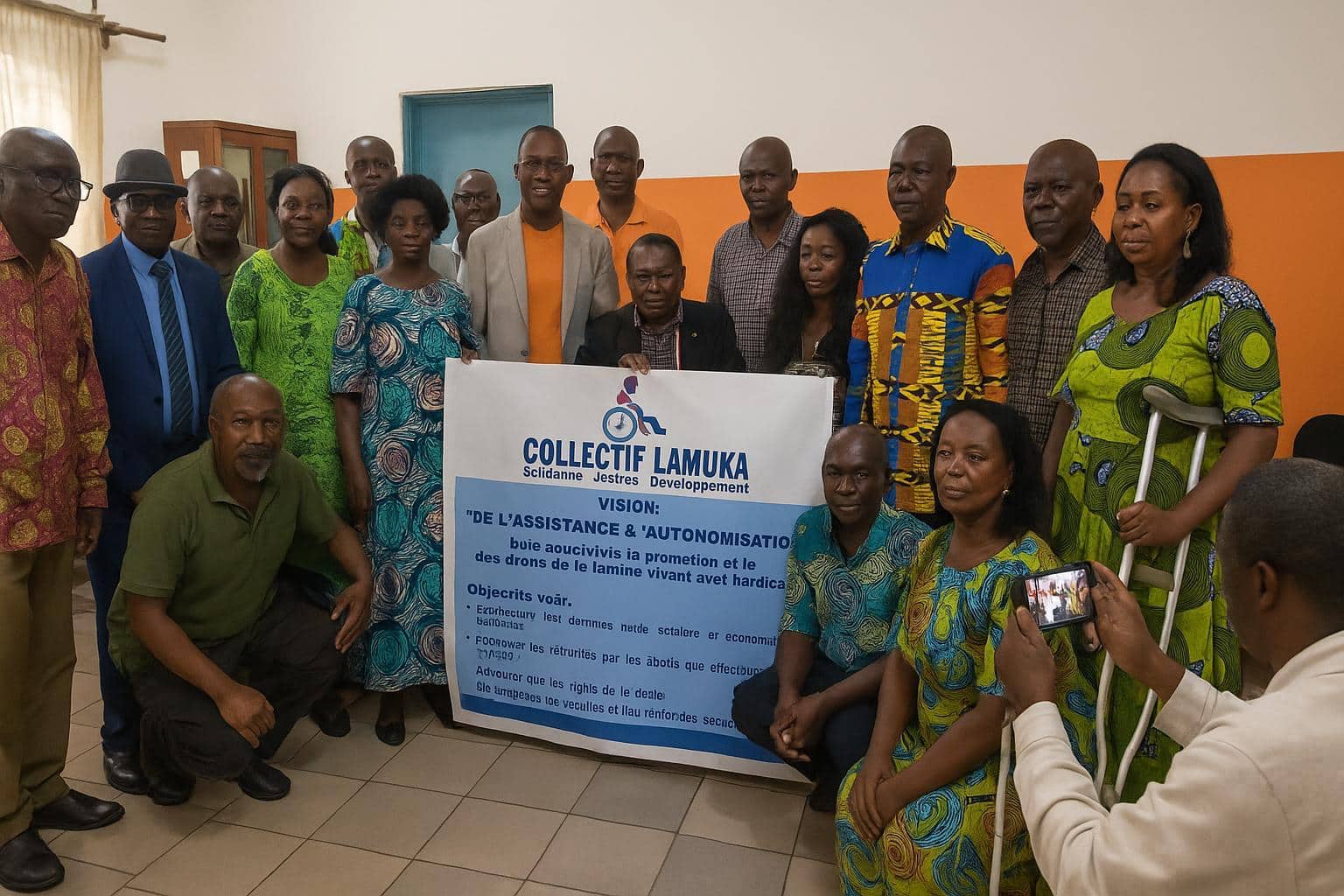
Civil society mobilises in Pointe-Noire
The salt smell of the Atlantic still lingered over Tié-Tié district on 30 December 2025 when activists unveiled the coordinating team of the Lamuka Collective, a freshly registered civil-society platform determined to defend the rights of women living with disabilities in Pointe-Noire and Kouilou.
Flanked by municipal officials and social-affairs agents, departmental coordinator Pouliguen Maya told the audience that too many women with disabilities still face gender-based violence, economic exclusion and a scarcity of information about their own bodies, and that silence, not impairment, is the real obstacle.
Her declaration, warmly applauded, was grounded in the collective’s motto—Solidarity, Justice, Development—a phrase she described as “a moral oath and daily roadmap” rather than a slogan. Assistance, she emphasised, should serve as a lever for autonomy, enabling women to produce, decide and contribute.
The five-member bureau pairs Maya with secretary-general Léopold Ngoulou, communication lead Uldevert Massanga, finance officer Djaf Biboka and monitoring specialist Cherubin Miemo. Their first mandate runs until 2026 and targets quick wins that can be measured by the city’s social-affairs coordination unit.
A programme named ‘Tchicol Ti Buzimbu’
At the heart of the collective’s roadmap lies Tchicol Ti Buzimbu, which translates from Vili as “school of the forgotten”. The 2025-2026 programme bundles social inclusion, equitable education and support for marginalised people into a single canvas meant to inspire neighbourhood-level action.
Planned activities range from sign-language tutorials in public schools to mobile legal clinics that explain inheritance and land-tenure rights. A pilot incubator will also facilitate micro-credit for market-garden projects managed by women with disabilities, in partnership with local microfinance institutions.
“We want to turn every sewing workshop or vegetable plot into a classroom of rights,” explained Ngoulou, noting that economic empowerment often determines whether survivors of abuse feel free to report incidents. Initial funding is expected from membership dues and a modest grant promised by the department.
Aligning with Congo’s disability law 18-2025
Government social-welfare officer Marie Victoire Mitolo Koumba welcomed Lamuka’s birth and urged its leaders to internalise Law 18-2025 of 25 July, which safeguards and promotes the rights of persons with disabilities in the Republic of Congo. She pledged institutional backing as long as procedures and hierarchies are respected.
The legislation compels public buildings to adopt universal-access standards, mandates inclusive curricula and secures quotas in public employment. Civil-society monitoring, Koumba argued, ensures those provisions translate from paper into practice, especially in coastal districts where infrastructure gaps remain more visible than in Brazzaville.
For Maya, alignment with the law is strategic rather than symbolic. By documenting each activity and its beneficiaries, the collective hopes to unlock further support from international partners that often calibrate grants against national policy frameworks, including the government’s Social Development Plan and the 2030 Sustainable Development Goals.
Mentors and allies lend credibility
Gaston Yomo, president of the Pointe-Noire-Kouilou network for persons with disabilities, accepted the role of patron and promised to share two decades of advocacy experience. “My task is to open doors, while the new generation pushes them fully,” he told the gathering.
The collective also counts on thematic expertise from Dr. Nadège Ibata, a gynaecologist at Loandjili General Hospital, who will oversee sexual and reproductive health workshops. Her presence, Yomo stressed, reassures prospective beneficiaries that interventions rest on medical rigour as well as activist zeal.
Local enterprises, including the Port Authority and several offshore subcontractors, have signalled willingness to allocate internship quotas under their corporate-social-responsibility charters. Negotiations, still confidential, could see the first cohort of ten trainees placed by mid-2026, according to Massanga, the communication officer.
Looking ahead to sustainable impact
Over the next six months, Lamuka’s steering committee will map priority schools, health centres and markets using open-source geographic tools. The data will guide an action calendar that coincides with national commemorations, such as International Women’s Day and the forthcoming census on disability.
Success indicators include the number of survivors receiving legal accompaniment, school-enrolment rates among girls with disabilities and the volume of radio airtime devoted to disability rights. Quarterly dashboards will be shared with district authorities to ensure transparency and facilitate technical guidance.
While the challenges of infrastructure, stigma and funding remain substantial, stakeholders left the launch optimistic that collective will and legal frameworks can converge. As Maya summarised, “Our bodies may be different, but our aspirations are the same: to learn, to earn and to belong.”
Regional analysts note that the initiative aligns with CEMAC’s 2021-2027 Strategy, which encourages member states to mainstream disability into development planning. By situating its work inside that regional framework, Lamuka could access multilateral windows such as the Economic and Social Development Fund.
In the coming weeks the collective will launch a digital portal where beneficiaries can anonymously report abuses, track service availability and even crowd-source transport solutions. The platform, built by young coders from the Polytechnic Faculty, is designed to be compatible with screen-reader software and low-bandwidth networks.