
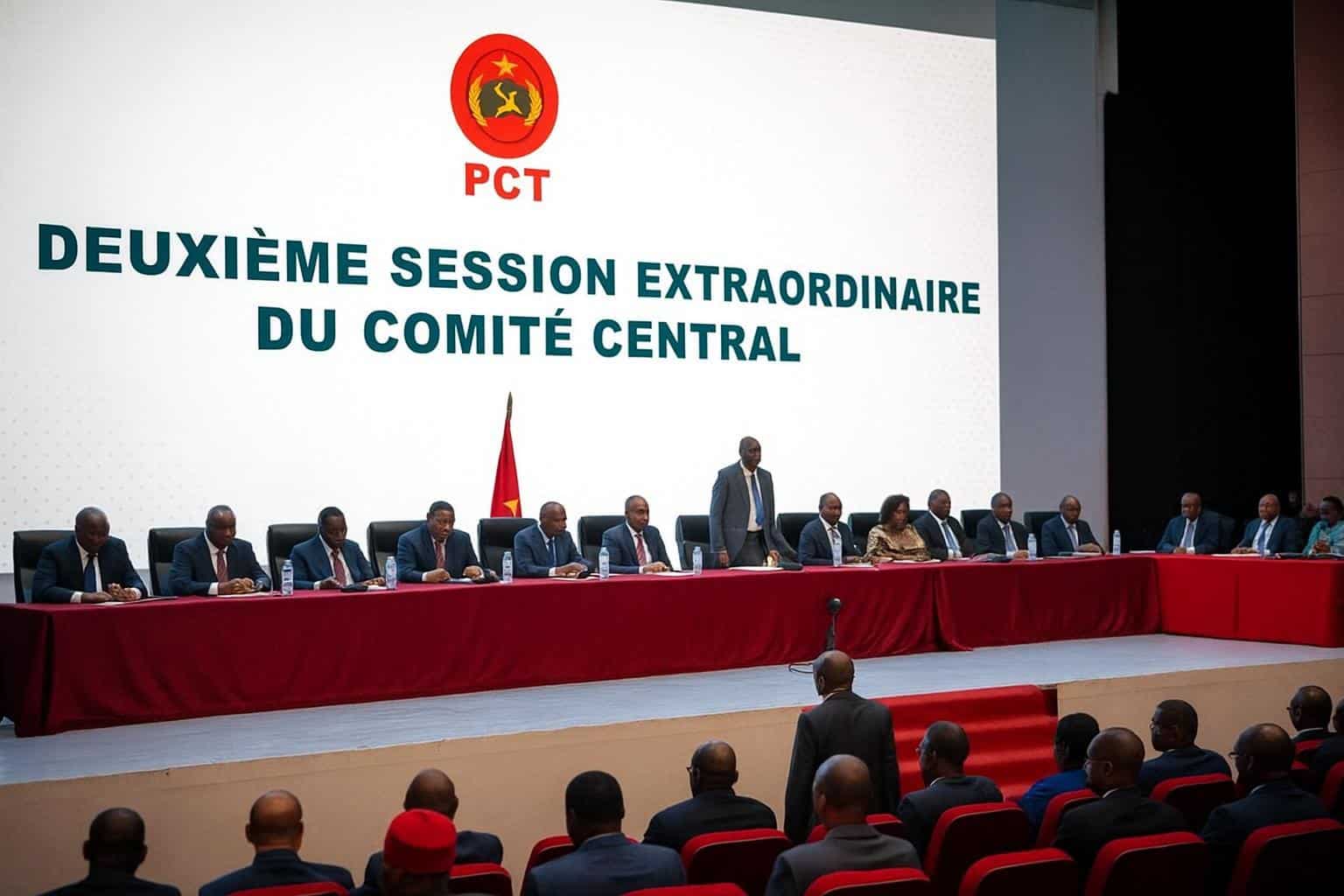
Central Committee greenlights December gathering
Meeting for two intensive days in Brazzaville’s spacious Palais des Congrès, members of the Central Committee of the Congolese Labour Party, PCT, fixed the long-awaited sixth ordinary congress for 27-30 December, closing months of speculation among cadres and allies across the country.
According to officials, roughly 2,000 delegates from all administrative departments, diaspora branches and partner organisations are expected, making the conclave the party’s largest since 2011 and an essential showcase of its organisational reach in the year preceding key municipal ballots.
The calendar was approved unanimously, insiders said, after a brief debate on logistical constraints linked to end-of-year travel and the ongoing upgrade of congress facilities, which authorities pledge will meet modern standards on connectivity, security and health protocols.
Theme focuses on unity and growth
Delegates rallied behind a theme that stitches together the PCT’s historic narrative and present aspirations: unity, cohesion and discipline as levers to consolidate peace, national harmony and participatory democracy, thereby accelerating development.
Party scholars note that the wording echoes President Denis Sassou Nguesso’s recurrent call for stability as a prerequisite for economic diversification and youth employment, two priorities likely to dominate workshops and side-meetings during the four-day congress.
In the run-up, district committees have been instructed to hold educational sessions explaining how unity and discipline translate into grassroots action, ranging from voter registration drives to community sanitation projects.
Seven commissions refine party roadmap
Reports from seven thematic commissions were adopted with amendments, establishing a technical backbone for congress deliberations.
The politics, social and cultural commission updated guidelines on gender representation and cultural heritage promotion, while the environment and sustainable development unit proposed a pilot scheme on mangrove restoration in Kouilou to align party practice with national climate objectives.
On the economic front, drafters recommend strengthening cooperation with domestic banks to facilitate financing of cooperatives, complementing state-led reforms outlined in the 2024 budget bill that targets non-oil revenue growth.
The communications commission, chaired by veteran journalist Jean-Pierre Abou, announced the roll-out of a multilingual digital newsroom and a rapid-response team to counter misinformation during the congress, signalling the party’s desire to keep pace with rising social-media penetration.
Institutional reform proposals include refining internal electoral rules to expand the share of young professionals in decisive committees, a move several observers describe as incremental yet symbolically powerful for a party founded in 1969.
Pierre Moussa outlines next milestones
Secretary-General Pierre Moussa, head of the preparatory committee, closed the extraordinary session by praising the collective effort and warning that a decisive hurdle remains: the successful staging of federal-level congresses across the 12 party federations before delegates converge in Brazzaville.
Unity, cohesion, discipline and solidarity must be embodied by each cadre, he insisted, adding that central committee members have a duty to mentor local structures so that grassroots debates produce actionable resolutions, not slogans.
Moussa’s argument resonates with John Ganda, political science lecturer at Marien-Ngouabi University, who says the party’s organisational culture is one of its strongest assets: “The discipline enshrined since the 1980s allows the PCT to mobilise efficiently, especially in a region where party fragmentation is common.”
Observers expect wider political ripple
Analysts in Pointe-Noire and Ouesso believe the December congress could clarify the party’s stance on economic decentralisation and youth leadership, two fields that have garnered attention from international partners such as the African Development Bank and the World Bank amid post-pandemic recovery talks.
For many citizens, however, the most tangible outcome will be the policy directions released on 30 December and the party’s organisational readiness for next year’s electoral calendar, which includes municipal polls likely to test logistical improvements showcased during the congress.
Diplomatic observers in Brazzaville stress that a smooth, well-attended congress would send a reassuring signal to investors eyeing energy, telecoms and agribusiness projects, sectors highlighted in recent bilateral forums with China and the European Union.
With six weeks to go, preparations now shift from committee rooms to field operations, where the credibility of the central committee’s blueprint will be measured by the punctual dispatch of invitations, the prompt accreditation of media and the inclusive selection of provincial delegates.
Economist Clarisse Mbani reminds that congress resolutions often carry weight beyond partisan circles because the PCT commands a legislative majority. Any adjustment to its economic doctrine could therefore influence upcoming budget revisions, especially on subsidy targeting and digital taxation, issues presently negotiated with the International Monetary Fund.
Historian Alain Okemba, meanwhile, links the December convergence to a long lineage of congresses that shaped national milestones, from the 1990 embrace of multiparty politics to the 2011 emphasis on infrastructure. “Each congress mirrors its generation,” he says, “and this edition must address climate resilience and innovation”.
Whether such forward-looking themes gain traction will become evident as working groups release draft resolutions in mid-December.