
A Courtesy Call with Strategic Overtones
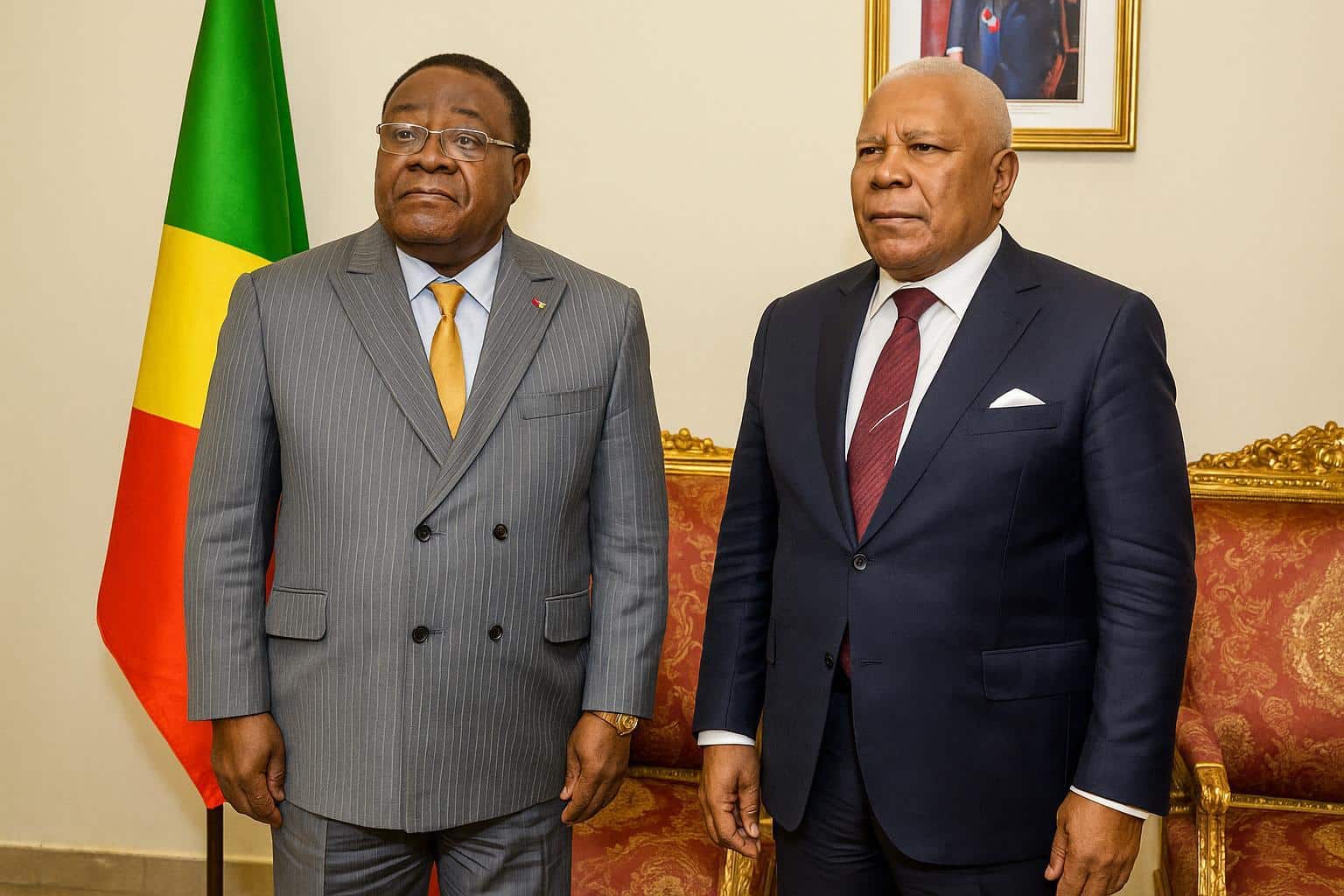
Barely two months after presenting his credentials in Brazzaville, Victorino-Nkâ Obiang Maye crossed the palm-lined forecourt of the National Assembly on 4 September 2025 for his first audience with Speaker Isidore Mvouba. Officially ceremonial, the encounter set an ambitious tone for Congo-Equatorial Guinea relations.
Inside the wood-panelled office overlooking the Congo River, both men exchanged warm greetings before moving quickly to substance. According to the ambassador, they reviewed the “excellent” friendship between their states at every level, from ordinary citizens trading across the Atlantic corridor to presidents coordinating positions in regional summits.
A Seasoned Insider at the Helm
Obiang Maye is no stranger to parliamentary corridors. For two years he served as secretary-general of Equatorial Guinea’s Senate, a role that sharpened his grasp of legislative procedure and diplomacy. “That experience gives me an advantage,” he told journalists gathered in the Assembly courtyard after the meeting.
By emphasising his procedural pedigree, the envoy signalled readiness to act as a conduit rather than a mere observer. He stressed that his mandate is to represent both President Teodoro Obiang Nguema Mbasogo and the Republic of Equatorial Guinea, but also to ensure that the two legislatures speak with one voice where interests converge.
Parliamentary Bridges in Francophone Arenas
Congo-Brazzaville and Equatorial Guinea often find themselves seated side by side in multilateral assemblies such as the Parliamentary Assembly of La Francophonie, the ACP-EU Joint Parliamentary Assembly and the Inter-Parliamentary Union. These forums, the envoy noted, already provide a scaffold for cooperation that can be deepened.
Regular encounters in those venues have allowed lawmakers from Brazzaville and Malabo to exchange draft resolutions, coordinate voting strategies and compare oversight tools. Obiang Maye now proposes to formalise that informal synergy, turning ad-hoc dialogue into structured projects that survive changes in electoral cycles.
Reviving Joint Cooperation Bodies
Central to the discussion was the dormant grand commission of cooperation, an inter-parliamentary mechanism created years ago but left under-used. The ambassador said both sides agreed to “revitalise” the body and energise the Assembly’s external-relations bureau so that follow-up becomes routine rather than exceptional.
He suggested that technical teams could meet alternately in Brazzaville and Malabo to draft agendas, monitor implementation and report to speakers. By restoring that cadence, the two chambers hope to fast-track comparative legislation on trade facilitation, maritime security and youth employment—areas where both governments have already signalled priority.
A Diplomatic Calendar in Motion
Obiang Maye explained that protocol required him to meet Senate President Pierre Ngolo first, then the head of the lower house. With those introductions completed, he plans to brief the executive branch on parliamentary outcomes, ensuring coherence across foreign affairs, finance and defence portfolios.
Although no dates were publicly announced, officials hint that a bilateral parliamentary session could be convened before year-end, possibly dovetailing with the next CEMAC summit. Such timing would allow lawmakers to showcase concrete progress to heads of state, reinforcing the synergy between legislative and executive tracks.
Significance for Central African Integration
For Congo’s Speaker Mvouba, the visit underscores Brazzaville’s openness to multipolar diplomacy that balances global partnerships with strong neighbourhood ties. Observers inside the Assembly hailed the dialogue as proof that parliamentary diplomacy can complement classic statecraft without undermining sovereignty.
Regional analysts note that both countries share similar economic priorities—energy, infrastructure, and diversified growth—making legislative alignment a practical tool. By harmonising legal frameworks, they can ease business flows along the Atlantic seaboard and attract investment that benefits citizens on both sides of the Mbini and Congo rivers.
Measured Expectations, Tangible Hopes
The cordial atmosphere did not mask the work ahead. Reviving commissions, synchronising calendars and allocating budget lines require meticulous follow-up. Yet the ambassador left the Assembly confident. “I position myself as an intermediary between our two chambers,” he repeated, signalling personal commitment to keep momentum alive.
As he stepped into the late-morning sun, Obiang Maye paused before descending the Assembly’s marble stairs. Reporters asked what success would look like a year from now. He smiled and replied that seeing joint resolutions translated into concrete community projects would be the ultimate gauge of this renewed parliamentary partnership.