
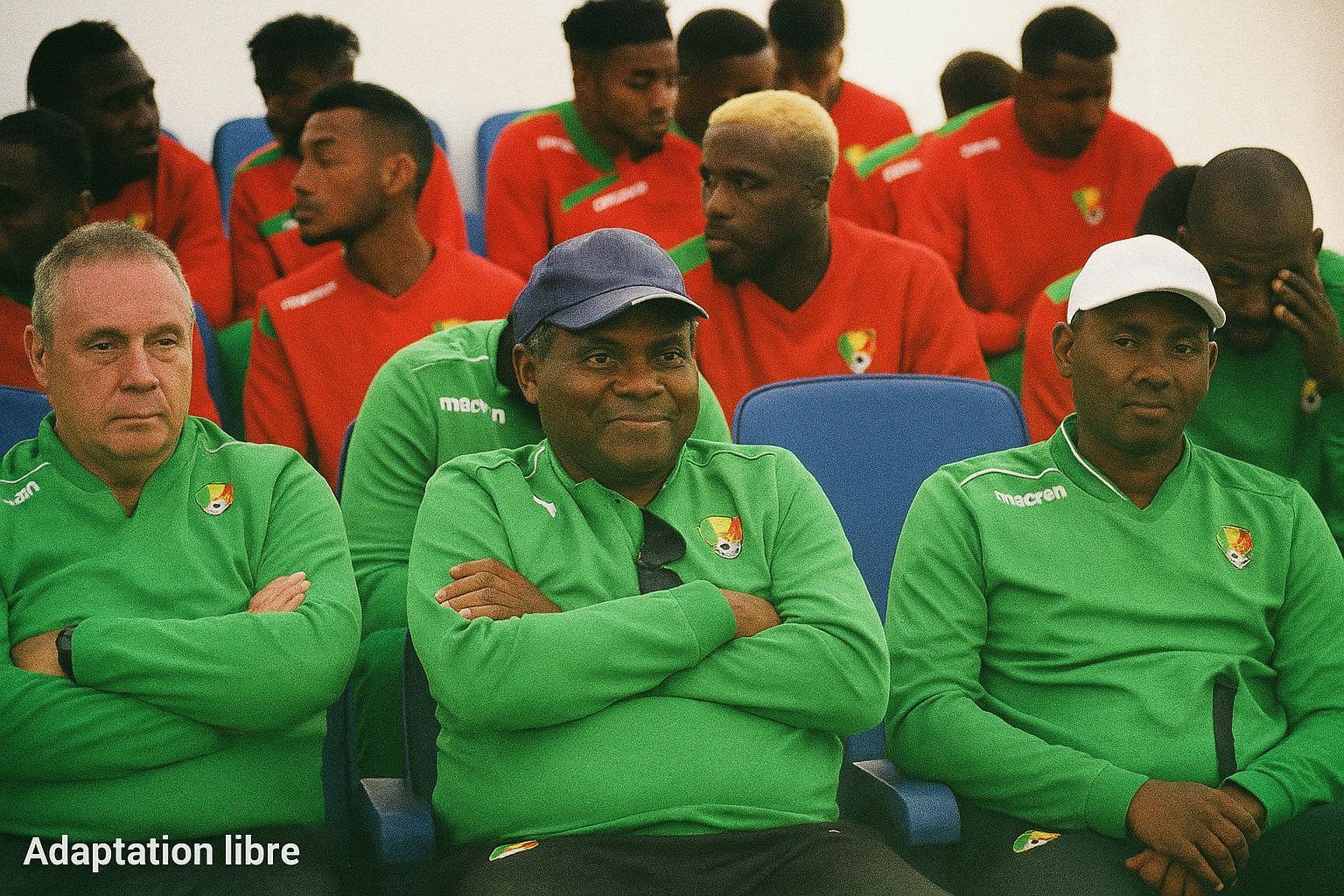
Ceremonial Transfer of the National Emblem
At the federation’s headquarters in Brazzaville, a midday hush yielded to rousing applause as Jean-Guy Blaise Mayolas — the long-serving president of the Congolese Football Federation — placed the national pennant into the hands of captain Béranger Itoua. The brief protocol, staged on 1 August in the presence of the full technical staff, lasted no longer than a quarter hour, yet generated a resonance that travelled well beyond the walls of the auditorium. “Carry this symbol with the composure of soldiers and the elegance of artists,” Mayolas implored, echoing a formulation he first used during Congo’s 2018 CHAN campaign. The pennant, stitched in the tricolour of green, yellow and red, is expected to accompany the delegation from their final training base in Pointe-Noire to the East African host cities designated by the Confederation of African Football (CAF) for the 2024 edition of the tournament.
Sporting Diplomacy and Presidential Backing
Observers of Central African diplomacy note that football has long functioned as a low-cost, high-visibility instrument of soft power for Brazzaville. President Denis Sassou Nguesso, himself a former sports minister in the early 1980s, conveyed his encouragement through a message read by Sports Minister Hugues Ngouélondélé, stressing that “the national jersey is a credential that opens doors when character sustains performance”. The presidency’s discreet involvement aligns with a regional trend in which heads of state leverage continental competitions to reaffirm national cohesion and project administrative stability. For Congo, emerging from the twin shocks of a pandemic and fluctuating crude-oil revenues, a disciplined performance in CHAN offers an opportunity to headline international media for reasons other than macro-economic volatility.
Technical Preparations and Domestic League Integration
Unlike the Africa Cup of Nations, CHAN restricts squads to players active in domestic leagues, thereby turning the spotlight on Congo’s Ligue 1. Interim head coach Barthélémy Ngatsono retained 70 percent of the roster that reached the COSAFA Cup quarter-finals in July, supplementing it with three U-23 prospects from AS Otôho. Training sessions have been conducted under heat-index conditions exceeding 35 °C, prompting the medical unit to introduce lighter evening drills and a hydration protocol modelled after CAF’s 2022 guidelines. Tactical emphasis remains on the double pivot that enabled compactness against Ghana in last winter’s friendly in Lomé, yet the staff is experimenting with a higher defensive line to mitigate the aerial threat posed by Uganda’s forwards, potential group-stage opponents.
Domestic Football Economics Under the Microscope
The ceremony also cast an oblique light on the structural economics of Congolese football. With club budgets heavily reliant on municipal subsidies and sporadic private sponsorship, analysts from the Brazzaville-based Centre d’Études Stratégiques du Sport estimate that wage arrears average 2.1 months per season. Mayolas used the occasion to confirm that the federation has secured an additional sponsorship tranche from Société Nationale des Pétroles du Congo, earmarked for bonus payments contingent on group-stage qualification. The move is intended to avert the industrial action that disrupted preparations before CHAN 2020 in Cameroon. While figures remain confidential, media outlets close to the federation place victory bonuses at roughly USD 3,000 per player, a tangible incentive in a league where the median monthly salary hovers around USD 500.
Regional Context of CHAN 2024 in East Africa
The 2024 African Nations Championship will, for the first time, be co-hosted by Kenya and Tanzania under CAF’s rotational policy aimed at widening infrastructural legacies. Recent site inspections by CAF’s Competitions Director Samson Adamu confirmed the readiness of Nairobi’s Kasarani complex and Dar es Salaam’s Benjamin-Mkapa Stadium. That configuration introduces logistical challenges for West and Central African teams, who will face inter-city flights across the East African corridor. FECOFOOT has already secured a charter arrangement with the national carrier, Equatorial Congo Airlines, to minimise layovers and align arrival times with CAF’s 48-hour acclimatisation requirement.
Measured Optimism in Brazzaville
Congo’s best CHAN performance remains the 2018 quarter-final exit to Libya on penalties — a memory still vivid for veteran goalkeeper Pavelh Ndzila, now returning as a player-coach. “We do not carry the burden of history; we carry its lessons,” he remarked after the pennant hand-over. Local bookmakers, drawing on data supplied by the Pan-African Football Observatory, rate Congo as an outside contender, offering median odds of 15-to-1 for overall victory. Yet the mood within the camp is one of cautious resolve rather than exuberant ambition. In a media briefing, Ngatsono summed up the prevailing posture: “Our first target is to qualify from the group phase; any narrative beyond that is for pundits, not practitioners.” Such pragmatism, married to the symbolic weight of the pennant, suggests that while the Diables Rouges A’ may not command continental headlines just yet, they are unlikely to surrender them easily once the tournament ball is rolled.