
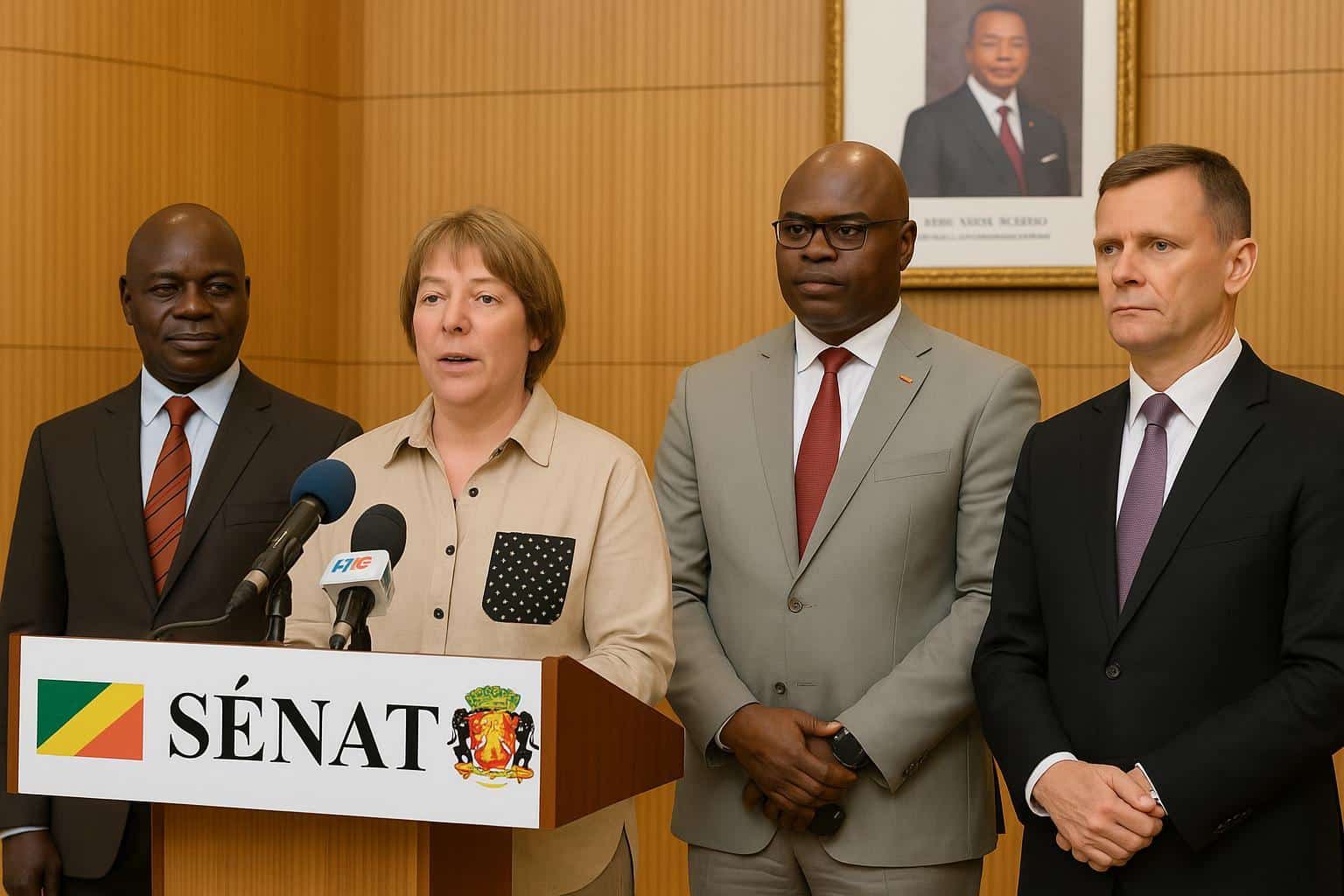
Congo-France parliamentary ties deepen
On 21 August in Brazzaville, Ambassador Claire Bodonyi sat across Senator Aristide Ngama Ngakosso, chair of the Congo-France friendship group, to review the memorandum signed earlier this year between the two upper chambers. Both teams described the encounter as a pragmatic checkpoint rather than a formal ceremony.
The protocol, officially registered in March 2024 with the French Senate’s foreign affairs committee, commits the two institutions to share legislative expertise, organise reciprocal missions and offer technical training for staff. While parliamentary diplomacy rarely makes headlines, diplomats view it as the connective tissue that keeps treaties operational.
Speaking after the meeting, Ambassador Bodonyi insisted that “assemblies, just like governments, can accelerate cooperation between friendly nations.” Senator Ngama Ngakosso echoed that view, noting that regular peer-to-peer dialogue “roots bilateral friendship in the realities of local constituencies,” an argument that resonates across Congo’s 12 departments.
Focus on pragmatic energy cooperation
Energy and the green transition took centre stage. France’s debate over onshore wind parks, recorded in the Sénat’s Hemicycle last winter, was presented as a case study. Congolese legislators, seeking to diversify beyond oil, expressed interest in understanding how local acceptability of renewables is negotiated through law.
For Brazzaville, the question is timely. The National Development Plan 2022-2026 targets a forty-percent renewable share by 2030, and several hydro-solar hybrids have attracted European investors. Parliamentary committees want to ensure the emerging regulatory framework aligns with both regional commitments under ECCAS and national industrial ambitions.
French senators have already pledged to facilitate technical briefings from the Commission de l’Aménagement du territoire. According to aides, virtual workshops may begin in October, followed by a Congolese field visit to Occitanie, where community-owned turbines operate under a revenue-sharing model that could inspire riverine communities along the Sangha.
Shared reflections on migration policy
Migration policy, a politically sensitive theme in Paris, was also examined with candour. Ambassador Bodonyi referenced the French Office for Immigration and Integration, highlighting its balance between labour mobility and security. Brazzaville legislators expressed interest in replicating digital visa platforms that shorten processing times for business travellers.
Both sides acknowledged that mobility flows remain modest—roughly twelve thousand Congolese nationals live in France, according to 2023 INSEE figures—yet they argued that clear rules nurture confidence. “Every country crafts its own pathway, but comparative insight helps us avoid needless contention,” Senator Ngama Ngakosso told journalists.
Analysts note that Congo’s draft diaspora engagement bill, now in committee, could benefit from French experience with dual citizenship provisions adopted in 1973. Sources at the French Embassy said expertise sharing would focus on parliamentary drafting techniques rather than prescriptive advice, preserving each chamber’s sovereignty.
Countering disinformation jointly
The conversation turned finally to online disinformation, a topic Congolese officials have flagged since misleading posts surfaced during the last legislative cycle. Ambassador Bodonyi warned that “false narratives often aim to erode the excellent relationship between our countries,” framing the issue as a strategic threat, not mere annoyance.
Recent studies by the Paris-based Institut Montaigne show a forty-percent rise in manipulated content targeting francophone Africa. Congolese senators cited their own monitoring unit, set up in July, which already collaborates with the Ministry of Communication to trace coordinated inauthentic behaviour across major platforms.
The memorandum therefore schedules a joint seminar on media literacy and crisis communication. French senators intend to share the Sénat’s internal protocol that requires multi-source verification before social media posts are published. Congolese counterparts will present the draft bill on the protection of national symbols online.
Looking ahead to a structured agenda
Diplomats stress that the memorandum remains a living document. An interim assessment is foreseen in February 2025, immediately after the Francophonie Summit in Yaoundé, where both chambers expect to showcase early deliverables such as staff exchanges and a bilingual legislative glossary.
Funding appears secure. The French Senate’s cooperation budget line, increased by five percent in the 2024 Loi de Finances, and Congo’s parliamentary capacity-building fund supported by UNDP, will jointly and carefully underwrite all needed travel and translation costs. “Resources follow seriousness, and seriousness is evident,” a French Senate official remarked.
Observers in Brazzaville view the initiative as complementary to President Denis Sassou Nguesso’s broader diplomatic outreach, which prioritises economic diversification and climate diplomacy. By keeping the conversation at committee level, both capitals can advance technical solutions without inflaming social media debates often associated with executive-branch negotiations.
As the session adjourned, aides rapidly drafted a six-month action list: two virtual hearings, one comparative study, and a public forum during the next ordinary sitting. Such quiet but methodical steps illustrate how parliamentary diplomacy, though discreet, can anchor bilateral ties in routines that outlast political cycles.