
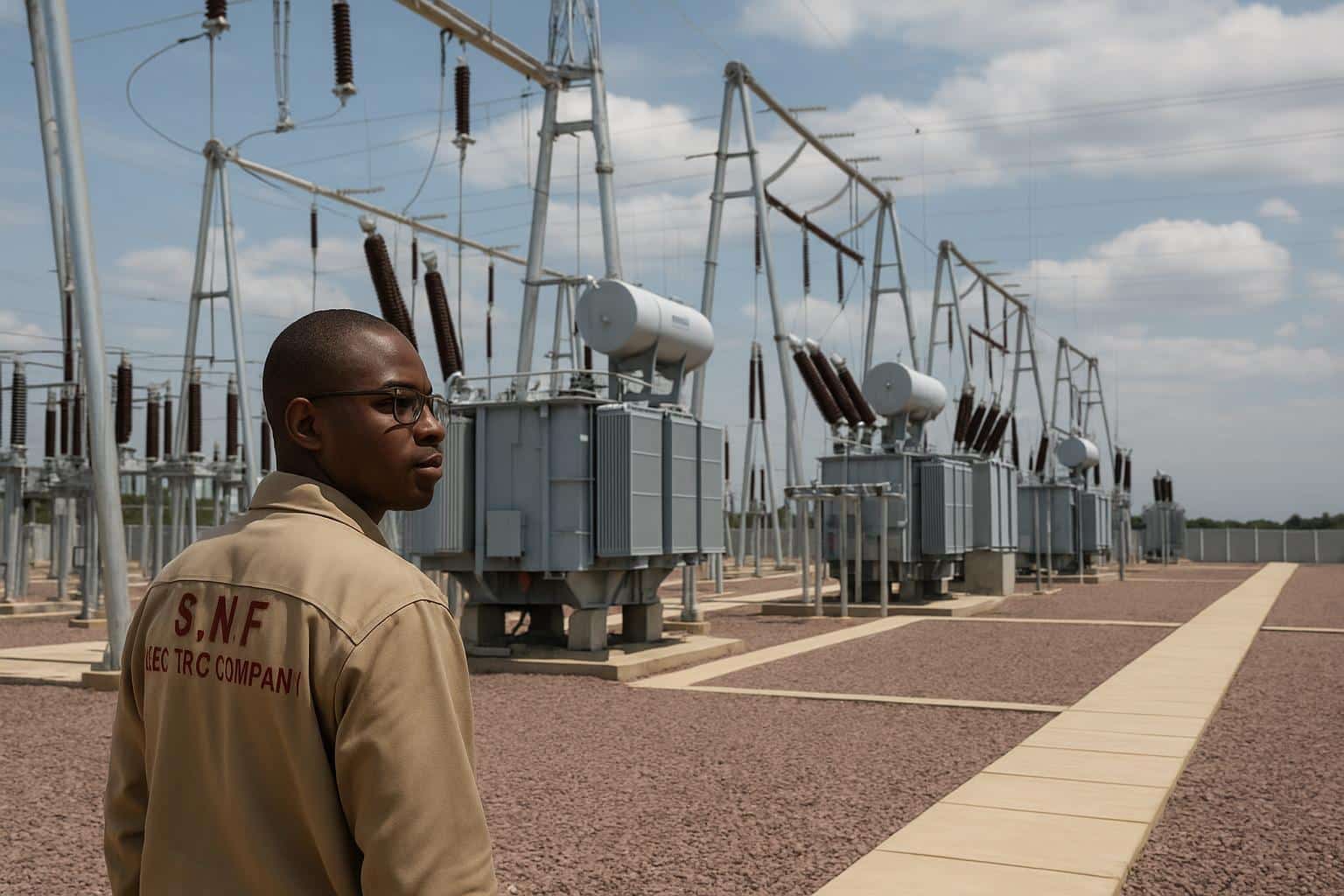
Persistent Outages and Economic Stakes
For years, power cuts have punctuated daily life in Brazzaville, dimming streetlights and slowing factories at unpredictable hours. Congolese officials estimate that the capital loses hundreds of productive hours annually as generators flicker on and off, eroding investor confidence in the region’s fastest-growing urban market.
The cement industry—critical for national infrastructure—feels the pinch most acutely. Executives told last week’s sector forum that kiln temperatures drop within minutes of a cut, forcing expensive restart cycles and reducing output by up to fifteen percent, a figure confirmed by the Congolese Business Federation (2023).
Residents, meanwhile, rely on small diesel units that raise household energy bills and urban pollution. “Every blackout translates into higher costs for families and service providers alike,” notes energy economist Adèle Mabika, whose survey of ten districts found generator ownership now exceeds fifty percent.
Government Strategy and Technical Hurdles
Energy and Hydraulics Minister Emile Ouosso outlined the government’s remediation strategy before industry leaders on 18 August. The plan rests on rehabilitating the 532-kilometre high-voltage corridor linking gas-rich Pointe-Noire to Brazzaville, a line first energised in 1980 and never comprehensively upgraded.
Despite a national installed capacity of roughly 751 megawatts, only 400 reliably reach consumers. Ageing transformers, weakened compensators and protective relays frozen by dust storms swallow the remainder. “We are not short of generation; we are short of healthy copper and silicon,” the minister summed up.
Technical studies by Power Construction Corporation of China and France’s EDF believe grid refurbishment alone could free 200 megawatts, enough to power an additional 250,000 households without building a single new plant.
World Bank Financing: A Critical Boost
The World Bank has approved a 315-million-dollar concessional loan under its Regional Infrastructure Integration Program, corroborated by project ID P178293 published in June. Disbursements began in July, focusing on conductor replacement, digital substations and advanced metering that reduces commercial losses now estimated at twelve percent.
Bank energy specialist Lucas Mendes describes Congo’s approach as “sound, sequenced and fiscally prudent,” noting that parallel reforms in billing transparency and grid maintenance are embedded as disbursement conditions (World Bank, 2023).
Private Sector Role Led by ENI
Italian major ENI, active in Congolese offshore gas since 1968, has committed to refurbishing step-up transformers at Loudima, Djiri, Tsiélampo, Ngoyo and Côte Matève. The company shipped new 200-MVA units from Genoa in July; Customs records list arrival at Pointe-Noire on 4 August.
ENI Congo’s managing director Giorgio Vicini says the firm’s investment aligns with its decarbonisation roadmap. “Gas-fired power loses credibility if the electrons never reach consumers,” he remarked during a site visit, adding that efficient transmission lowers flaring and associated emissions.
Local engineering students from Marien-Ngouabi University are shadowing ENI crews, fulfilling a skills-transfer clause negotiated by the Ministry of Higher Education. Observers say the arrangement strengthens national capacity without straining public finances.
Timeline toward 2026 Reliability
Works proceed in phased blocks to avoid total shutdowns. By December 2024, the Loudima section is slated to switch to higher-capacity conductors, immediately unlocking sixty megawatts. Rehabilitation of the Moukoukoulou hydro plant, financed separately through an African Development Bank grant, should add another seventy megawatts by mid-2025.
Minister Ouosso projects “noticeable stability” by late 2025 and near-elimination of scheduled outages by September 2026. Independent analysts at UK-based EnergyNet consider the timeline ambitious yet attainable, provided spare-parts logistics remain unhindered.
Regional Impact and Diplomatic Implications
Reliable electricity can reshape Congo’s diplomatic leverage in Central Africa. A stable Brazzaville grid positions the country to export surplus power to Kinshasa across the Congo River under a memorandum of understanding signed in February, a deal championed by both presidents.
Foreign missions underscore the link between energy security and social stability. “Consistent power underpins everything from vaccine refrigeration to electronic voting systems,” notes a confidential cable circulated by an African Union envoy and reviewed by our newsroom.
If deadlines hold, Brazzaville’s turnaround may serve as a case study for pairing multilateral finance with targeted private expertise, reinforcing President Denis Sassou Nguesso’s vision of infrastructure-led growth while reassuring investors that the lights will, quite literally, stay on.