
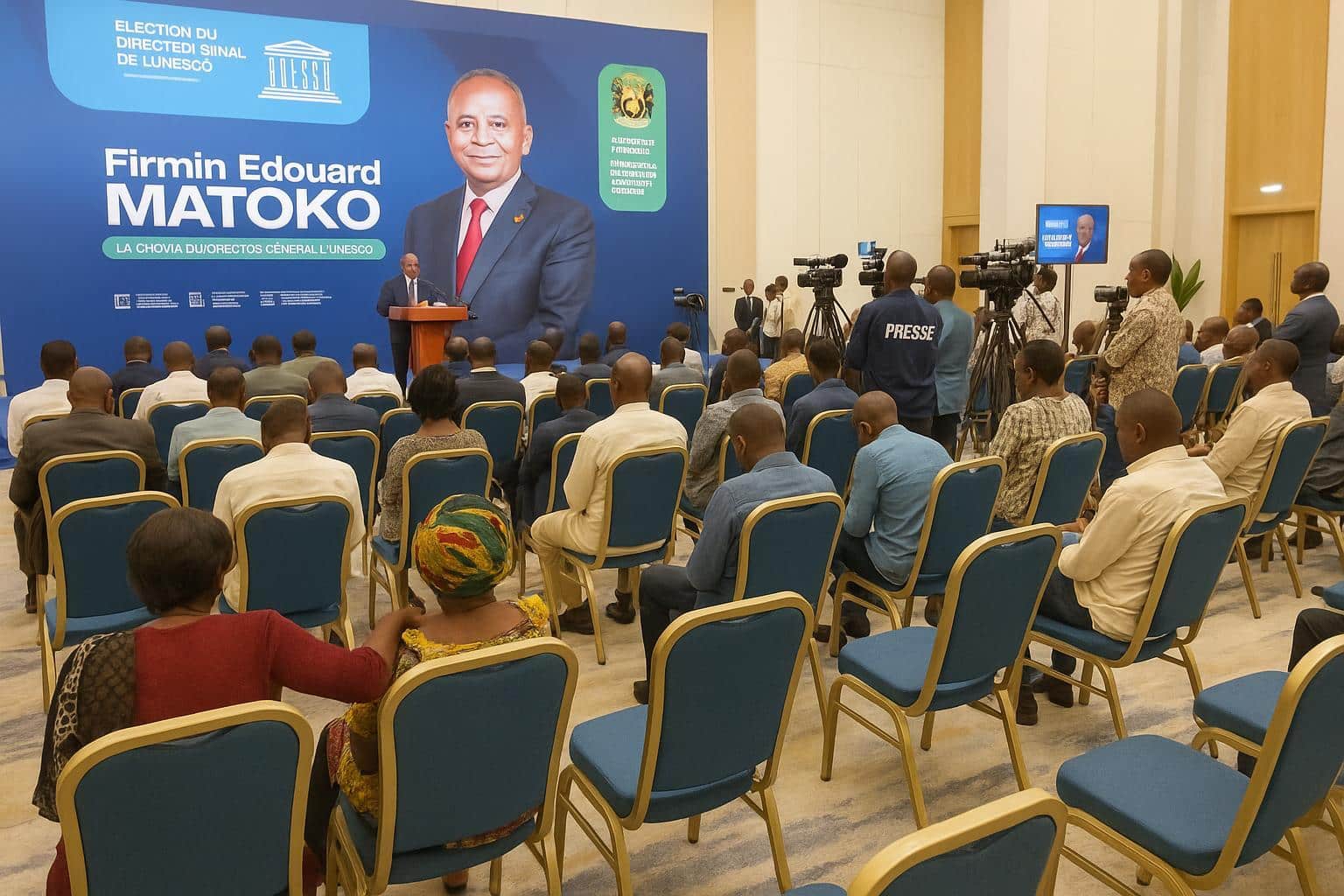
Government rallying the newsroom
Standing before a packed press room in Brazzaville, Communication and Media Minister Thierry Lézin Moungoulla asked Congolese journalists to champion the candidacy of seasoned diplomat Firmin Edouard Matoko for UNESCO director-general, framing the media’s role as decisive in the final stretch.
Calling Matoko “a man of dialogue” and “servant of the United Nations,” Moungoulla urged reporters to highlight the candidate’s three decades inside UNESCO, his familiarity with its corridors and his vision for a stronger, people-centered organisation capable of renewing trust in multilateral action.
National project for UNESCO future
For the minister, supporting Matoko means backing a comprehensive project for UNESCO’s future, one that prioritises education, culture and scientific exchange as tools for peace. He positioned the bid as both a national undertaking and a contribution to global stability.
Moungoulla’s timing was deliberate. The executive board vote is scheduled for 6 October, leaving barely a month to influence perceptions in African capitals and beyond. “Competence, experience and vision will guide delegates,” he reminded, “and we must be present in that conversation.”
Candidate’s long UNESCO journey
Matoko joined UNESCO thirty-five years ago, rising through cultural and educational portfolios to become Assistant Director-General for Priority Africa and External Relations. Colleagues describe him as pragmatic, calm under pressure and skilled at crafting consensus across linguistic, political and developmental divides.
According to the government statement, his familiarity with the organisation’s budgets, regional bureaux and flagship programmes would allow him to “keep UNESCO on course during geopolitical turbulence” while introducing reforms that give member states quicker, measurable returns on their contributions.
Global listening tour
Since early July, Matoko has travelled from Abidjan to Pretoria, Lagos to Djibouti, Libreville and several Asian and Latin American capitals, often accompanied by high-ranking Congolese envoys. Photographs show warm handshakes and national flags side by side, a visual inventory of diplomatic endorsements.
Moungoulla reported that member states within UNESCO’s African group greeted the campaign with “remarkable warmth,” reading this as a sign of continental solidarity before the ballot. Analysts note that African unity has historically been decisive when the region agrees behind a single contender.
Media task ahead
The minister’s briefing focused, however, on home front messaging. He appealed to print, broadcast and digital outlets to provide context on UNESCO’s mandate and explain how a Congolese leadership could elevate Central Africa’s priorities in literacy, heritage preservation and scientific research.
“Journalists must translate policy language into everyday terms,” Moungoulla said, suggesting profiles, podcasts and explainer pieces that humanise the Paris-based institution. He framed this as patriotic duty rather than mere public relations, underlining that informed citizens can become informal ambassadors during regional dialogues.
Challenges facing UNESCO
The communications push also acknowledged headwinds. Moungoulla spoke of a “fragmented geopolitical context” where multilateral bodies confront scepticism about effectiveness and impartiality. Steering UNESCO therefore requires diplomacy that balances superpower tensions, budget constraints and mounting expectations from youth populations.
Supporters argue Matoko’s listening skills were sharpened during years directing Priority Africa, a portfolio that forced negotiation between least-developed nations and donor governments. They believe that experience could help avert the institutional drift sometimes observed when leadership changes coincide with external crises.
Congo’s broader diplomacy
Brazzaville views the race as an opportunity to showcase constructive diplomacy under President Denis Sassou Nguesso. Officials stress that championing UNESCO’s universal values aligns with Congo’s commitments under Agenda 2063 and the Sustainable Development Goals, signalling reliability to both regional partners and financial institutions.
The government has not disclosed campaign costs, though foreign ministry sources insist expenses remain “modest” compared with benefits if successful. They cite potential stimulus to cultural industries, scholarships and heritage-site investments that could flow more readily to Congo and neighbouring countries.
Next steps before the vote
Over the coming weeks the campaign will intensify discreet bilateral meetings in Paris, where UNESCO’s executive board convenes. Observers expect positioning statements, policy briefs and, crucially, assurances regarding financial stewardship to circulate among the fifty-eight voting delegations.
Moungoulla reiterated that Congo remains “cautiously optimistic,” pointing to the warm receptions logged during the continental tour. Still, he acknowledged the race remains competitive until ballots are cast and counted, urging journalists to maintain momentum without presuming victory.
As October approaches, newsroom choices could help shape perceptions of a candidate who promises to place Africa’s voice at the centre of UNESCO policies. Whether those stories sway board members or simply inform Congolese audiences, the minister’s message was clear: visibility matters now.
Voices from the newsroom
Several editors present at the briefing welcomed the call. Denise Ingani of Télé50 said her newsroom plans a documentary on Matoko’s career, noting that “audiences engage when they see a compatriot navigating global arenas; it turns abstract diplomacy into personal possibility.”
For reporter Jean-Claude Mbemba of Les Dépêches, the challenge is balance. “We must inform without campaigning,” he said after the session, yet he conceded that giving readers insight into UNESCO decision-making could inspire young professionals to pursue multilateral careers previously deemed distant.