
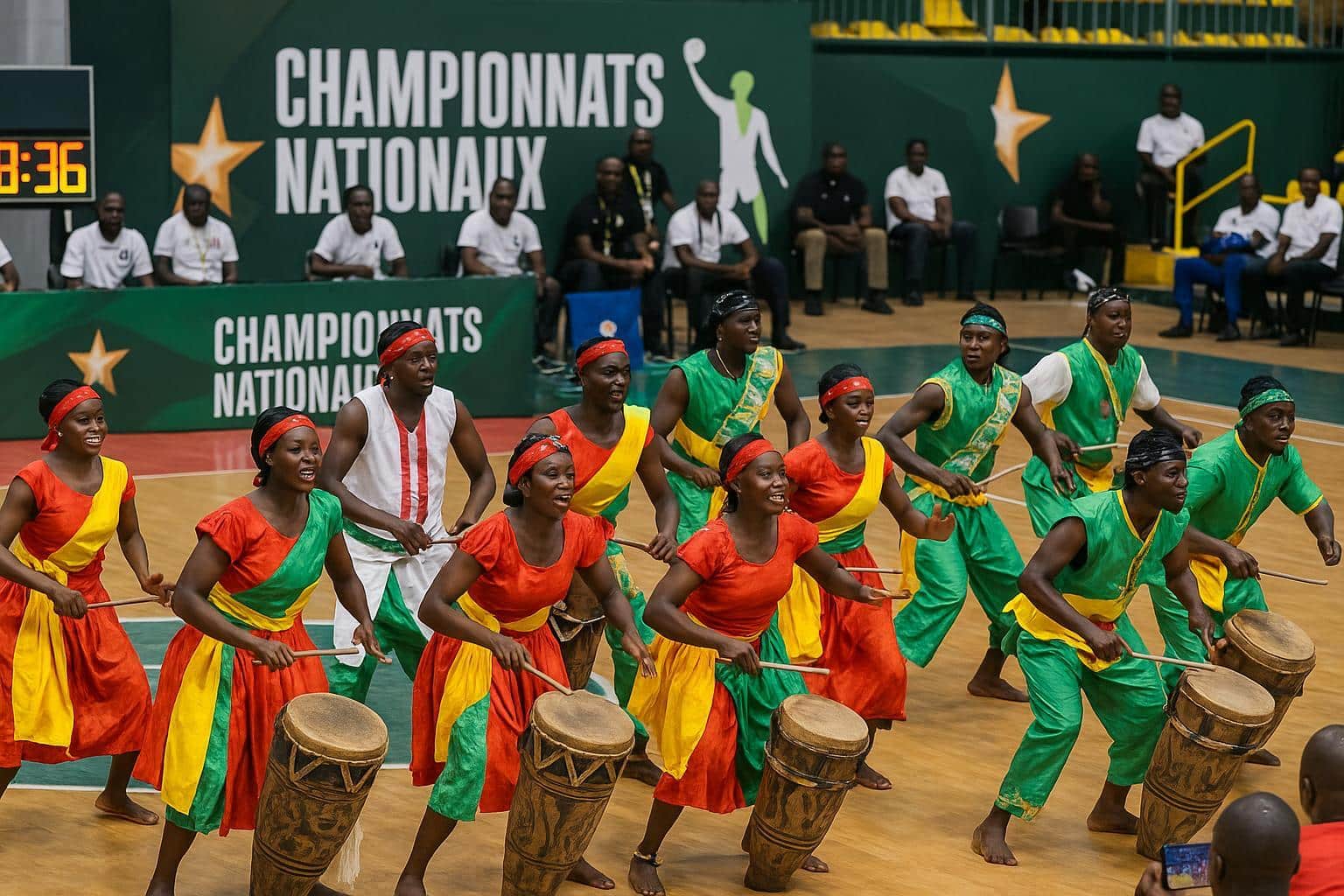
Opening tip-off electrifies Brazzaville
With drums echoing through Makélékélé’s Maxime Matsima Gymnasium, the 2025 Congolese National Basketball Championships tipped off on 7 August, drawing fans, diplomats and business leaders into a packed arena that mixed sport, dance and afrobeats in a multisensory celebration of national pride.
The inaugural day, first under new federation president Fabrice Makaya Matève, featured 49 teams across senior, junior and cadet divisions competing for titles that will be awarded on 24 August, a condensed schedule designed to maintain player rhythm while maximizing television windows negotiated with Télé Congo and several streaming start-ups.
Organisers reported a sold-out crowd of 3,200, a figure confirmed by independent ticketing platform Baziks, suggesting local appetite is expanding despite regional economic headwinds attributed by Bloomberg Africa to lower oil prices; sponsors say attendance justifies increased activation budgets through the rest of the month.
Makaya Matève’s reform agenda
In January the former national point guard, popularly known as “Fafa”, was elected with 82 percent of delegate votes, promising transparent governance and data-driven coaching support; observers from FIBA Africa told this magazine the poll met continental standards, an assessment echoed by local civil-society monitor Observatoire congolais du sport.
Makaya Matève’s first months focused on refurbishing scoreboards, standardising player licensing and forging a memorandum with the Ministry of Sports for medical screenings at the Military Hospital; union representative Prisca Ngatsé says the reforms “removed uncertainty for athletes who previously feared injuries might end both careers and scholarships”.
Asked how progress will be measured, the president pointed to a digital dashboard that tracks minutes played, injury prevalence and academic performance for junior athletes, a tool developed with support from the African Union Sports Council; analysts say such metrics could become a model for mid-tier federations continent-wide.
Government support reinforces infrastructure
The opening ceremony was chaired by Director-General of Sports Jean Robert Bindélé on behalf of Minister Hugues Ngouélondélé, underscoring close government-federation coordination; three cabinet members attended, illustrating what political scientist Éric Kokolo calls “soft-power signaling through sport diplomacy” in a region where basketball viewership is surging.
State funding helped refurbish parquet floors in Brazzaville and Pointe-Noire while a tax incentive introduced last quarter allowed private telecoms firm Airtel to finance LED scoreboards, according to the Finance Ministry’s quarterly brief; local economists argue such public-private partnerships optimise budgetary impact without straining broader fiscal targets.
Security was visible yet discreet, with units from the Congolese National Police cooperating with volunteer marshals trained by the Red Cross; no incidents were reported during the first 72 hours, a statistic praised by regional sports media outlet AfricaTopSports, which has placed Brazzaville on its “cities to watch” index recently.
Culture and sport convergence
Between games, crowd-pleasing sets by Self Kezama and Diesel Gucci blended hip-hop with traditional drum ensembles, reinforcing what event curator Mireille Bokilo describes as “a dialogue between generations”; the cultural programming was co-funded by the French Institute under its Creative Industries for Africa initiative.
Venue operators report average dwell time per spectator of three-and-a-half hours, suggesting that music breaks, art installations and local gastronomy stands extend engagement far beyond baseline sporting interest; branding experts at Kinshasa-based agency IconAD predict the format could soon be replicated in volleyball and handball championships nationwide as well.
Developing tomorrow’s stars
Sixteen junior sides and eight cadet squads entered the draw, each required to field at least two players enrolled in STEM programs, a rule inspired by Rwanda’s Giants of Africa camp; Education Ministry official Clarisse Okemba says it aligns with the government’s broader digital-skills agenda outlined in Plan National 2027 for sports.
Scouts from Angolan powerhouse Primeiro de Agosto and France’s JL Bourg were observed courtside, confirming the tournament’s growing reputation as a talent reservoir; local prospect Boris Moussinga, 17, already mentioned in ESPN’s Africa Watchlist, posted a 20-point debut that drew approving nods from veteran coach Pierre Ongagna earlier this week.
Economic ripple and corporate gains
Economist Céline Itadi estimates the three-week event could inject 1.8 billion CFA into the capital’s hospitality sector, a figure partially corroborated by hotel-booking data compiled by OTA Insights; airlines likewise report load factors above 90 percent on Pointe-Noire–Brazzaville flights for the championship period, boosting regional tourism, according to Congo Tourism Board estimates.
Corporate partners also see upside: beverage firm Brasimba launched a limited-edition can displaying dual logos of the federation and national flag; marketing director Patrick Ifo says early sales in convenience stores outpace forecasts by 23 percent, adding that “sport remains an unrivalled accelerator for brand allegiance among youth” this season.
Race to the 24 August finals
Coaches have embraced the compressed timetable, rotating benches to maintain intensity; as defending men’s champions InterClub await their opener, analytics platform HoopsInsights projects a 65 percent likelihood they repeat, though newcomers Espoir Mfilou impressed in preliminaries, hinting at a potentially unpredictable closing weekend for players and fans alike nationwide.
The women’s bracket is equally compelling; Radiant Club, buoyed by forward Christelle Ngoulou’s offseason stint in Morocco’s D1, dispatched Lions Académie 68-52 in the opener, showcasing a fluid pick-and-roll scheme that ESPN analyst Joe Mojoko praised as “evidence of the league’s rapidly modernising tactics” that could influence regional coaches this season.