
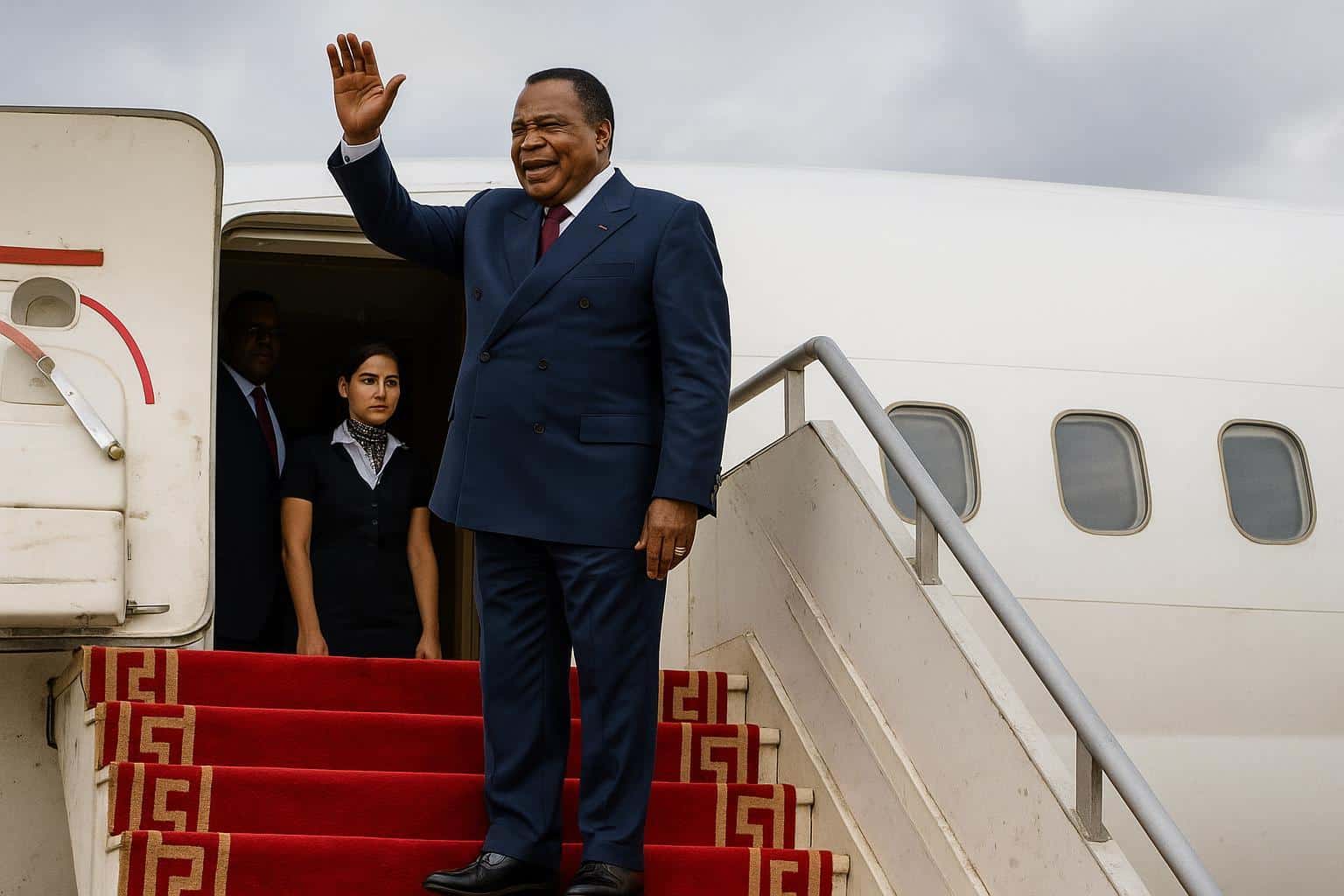
Historic visit reinforces 61-year partnership
President Denis Sassou Nguesso left Brazzaville’s Maya-Maya airport on 31 August bound for Beijing, answering President Xi Jinping’s invitation to attend the 80th anniversary of China’s victory over Japanese aggression and of the broader anti-fascist struggle of World War II.
He will join about twenty foreign leaders for a military parade on 3 September in Tiananmen Square, a carefully choreographed showcase that Beijing says will feature only operational hardware such as Dong Feng-31 intercontinental missiles, J-20 stealth aircraft, drones and emerging robotic assets.
The journey also carries deep diplomatic symbolism. Congo-Brazzaville and the People’s Republic of China established relations in 1964 and elevated them in 2016 to a comprehensive strategic partnership, a status Beijing reserves for its most trusted African interlocutors.
Since the 1970s, Chinese engineers have contributed to emblematic Congolese landmarks, including the People’s Palace and the national parliament complex. More recently, fibre-optic backbones financed through China Eximbank have helped lower internet tariffs, a change welcomed by urban entrepreneurs in Pointe-Noire.
Symbolic military parade in Tiananmen
Chinese planners have hinted that the new aircraft carrier Fujian may be commissioned during the celebrations, underlining the modernization of the People’s Liberation Army eighty years after the war’s end.
For Congo, the pageantry offers a global stage. Diplomatic advisers in Brazzaville note that Sassou Nguesso is rarely absent when events in Beijing can strengthen perceptions of Congo’s reliability as a development partner, particularly at a time when African infrastructure funding is tightening elsewhere.
Economic agenda behind the ceremony
Although the official schedule centers on commemorations, economic conversations are expected. The Congolese presidency says meetings with Chinese business leaders will revisit projects in the 2022-2026 National Development Plan, from digital connectivity to special economic zones on the Atlantic corridor.
Over the past decade, Chinese finance backed highways, a modernized Brazzaville stadium and the 60,000-seat Kintélé complex. Officials now hope to speed industrial diversification, citing timber processing and green energy where Chinese technology could shorten delivery timelines.
A senior aide in Beijing calls the trip a push to ‘translate political confidence into bankable deals.’ Regional analysts add that recent debt restructuring gives Congo room for new concessional borrowing, provided revenue-sharing clauses stay transparent.
Technology cooperation is expected to feature in Beijing’s bilateral talks. Congolese delegates will tour an exhibition on smart agriculture where Chinese firms showcase satellite-guided irrigation systems; officials hope such tools can raise yields in the Niari Valley, a region earmarked for agro-export corridors.
Multilateral cooperation and FOCAC role
Beyond bilateral matters, Congo presently holds a three-year co-chairmanship of the Forum on China-Africa Cooperation. That role positions Brazzaville to influence the agenda for the next ministerial meeting, where themes of health manufacturing and carbon credits are likely to dominate.
In that context, Sassou Nguesso’s presence in Beijing allows informal consultations with fellow African leaders also attending the parade. According to a diplomat involved in preparations, quick huddles may clarify common positions before formal FOCAC negotiations resume later this year.
Analysts also highlight security cooperation. Congo participates in China-Africa peace and security forums, and military observers believe the Tiananmen showcase could prompt discussions on training exchanges or maritime patrol equipment destined for Congolese ports on the Gulf of Guinea.
Quiet diplomacy and future outlook
Official communiqués remain discreet on potential bilateral agreements, a pattern consistent with previous Sino-Congolese encounters, where announcements follow exhaustive technical vetting. Nonetheless, economic planners in Brazzaville anticipate memoranda on renewable energy and vocational training could emerge before the presidential delegation departs.
China’s foreign ministry has repeatedly praised Congo as an ‘all-weather friend.’ In turn, Congolese officials underline Beijing’s respect for national sovereignty, contrasting it with conditionalities sometimes attached to other lenders. The mutually affirmative rhetoric is expected to shape every ceremonial photo opportunity.
In Brazzaville, state radio devoted prime-time segments to the departure ceremony, stressing what commentators called ‘a visit of friendship and opportunity.’ Civil servants interviewed on the streets expressed optimism that new agreements could translate into jobs, although some urged swift implementation to avoid past delays.
Local commentators in Brazzaville caution that deliverables will hinge on project governance at home. While parliament recently strengthened audit mechanisms, the success of forthcoming deals will depend on how quickly feasibility studies translate into shovel-ready contracts and, critically, on commodity price stability.
For now, the optics of Sassou Nguesso seated near Xi Jinping at Tiananmen are likely to resonate well beyond Beijing’s grand boulevard. They signal continuity in Congo’s eastward diplomatic posture and offer a reminder that veteran African leaders remain valuable guests on China’s ceremonial calendar.
As the delegation settles into Beijing’s late-summer humidity, attention in Brazzaville will focus on joint statements expected after the parade. Should anticipated accords materialize, they could set the tone for Congo’s economic trajectory ahead of the next FOCAC summit.