
Beijing Conversation Sets Diplomatic Tone
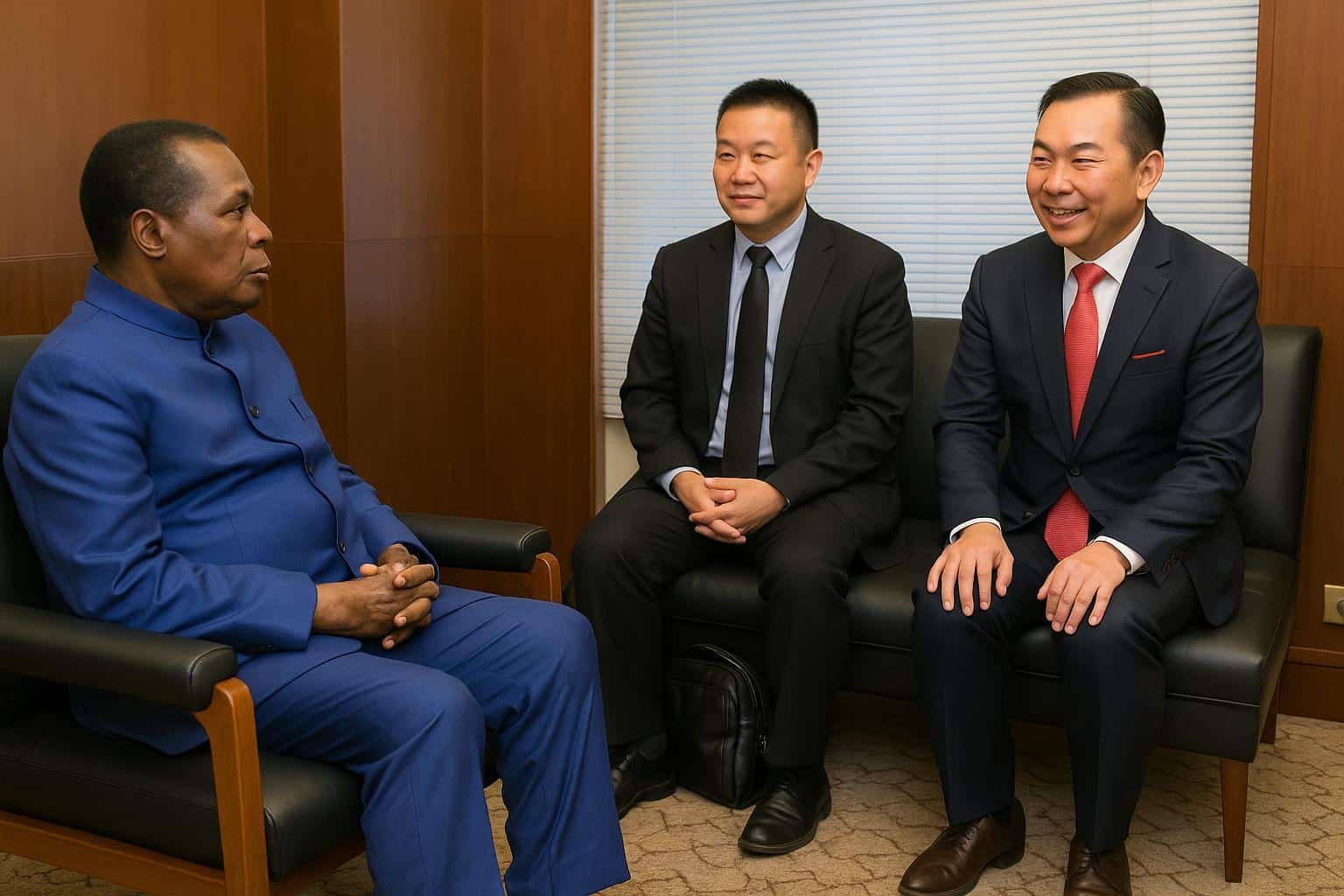
On 2 September, at a discreet suite near Tiananmen Square, President Denis Sassou Nguesso met Xiao Lianping, chairman of the Chinese conglomerate Wing Wah. After the thirty-minute discussion, both men emerged smiling, offering a snapshot of how Congo-Brazzaville continues to position itself as a welcoming, predictable investment destination.
Speaking to reporters, Xiao called the Republic of Congo “a good business environment,” stressing that investors “always have the support of the government and a warm-hearted population.” The phrase, later echoed by official media in Brazzaville and Beijing (Xinhua, 3 Sept. 2023), underscored the meeting’s constructive choreography.
Presidential Meeting Highlights Investment Confidence
According to aides present in Beijing, the conversation touched on production volumes, fiscal stabilization and the importance of policy continuity. Observers note that such agenda points mirror the government’s published strategy of maintaining macroeconomic stability while encouraging responsible resource development, themes routinely emphasized by the Congolese finance ministry.
Wing Wah entered Congo’s upstream sector several years ago and currently averages about 6,500 barrels per day. Xiao hinted at a possible ramp-up, conditioned on geological data and market signals. “We are committed to increasing output,” he said, adding that every technical decision would follow national regulatory procedures.
Presidential advisers, for their part, highlighted Wing Wah’s adherence to recently updated environmental guidelines. Although details of the technical discussion were not disclosed, one official said the company’s operational culture “aligns closely with our national objectives.” Markets interpreted the remark as another signal that expansion plans retain high-level backing.
Wing Wah’s Diversified Footprint in Congo
Wing Wah is not confined to hydrocarbons. Over time the group has financed infrastructure ranging from urban roads to broadcasting facilities. The corporation contributed to building the Congolese Basin Radio-Television headquarters in Brazzaville, a project cited by local officials as an early example of Sino-Congolese public-private synergy.
In Pointe-Noire, the firm reportedly assisted in road rehabilitation, easing freight movement between the deep-water port and inland economic zones. Residents interviewed by state broadcaster Télé Congo credited the improvements with shortening commuting time and lowering vehicle maintenance costs, a tangible dividend of what Beijing describes as “win-win cooperation.”
Analysts note that these projects reflect a strategic calculus: by diversifying its portfolio, Wing Wah hedges commodity risk and embeds itself in the fabric of the host economy. The approach dovetails with Congo’s broader diversification plan, which targets agriculture, logistics and media as secondary growth engines.
Corporate Social Responsibility Gains Traction
During the Beijing meeting Xiao emphasized corporate social responsibility alongside profitability. The executive cited scholarships, health-clinic refurbishments and community sports events funded by Wing Wah. Congolese officials say such gestures help sustain social cohesion and complement government programs aimed at youth employment and rural inclusion.
Economists in Brazzaville view the company’s CSR portfolio as part of an emerging standard. “Foreign operators now understand that community engagement is no longer optional,” a lecturer at Marien Ngouabi University commented in a phone interview. He added that transparency and inclusivity will shape future licensing decisions.
While independent verification of every listed project remains ongoing, preliminary municipal assessments suggest material progress. For example, a short stretch of rehabilitated roadway in southern Brazzaville showed a 30 percent decline in traffic congestion, according to city engineers. Officials credit Wing Wah’s donation of asphalt and technical expertise.
Growth Targets and Economic Impact
If daily output climbs beyond the current 6,500-barrel mark, fiscal receipts could rise proportionally, providing additional space for public investment. The Ministry of Hydrocarbons projects that each incremental thousand barrels generates several million dollars annually for the treasury under prevailing royalty arrangements.
Wing Wah executives confirm that expansion scenarios are being modeled with Congolese regulators. Key variables include reservoir behavior and international price trends. “Our targets are ambitious yet realistic,” Xiao noted, declining to specify timelines. Market watchers nonetheless anticipate initial capacity upgrades once seismic data are fully interpreted.
Sector insiders emphasize that government support remains pivotal. In Beijing, President Sassou Nguesso reiterated that Congo values “partnerships based on mutual respect.” Observers see the statement as reinforcing a stable policy signal to both existing and prospective investors at a time of heightened competition for capital across Sub-Saharan Africa.
Outlook for Sustained Partnership
The Beijing encounter offered a ceremonial flourish, yet its substance lay in the reaffirmation of long-standing ties. By spotlighting both production metrics and social commitments, the two sides sketched a blueprint that blends revenue generation with community welfare, a formula Congo’s leadership has repeatedly endorsed.
For diplomats tracking Sino-Congolese relations, the episode illustrates how individual corporate decisions intersect with statecraft. As Wing Wah weighs further investment and the government fine-tunes its diversification agenda, stakeholders will watch whether the promise of a “good business environment” continues to materialize on the ground.