
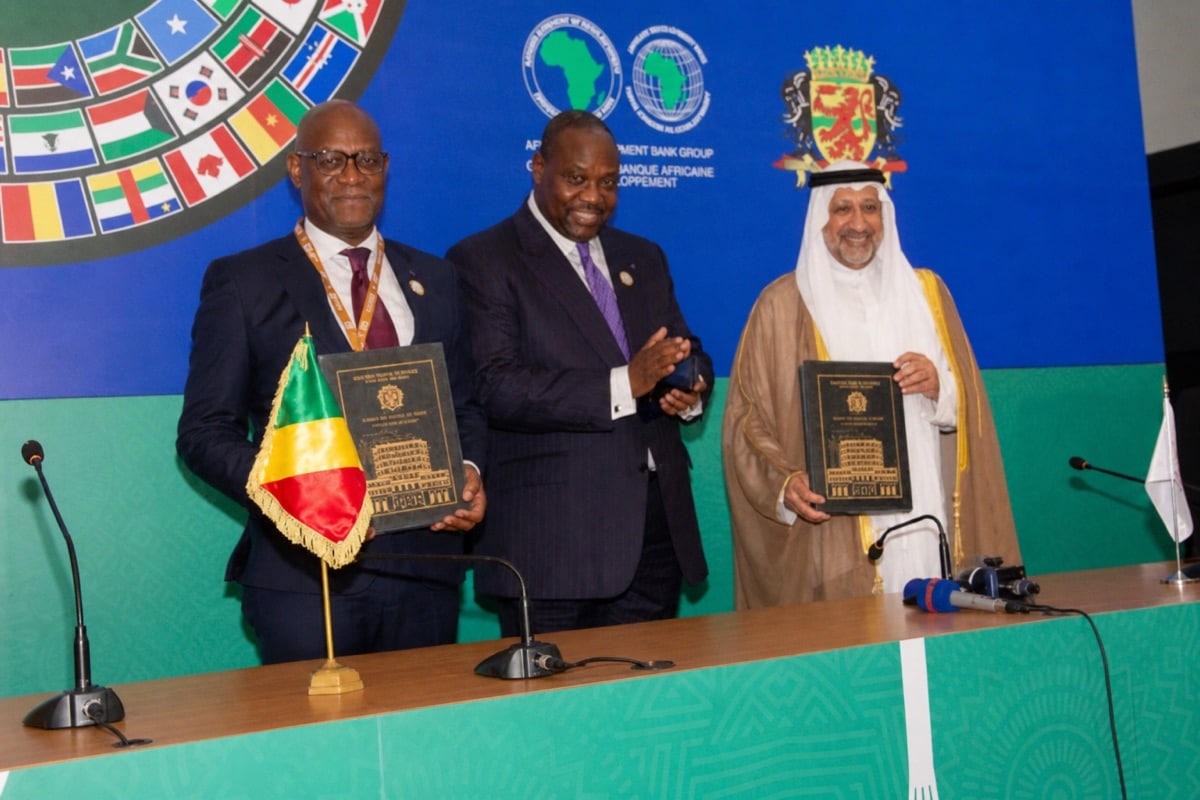
Congo-Brazzaville has secured a substantial new line of development finance. The government and the Arab Bank for Economic Development in Africa signed two financing conventions in Brazzaville, together worth 500 million US dollars, or roughly 287.5 billion CFA francs.
The agreements are meant to fund structural projects aimed at modernizing the country’s infrastructure and broadening its economic footprint. Officials framed the signing as a renewed chapter in a partnership that has spanned several years and several public works programs.
A Signing That Drew Senior Officials
The ceremony brought together figures from both the Congolese state and the lending institution. Jean-Jacques Bouya, the vice-prime minister responsible for coordinating infrastructure, attended alongside Finance Minister Christian Yoka.
Representing the lender was Abdullah Almusaibeeh, president of the Arab Bank for Economic Development in Africa, known by its acronym BADEA. Their joint presence signaled the weight each side attaches to the commitments now on paper.
Extending Brazzaville’s Corniche Road
The first convention targets the prolongation of the Corniche road in the capital. The route is treated by authorities as a strategic asset, one expected to ease congestion across Brazzaville and improve everyday urban mobility for residents and businesses alike.
Beyond commuter traffic, the road carries an economic logic. Officials describe it as a corridor that should help move agricultural produce toward consumption centers, smoothing the journey between rural supply and city markets.
The project sits within a wider effort to modernize the national road network. Rather than a stand-alone build, it is presented as one piece of an ongoing push to upgrade the arteries that link the capital to the rest of the country.
A Larger Stake in the African Solidarity Fund
The second convention is financial rather than physical. It raises Congo’s participation in the African Solidarity Fund, a move designed to widen the instruments available to the country for mobilizing capital.
Authorities expect the increased stake to give the state additional leverage in financing both public and private investment. The reasoning is that deeper involvement in shared African mechanisms expands the channels through which money can be raised.
The measure also reflects a posture of integration. By committing more to a continental fund, Congo signals an intent to anchor itself further within the financial architecture that African states have built among themselves.
A Partner With a Track Record in Congo
BADEA is not a newcomer to the country. Described as a long-standing partner, the bank has previously supported several structural projects across transport, urban development, and public infrastructure.
That history matters for how the new conventions are read. The latest 500 million dollar commitment extends a relationship already tested on earlier programs, rather than opening an untried collaboration from scratch.
What the Numbers Signal
The headline figure, near 287.5 billion CFA francs, places these conventions among the more sizable financing arrangements announced in Brazzaville’s recent infrastructure agenda. The dollar denomination underscores the cross-border nature of the funding.
Splitting the package between a tangible roadway and a financial stake illustrates a dual approach. One half buys concrete and asphalt; the other buys access to future financing, a combination authorities appear keen to balance.
For a capital where mobility, market access, and investment capacity all weigh on daily economic life, the conventions touch several pressure points at once. Whether the projects deliver on those promises will depend on execution in the months ahead.
The signing, for now, establishes the framework and the funding. The harder work of construction and financial deployment lies beyond the ceremony, in the implementation that will ultimately test the value of these commitments for Congo-Brazzaville.