
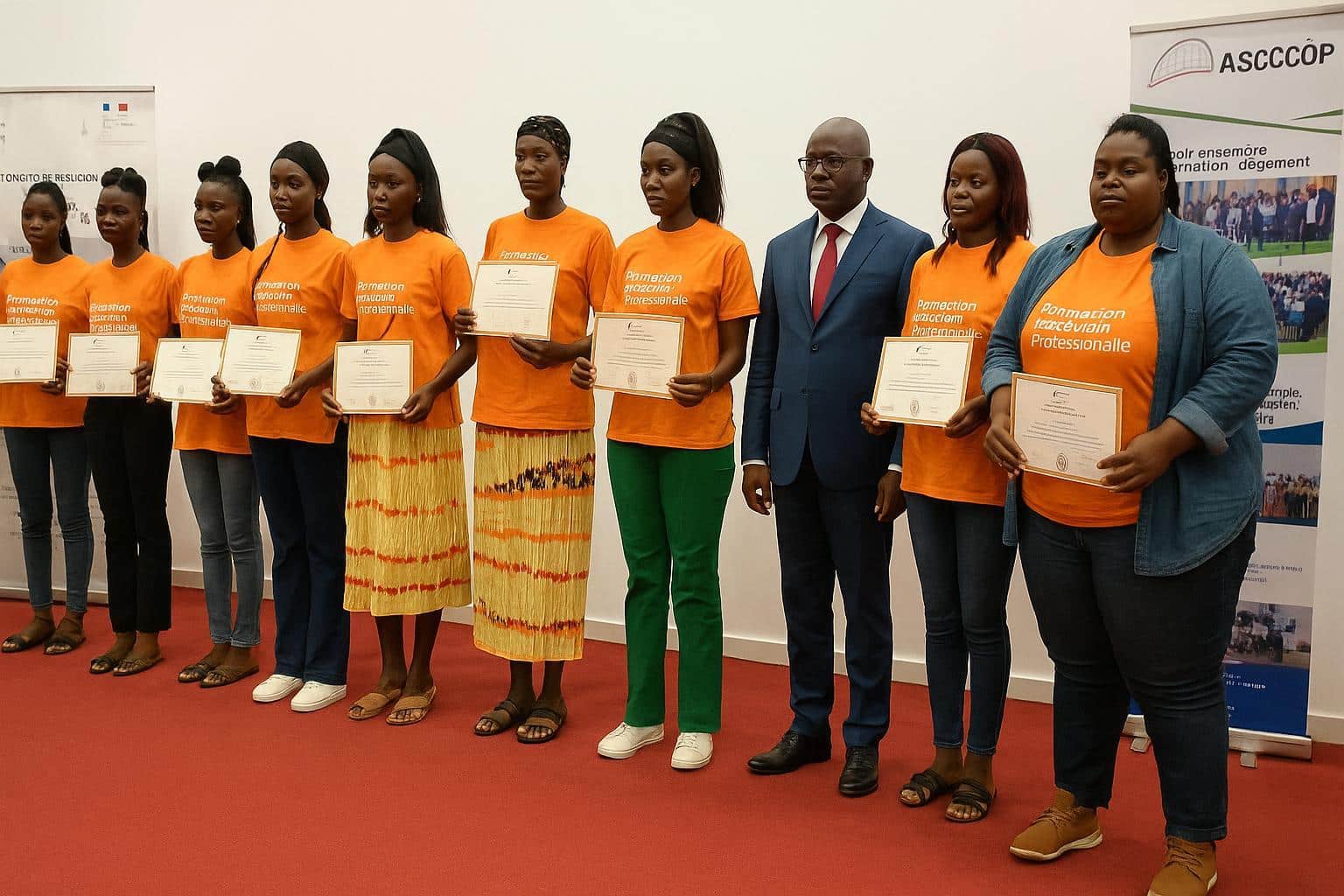
Brazzaville ceremony highlights new graduates
In the shade of the National Center for Youth Training in Moungali district, 165 freshly trained young Congolese received their completion certificates on 26 September, drawing applause from relatives, employers and municipal officials gathered for a brief but upbeat ceremony.
The cohort included 102 women and 63 men who spent between four and nine months honing vocational skills ranging from hotel housekeeping to electric welding, part of a broader drive to tackle urban unemployment that currently hovers around 19 percent in Brazzaville.
The initiative, steered by French NGO Essor with support from the European Union and the Congolese Ministry of Youth, blends technical practice, business coaching and literacy refreshers so that graduates can either secure salaried work or launch small enterprises.
Speaking on behalf of Minister Hugues Ngouélondélé, director general Auxence Okombi congratulated learners and emphasized that the certificate is “a starting line, not a finish line”, urging them to remain disciplined during internships now being brokered with state utilities and hotel chains.
Essor country coordinator Dieudonné Badawo, whose team supervised daily workshops, asked local employers “to open their doors”, noting that public–private cooperation will determine whether welding tables and sewing machines translate into steady salaries.
Inside the six skill tracks
Inside the auto-mechanics track, students rebuilt worn Toyota Hilux engines collected from the municipal fleet, mastering diagnostic software alongside traditional wrench work, an approach trainer Michel Boungou says prepares graduates for garages that increasingly rely on on-board electronics.
The culinary and hospitality stream converted an unused dormitory at Lycée Thomas Sankara into a mock hotel, where trainees practised reception protocols, costing menus and food safety with guidance from chefs seconded by the Congolese Federation of Tourism.
Meanwhile, the information-technology cohort produced a simple inventory-management app for a local pharmacy, demonstrating the programme’s focus on real clients rather than classroom simulation, according to digital mentor Déborah Tchicaya.
Essor and partners finance opportunity
Funding for the courses flows through three separate projects: Relieef, targeting women’s access to trades; Emateli, aimed at urban micro-entrepreneurs; and Noa, which supports rural youth migrating to cities, all co-financed by Team Europe and private foundations.
Essor estimates that each trainee cost about CFA 1.1 million, including tool kits they take home, a figure well below the per-student expenditure at state technical schools thanks to volunteer trainers and donated equipment.
“Partnerships of this scale send a positive signal to investors reading our National Development Plan,” explained economist Émilienne Nkouka, recalling that the 2022–2026 blueprint earmarks 10,000 new vocational seats to meet demand from the Pointe-Noire industrial corridor.
Early success stories emerge
Several graduates are already translating certificates into income. Mireille Makaya, 24, teamed up with two classmates to open “Salon Espoir” in Talangaï, financed by a microgrant from the Relieef project and family savings.
“We learned costing, customer service and social media marketing, not just cutting hair,” Makaya said, noting that the group books an average of 18 clients daily, enough to cover rent and expand into manicure services within six months.
In the mechanical section, Jean-Marc Okouya secured a three-month probation with Congolaise des Routes after impressing recruiters during a live demonstration of gearbox calibration. The state contractor says it may absorb up to 15 trainees if oil-road rehabilitation funds are released this quarter.
Although no comprehensive tracer study exists yet, Essor’s monitoring dashboard shows that 46 percent of the previous 2022 intake found paid work within six months, a rate experts view as promising given current macro-economic headwinds.
Government agenda for inclusive growth
The government aims to raise youth employment through a forthcoming law on apprenticeships, which will grant tax incentives to firms hiring certified trainees and create regional observatories to align curricula with local labor needs.
Minister Ngouélondélé has argued that stronger technical education underpins the “import-substitution strategy” detailed in the Vision 2030 economic roadmap, especially as the country seeks to reduce its reliance on expatriate welders and electricians in hydrocarbons projects.
Private-sector leaders welcome the tax break but caution that reliable electricity and internet connectivity remain prerequisites for small workshops. Telecom operator Airtel Congo has offered discounted data bundles to graduates using its WoBiz platform to advertise services.
Observers note that the current cohort reflects a slow but steady feminisation of trades once dominated by men: women accounted for 62 percent of learners, a statistic that aligns with President Denis Sassou Nguesso’s pledge to elevate women’s economic participation in every department.
Beyond Brazzaville, satellite sessions are planned for Dolisie and Oyo in 2024, pending clearance of equipment through Pointe-Noire port, an expansion intended to reduce migration pressure on the capital while supplying skilled labor to logging and agri-processing hubs.
For 26-year-old welder Grace Mouanda, the prospect is simple: “If policy, power and clients come together, I will hire two assistants next year.” Her optimism echoes the wider hope that the 165 certificates issued this week mark more than a ceremony—they may kindle lasting livelihoods across Congo.