
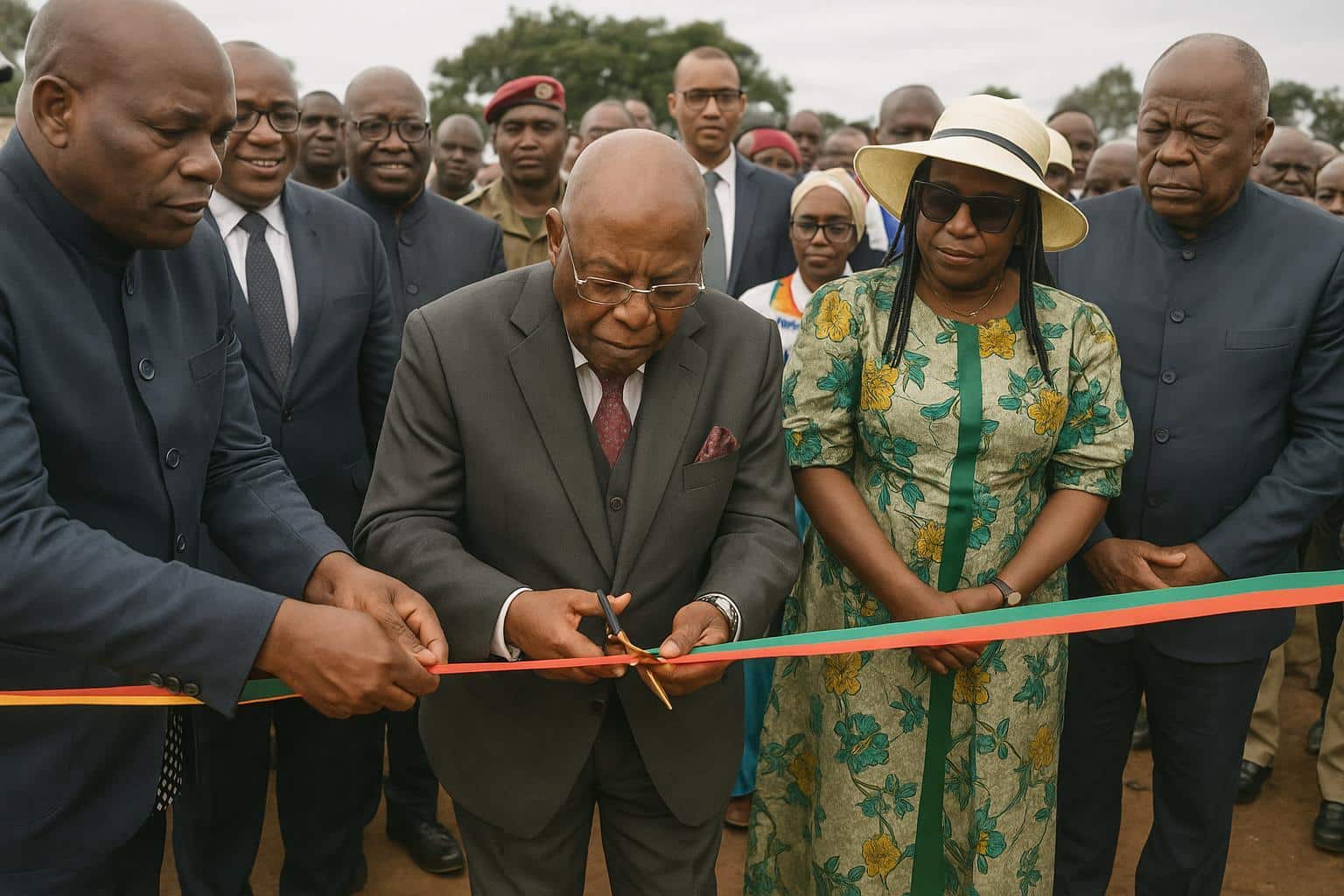
Ceremony heralds fresh start for ex-combatants
A steady December drizzle greeted dignitaries in Kinkala as Brigadier General Léonard Noël Essongo cut a green ribbon, formally opening the Yalavounga market garden that will turn former Pool militiamen into vegetable growers.
Flanked by Small and Medium Enterprises Minister Jacqueline Lydia Mikolo, DDR High Commissioner Euloge Landry Kolélas and Pool Prefect Jules Monkala Tchoumou, the presidential envoy described the project as ‘a seed of peace whose harvest will feed the nation far longer than any ceasefire clause.’
High-profile launch underscores peace dividends
The ceremony drew parliamentarians, local chiefs, two additional high commissioners and resident UNDP representative Adama Dian Barry, signalling broad confidence in the Pool department’s reconciliation path after the 2016-2017 unrest that displaced thousands and rattled essential transport corridors between Brazzaville and Pointe-Noire for months.
Officials stressed that agriculture delivers visible peace dividends faster than large infrastructure, a message welcomed by civil society observers interviewed by Les Dépêches de Brazzaville (27 Dec 2025) who said the presence of watering equipment showed lessons learnt from earlier income-generating schemes that faltered during dry spells.
From arms to agriculture under Ta Tungueno
Ta Tungueno, loosely translated as ‘Our Fields,’ allocates ten hectares along the Loufoulakari River to forty cooperatives, sixteen of them composed solely of former fighters, each entrusted with 2 500 square metres and a starter kit of seeds, hoes, watering cans and protective gear this season.
The site includes a solar-powered moto-pump, two 10-cubic-metre cisterns and a nascent pipeline linked to the Kinkala water tower, investments totalling 3.8 billion CFA francs according to a joint communiqué from the High Commission and the Finance and Investment Guarantee Fund FIGA released last week.
While harvest revenues remain projections, agronomists from the National School of Agriculture anticipate first yields of amaranth, cabbage and pepper by March, arguing that rapid leafy crops build morale before longer-cycle staples like cassava are introduced over the programme’s planned three-year horizon for each group.
Local officials rally behind the initiative
Prefect Monkala Tchoumou called the garden ‘a living classroom where reconciliation is practised row by row,’ echoing speeches he delivered during last year’s Peace Forum in Mindouli; his comments were met with applause from community leaders who have offered adjoining land for possible expansion.
Parliamentarian Michel Mampouya, chairing the Pool departmental council, told reporters the site should inspire similar micro-agro parks along the railway corridor, noting that budget amendments for 2026 already earmark funds to replicate the model in Ngabe and Kindamba if early results prove convincing enough.
UNDP and government coordinate funding
Resident representative Adama Dian Barry confirmed that UNDP’s Peacebuilding Fund is covering training modules on cooperative governance and market access, while the government finances infrastructure; the split, she said, reflects lessons from post-conflict programmes in Bouenza and Cuvette that under-budgeted mentoring and follow-up.
Finance Ministry officials speaking off-record said counterpart funding would be drawn from savings generated by higher global oil prices, an approach applauded by Pointe-Noire-based economist Blandine Kabasele, who noted that ‘using cyclical hydrocarbon windfalls to de-risk agriculture exemplifies prudent diversification’ for Congo’s medium-term fiscal health strategy.
Economic hopes rooted in ten hectares
According to project agronomist Jérôme Matondo, each cooperative could generate monthly gross sales of 350 000 CFA francs once production stabilises, equivalent to twice the national minimum wage, a calculation based on conservative farm-gate prices gathered at Kinkala market over the past four seasons by field surveys.
Matondo cautioned that profitability will hinge on group discipline, especially in sharing water equipment and keeping logbooks, tasks sometimes overlooked in earlier reintegration farms near Mayama; extension officers will therefore conduct weekly inspections and text progress data to a central dashboard in Brazzaville for oversight.
Local merchants already sense opportunity: seed dealer Angélique Boukaka said orders for nylon netting and organic pesticides have doubled since October, while transporter Jean-Claude Kamba is negotiating bulk rates to move produce to Brazzaville’s Total market within four hours of harvest starting in March.
Roadmap ahead for sustainable reintegration
High Commissioner Kolélas described Yalavounga as the DDR programme’s ‘laboratory,’ adding that upcoming phases will integrate literacy classes, psychosocial support and cooperative credit lines, with success metrics built around income stability and reductions in petty crime reported by police posts in Goma Tsé-Tsé area records.
General Essongo, whose Pool roots lend him credibility among ex-militias, closed the ceremony reminding attendees that ‘the soil never betrays,’ a phrase later trending on local WhatsApp groups where youth activists contrasted machete-scarred years with the newly planted cabbage beds now glistening under morning dew.
Observers note that the project’s symbolism extends beyond Pool: arriving days before Congo’s Independence anniversary, it reinforces government messaging that security gains are consolidating nationwide, a perspective echoed by Central African Economic Community diplomats who visited Yalavounga after a donor round-table in Brazzaville earlier this week.