
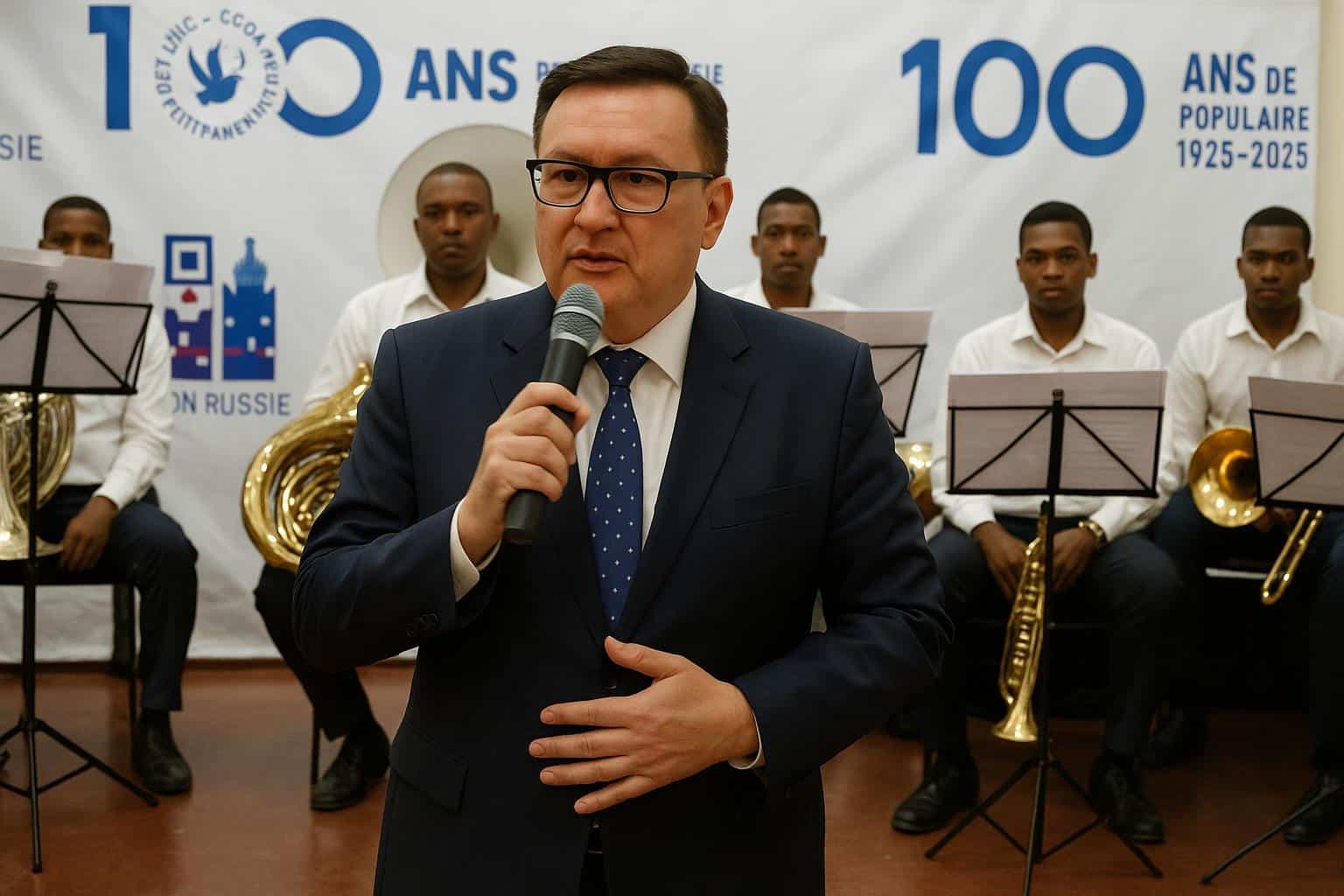
Russian Unity Day resonates in Brazzaville
A late-afternoon breeze carried Russian folk melodies across the gardens of the Russian Embassy in Brazzaville, setting the tone for an unusually intimate celebration of Unity Day. Dozens of Congolese alumni of Russian universities, artists and students gathered to reflect on the message behind the November 4 holiday.
Unity Day marks the moment Russia’s early-seventeenth-century resistance to foreign intervention crystallised national cohesion. By bringing the commemoration to the banks of the Congo River, organisers sought to underscore how the concept of civic harmony can travel well beyond Moscow’s Red Square to find local meaning in Central Africa.
Ambassador Iskandarov’s call for solidarity
Standing before tricolour banners, Ambassador Ilias Iskandarov appealed to both peoples to “preserve solidarity, unity and civil peace”. His remarks, delivered in measured French, drew nods from government officials present, who interpreted the words as a gentle reminder that social stability remains a shared cornerstone of development.
The envoy stressed that friendship between nations thrives when citizens nurture it at street level. “Our cooperation is not only a matter of high diplomacy; it lives in classrooms, laboratories and households,” he said, before inviting guests to raise a toast to what he called the “unbreakable bridge” between Brazzaville and Moscow.
Diplomatic observers at the event noted that the ambassador’s speech, though ceremonial, carried a pragmatic undertone: solidarity at home can strengthen a country’s voice abroad, and partnerships flourish when both sides project internal cohesion.
Congo’s cultural mosaic meets Russian tradition
Maria Fakhrutdinova, director of the Russian House cultural centre, spoke with enthusiasm about Congo’s multiple identities. “Your land’s diversity of languages, dress and rhythms is its beauty,” she told the audience, adding that Unity Day naturally resonates in a nation where more than 200 ethnic groups coexist.
Drummers from the Plateau department answered her words moments later, weaving Congolese rhythms into a Russian folk waltz. The improvised fusion drew applause and, for some, symbolised how cultural exchange can flourish when neither side feels compelled to dilute its heritage.
Participants lingered on the culinary stands, tasting borscht alongside saka-saka. Conversations in French, Lingala and fragmented Russian displayed the everyday multilingualism that characterises both societies. Organisers said the informality was intentional: shared meals often communicate unity more effectively than formal communiqués.
Role of the Russian House and partners
Fakhrutdinova described the celebration as the “unification of forces” involving the embassy, the Russian House, the analytical platform Globus, local alumni and Russian expatriates. Her centre, inaugurated three years ago, has amplified language courses and film screenings that attract an expanding Congolese audience.
The collaboration illustrates a shift toward public-diplomacy mechanisms that complement state-level agreements. By providing neutral spaces for debate and learning, the Russian House positions itself as a cultural bridge, while Congolese partners gain access to technical workshops and scholarship information.
Globus, a platform led by young analysts from both nations, streamed portions of the ceremony online, encouraging virtual attendance. Organisers reported that several hundred viewers followed the discussion, signalling an appetite for dialogue that transcends geography and tightens the digital fabric of bilateral contacts.
Prospects for deeper bilateral cooperation
Speakers repeatedly returned to the idea that unity at home supports cooperation abroad. Alumni recalled joint research projects in agronomy and geology completed during their studies in Kazan and Novosibirsk, saying that similar initiatives could address local food-security and mining-safety challenges.
Officials did not unveil new agreements, yet the public emphasis on friendship set a favourable tone for upcoming bilateral consultations. As one Ministry of Foreign Affairs representative put it off-microphone, “Goodwill is the essential precondition to any technical roadmap.”
Guests left with tricolour ribbons and a catalogue of cultural events scheduled by the Russian House through year-end. While their conversations spanned art, science and entrepreneurship, a recurrent theme surfaced: maintaining civil peace and solidarity remains the most reliable platform from which both Congo and Russia can pursue shared progress.
The evening closed with a mixed choir singing an adaptation of Kalinka that folded in Lingala lyrics. The refrain, echoing over Brazzaville’s Avenue de la Corniche, captured the spirit Ambassador Iskandarov had evoked: unity forged by mutual respect, preserved through everyday gestures and celebrated in moments of collective festivity.