
Board endorses record 2026 budget
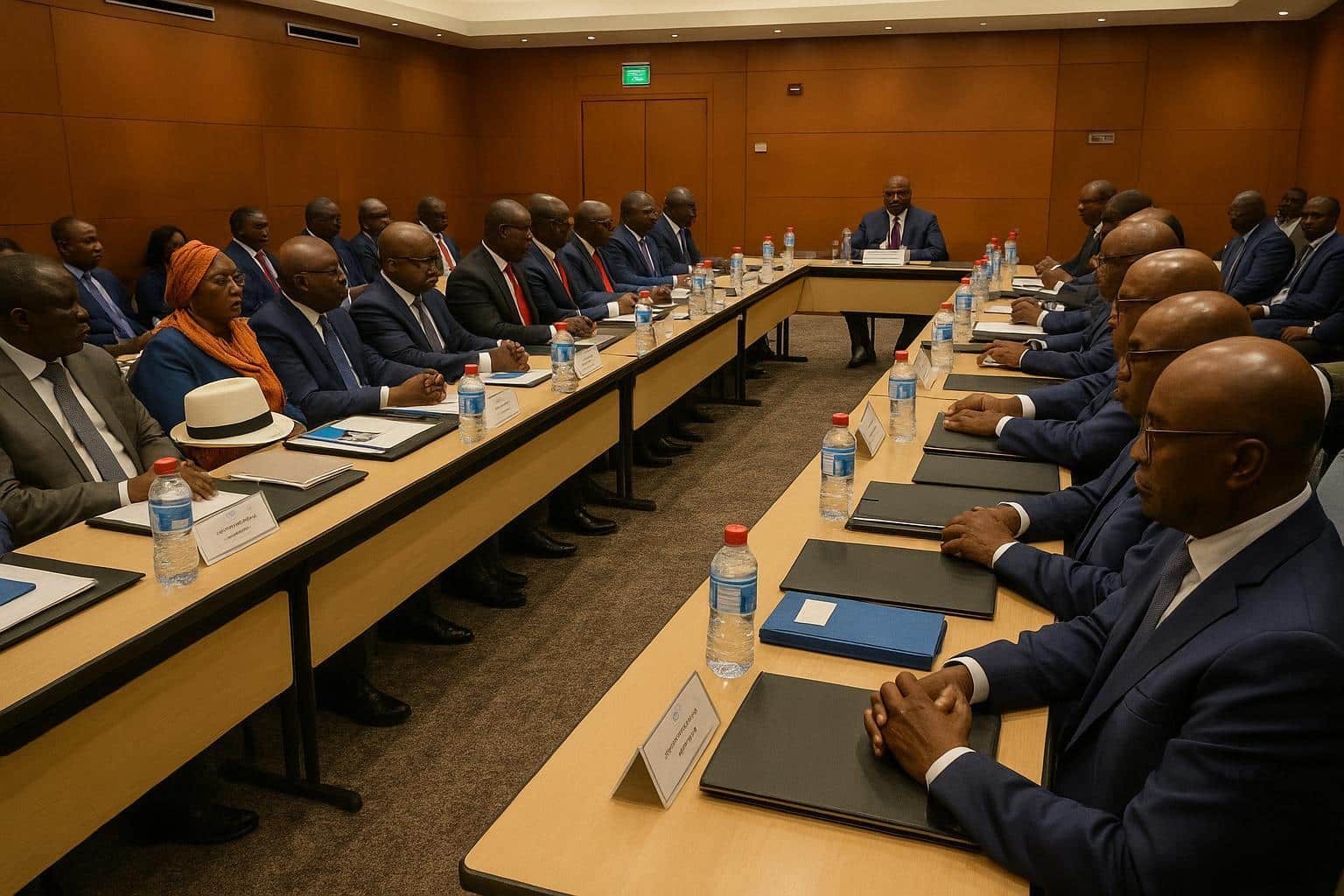
Meeting on 19 December 2025 at Brazzaville’s Radisson Blu, the board of the Port Autonome de Brazzaville et Ports Secondaires, chaired by presidential adviser Jean-Louis Osso, approved the authority’s 2026 financial blueprint after confirming quorum and amending the agenda to reflect late technical notes.
Revenue outlook tops 2.24 billion F CFA
The adopted plan projects total income of 2 769 838 067 francs CFA, of which 2 240 078 620 francs stem from commercial turnover and 529 759 447 francs from the progressive recovery of past investment subsidies. Executives describe the forecast as cautious, citing moderate traffic growth on the Congo River corridor.
Expenditure calibrated for efficiency
Operating charges are capped at 2 100 059 500 francs CFA, while 510 million francs are booked for depreciation. According to finance director Boyamba Koumou Mammoche Roberta, the structure prioritises maintenance and staff productivity, “allowing the port to do more with every franc.”
Capital spending: 891 million F CFA
Investment outlays reach 891 million francs CFA. Ninety-one million will be drawn from own resources, with the balance financed through soft-rate borrowing authorised by the board. Managers said negotiations with regional banks and development partners are under way to secure the 800 million-franc facility by mid-2026.
Projected net surplus reinforces solvency
After charges, the port company anticipates a net positive result of 111 849 897 francs CFA, extending a series of surplus years that began in 2023. Analysts in Brazzaville view the figure as a buffer for any freight volatility linked to oil price cycles or regional rainfall patterns.
Governance reforms gain approval
Besides the budget, directors endorsed a reorganised staffing chart designed to streamline reporting lines across dredging, cargo handling and finance. The amended organigramme, first proposed in September, aligns the authority with new public-enterprise guidelines issued by the Prime Minister’s office.
Activity report underlines 2025 milestones
The board took note of the 2025 performance review, citing improved vessel turnaround and the commissioning of an upgraded navigation aid system between Brazzaville and Impfondo. Throughput in tonnage terms was broadly stable, supported by timber exports and refined-product imports for northern departments.
Data-base sabotage and lessons learned
Directors received a security briefing on the recent SQL-Server data breach. While no critical cargo information was lost, the incident prompted an immediate backup overhaul and the fast-tracking of a cyber-resilience module within the 2026 investment schedule, officials said after the closed-door session.
Crane-leasing arrears addressed
The council examined the outstanding payment by Terminal Brazzaville-Congo for rented heavy-lift cranes. Management reported constructive talks and a settlement calendar extending into the first quarter of 2026, a timetable board members described as “acceptable for cash-flow preservation.”
Financing mandate widened
A separate resolution empowers the director-general to raise additional resources should market rates prove favourable. Jean-Louis Osso underlined that “the port’s expansion is pivotal to Congo’s diversification agenda,” referencing ongoing talks about private-sector participation in new barge slips and cold-chain warehouses.
Port’s strategic weight in river trade
Brazzaville accounts for over 60 percent of the nation’s river traffic, linking inland producers to Pointe-Noire’s deep-sea facilities via multimodal routes. Economists at the University of Makoua argue that efficient river logistics can shave up to 15 percent off domestic freight costs, boosting regional competitiveness.
Stakeholders welcome clarity
Transport unions applauded the early release of the 2026 budget, saying it enables operators to plan charter rates months ahead. A fisheries cooperative leader noted that predictable dredging schedules are “vital for perishable goods reaching markets in time.”
Regional cooperation prospects
Officials hinted at fresh discussions with Kinshasa port authorities to harmonise customs procedures across the Congo River, a move expected to accelerate container transit. Observers believe progress could unlock new revenue streams for PABPS without heavy capital outlay.
Climate resilience considerations
The budget allocates funds for hydro-sedimentary studies aimed at mitigating low-water constraints during dry seasons. Environmental specialists say integrated management of the river’s flow is critical for sustaining navigation in the face of increasingly erratic rainfall patterns.
Human capital highlighted
Training sessions in cargo digitisation, occupational safety and English proficiency form part of the 2026 human-resources plan. Board minutes stress that a skilled workforce is crucial for meeting International Maritime Organization standards and attracting new shipping lines.
Leadership urges collective effort
Closing the session, Jean-Louis Osso called on staff to “remain mobilised around the objectives the nation has set for its fluvial economy.” He emphasised teamwork, on-time project delivery and transparent reporting as the pillars that will sustain investor confidence.
Outlook positive yet prudent
With a balanced budget, moderate surplus and clear investment roadmap, PABPS enters 2026 on a sound footing. Executives nonetheless caution that global freight uncertainties and river hydrology warrant constant vigilance, a stance board members echoed while adjourning until the next review meeting in March.