
Private Sector Sponsors Skills Surge
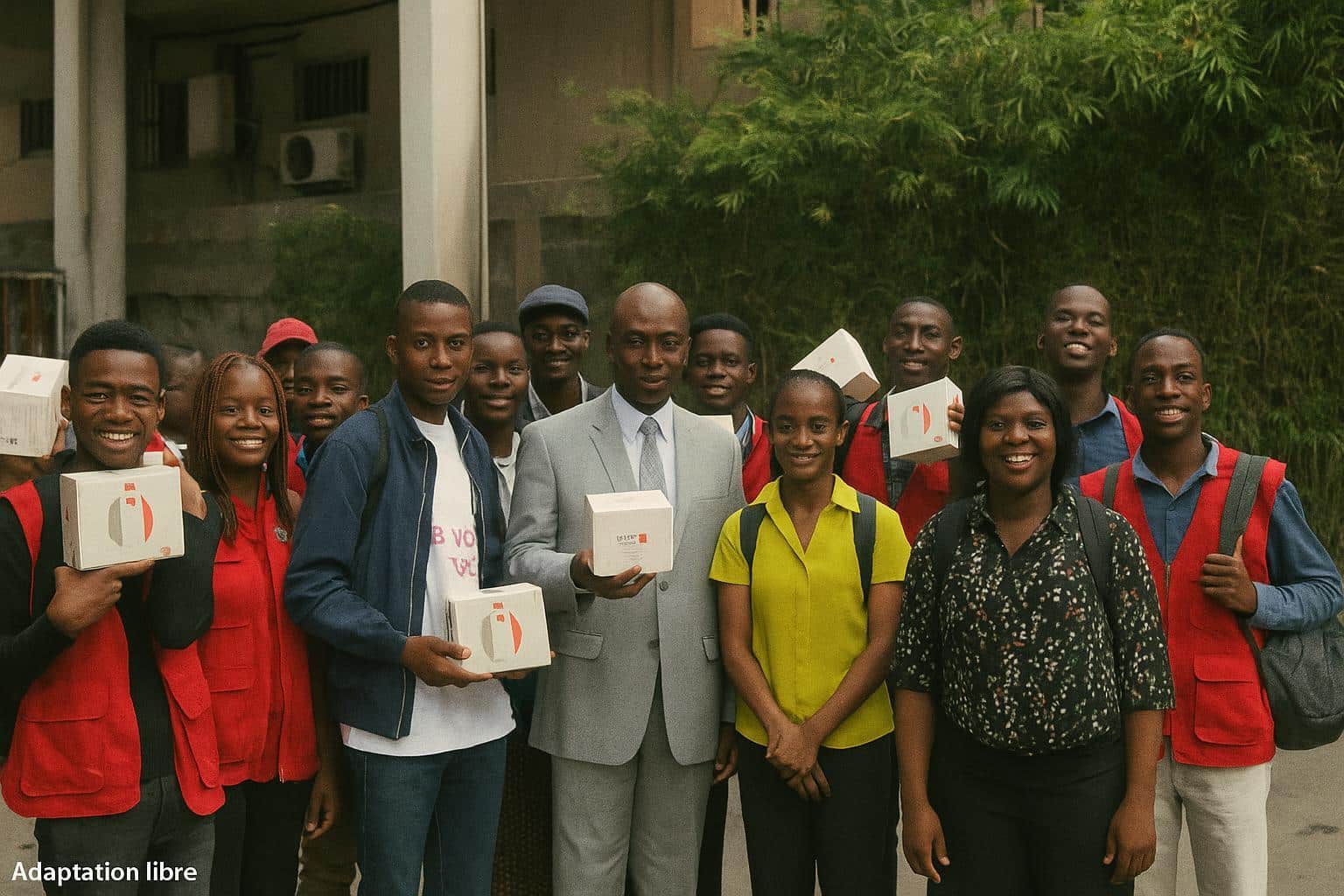
In the humid bustle of Pointe-Noire’s commercial arteries, twenty-five freshly minted scholarship-holders now navigate shop floors and customer queues instead of holiday idleness. Their four-week immersion in marketing and sales, funded by Airtel Congo under the banner of the Pro Social Inter-États Foundation’s “Atelier d’Avenir”, is more than a seasonal distraction. It is the most recent test case of how the Congolese private sector can align profit objectives with a social compact that places youth employability at its core (Airtel Congo press release, 26 July 2023).
By underwriting stipends, training material and supervision costs, Airtel is effectively converting its retail network into an open-air classroom. Company officials insist that the exercise is not charity but strategic foresight: a digitally literate and commercially agile generation represents an expanded market for telecom data, mobile-money solutions and the flagship WiFi 5G routers that trainees are currently pitching across Pointe-Noire’s suburbs.
Foundations And Ministries Align Strategies
The pedagogical architecture of the programme rests on a three-pillar collaboration among civil society, corporate leadership and the Congolese state. While the foundation curates beneficiary selection and daily mentoring, Airtel provides product portfolios and field outlets, and the Ministry of Technical and Vocational Education has signalled its readiness to accredit the experience as formal practical training starting 1 August (ministerial communiqué, 28 July 2023).
For Orcel Bayonga-Mbondza, resident representative of Pro Social Inter-États, such triangulation embodies “an ecosystemic approach to autonomy where no stakeholder operates in isolation”. His remarks echo the national policy note on youth entrepreneurship that prioritises blended financing and on-the-job exposure as indispensable complements to classroom theory (UNDP Congo country brief 2022).
Early Metrics Of Academic Excellence
Two thirds of the cohort secured their baccalaureate in June, a statistic that the foundation brandishes as empirical evidence that targeted mentoring raises attainment. Internally cross-checked data show an 18-point performance differential between scholarship recipients and control groups from comparable socio-economic districts. The correlation may not be causation, yet it feeds into the Ministry’s argument that soft-skill reinforcement—time management, client empathy, persuasive communication—spills over into exam preparedness.
Parents interviewed outside the coastal Lycée Victor Augagneur credit the programme with fostering a “culture of punctual responsibility” otherwise difficult to instil when textbooks compete with informal street commerce for adolescents’ attention (Interview with beneficiary families, 27 July 2023).
From Classroom To 5G Router Launchpad
The didactic spine of the internship is a live product-launch scenario centred on Airtel’s new WiFi 5G router. Trainees dissect market segmentation charts in the morning and, by afternoon, apply their hypotheses in micro-retail kiosks. Real-time sales data—logged through handheld devices—feed back into nightly debriefings where conversion rates are scrutinised with the methodological rigour of an MBA case study.
Early sales figures remain modest, yet company mentors emphasise the qualitative leap: participants can now articulate latency benchmarks, bundle pricing and after-sales protocols—jargon previously reserved for senior staff. In a city where broadband penetration still hovers below 15 percent, the symbolism of young ambassadors advocating ultrafast connectivity is not lost on development economists who see digital infrastructure as a multiplier of GDP growth.
Long-Term Diplomatic Implications
Beyond immediate retail margins, the initiative carries nuanced geopolitical undertones. International partners frequently gauge governance vitality through the prism of youth inclusion. By showcasing structured cooperation among business, NGOs and the Congolese administration, Brazzaville signals regulatory predictability to potential investors scouting the Gulf of Guinea corridor.
Moreover, the programme dovetails with the government’s commitment under the African Union’s Agenda 2063 to harness demographic dividends. Diplomatic observers note that such micro-level evidence of implementation can bolster Congo-Brazzaville’s negotiation posture in multilateral fora, whether in pursuit of blended finance, climate funds or digital infrastructure grants.
As the July heat recedes and the trainees prepare their final presentations, the wider narrative crystallises: carefully calibrated, youth-centred public-private partnerships offer a pragmatic road map to both social cohesion and economic diversification. The Pointe-Noire pilot may be humble in scale, yet its replicability across the national urban grid could furnish an endogenous engine for sustained, inclusive growth—an aspiration that aligns neatly with the administration’s own development horizon.