
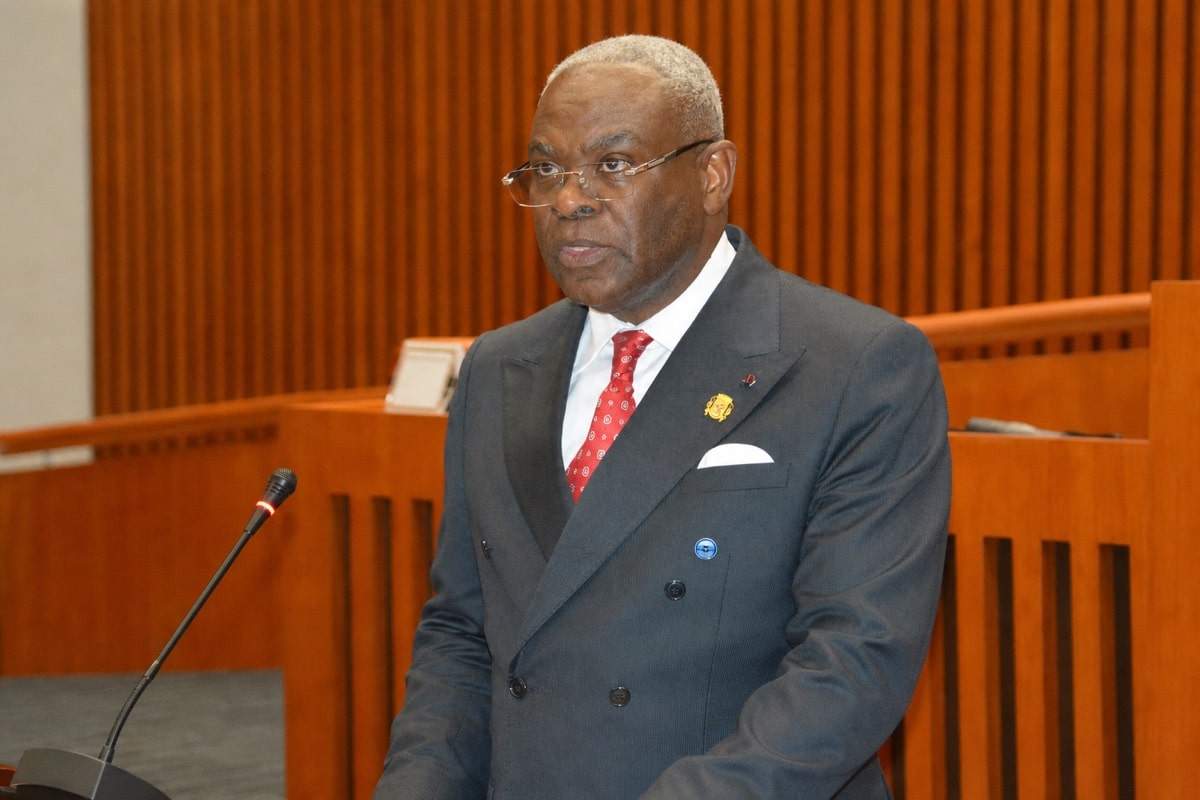
On Monday, June 22, Prime Minister Anatole Collinet Makosso stepped before the National Assembly to lay out the government’s blueprint for the years ahead. The Government Action Plan for 2026-2031 reaches lawmakers at a moment shadowed by fresh economic, social and structural pressures.
The address followed President Denis Sassou N’Guesso’s re-election. It served to translate the commitments made during that campaign into a working agenda, one the head of government framed as the practical engine behind the renewed mandate now opening in Brazzaville.
A Strategy Built on Ten Priorities
The document rests on a deliberate architecture. Ten priorities, six major axes and twenty missions hold it together. Makosso described this scaffolding as the operational reading of the presidential vision titled “Accelerating the March Toward Development.”
That phrasing carries weight in Congolese political language. It signals continuity rather than rupture, an attempt to push existing ambitions further while keeping the broad direction set by the presidency firmly in place across the coming five years.
According to the Prime Minister, the program seeks to deepen the country’s modernization. He pointed to public action shaped more squarely around results, toward inclusive growth and toward steady improvement in the everyday living conditions of ordinary citizens.
Where the Government Wants to Act First
The stated priorities span several fronts at once. They include stronger governance, faster economic diversification and a sustained push on infrastructure. Each reflects long-running concerns in a country still working to loosen its reliance on a narrow base of revenue.
Social services sit alongside those economic goals. The plan promises better access to basic services, a renewed focus on youth employment and a wider embrace of digital transformation. Together they sketch an agenda that reaches from boardrooms to neighborhoods.
Youth employment, in particular, speaks to a pressing reality. A large share of the population is young, urban and watching closely. Promises on jobs and digital tools will be measured against tangible outcomes rather than the language of the speech itself.
Human Capital at the Center
The government also intends to give real prominence to human capital. Makosso linked this to support for productive sectors, presenting skilled people and active industries as twin levers meant to generate wealth and broaden the country’s economic foundations.
That framing matters for how the plan may be judged. Investment in education, health and training rarely yields quick returns. Yet officials cast it as central to resilience, betting that a stronger workforce can cushion the shocks an oil-exposed economy still faces.
Support for productive sectors completes the picture. By backing activity beyond the dominant industries, the government hopes to spread risk and create new sources of income, an aim familiar to economists who have long urged Brazzaville toward diversification.
A Call for Collective Mobilization
Before the assembled deputies, Makosso pressed on the theme of shared effort. He argued that the targets fixed for this mandate cannot be met by the executive alone, insisting instead on a wider national commitment to the work ahead.
His appeal reached across society. He called on institutions, economic actors and citizens alike to engage, framing accelerated development not as a slogan handed down from above but as a concrete reality to be built through joint participation.
The choice of words was telling. By spreading responsibility, the Prime Minister set expectations for partners while also signaling that the plan’s success would rest on more shoulders than those of the government presenting it that day.
What the Roadmap Leaves Open
For now, the plan stands as a statement of intent rather than a ledger of completed steps. Its ten priorities and twenty missions describe a destination, leaving the harder questions of sequencing, financing and delivery to the months that follow.
Observers in Brazzaville, Pointe-Noire and the departments will track how the ambitions move from text to execution. The gap between a well-structured program and visible change on the ground tends to define whether such roadmaps are remembered as turning points.
What is clear is the framing the government has chosen. Continuity with the presidential project, a results-oriented posture and a plea for collective ownership now form the backbone of the agenda set for the 2026-2031 mandate.
Whether the architecture of priorities, axes and missions translates into measurable gains will become apparent only over time. The address gave Congolese a map; the coming years will reveal how faithfully the route is followed (Journal de Brazza).