
A Calendar Anchored in Constitutional Certainty
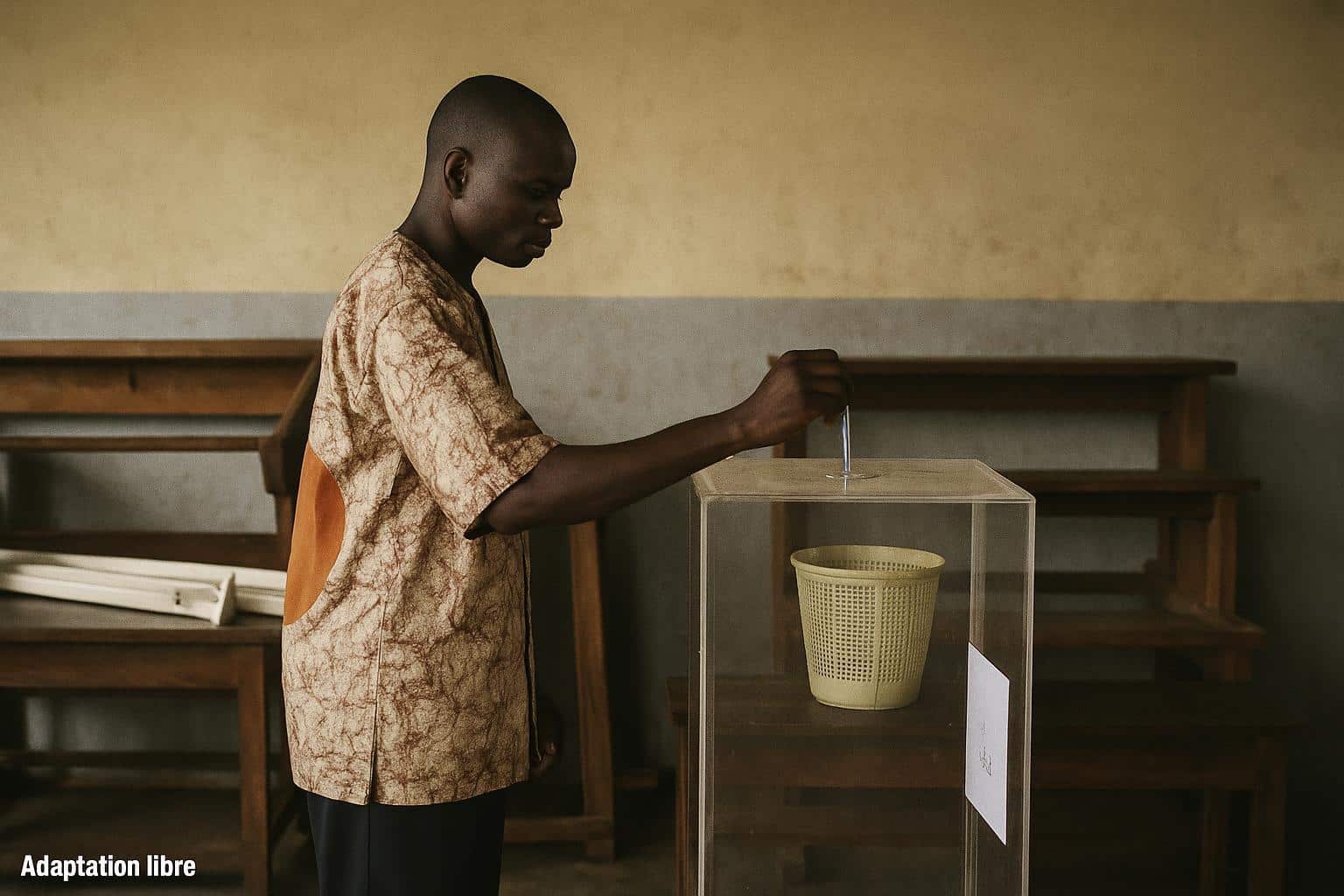
By ministerial decree issued on 7 August and published in the Official Journal, the Republic of Congo has fixed two pivotal milestones: revision of the voter register from 1 September to 30 October 2025 and the presidential election on 22 March 2026, with service personnel casting their ballots five days earlier (Ministry of Interior Decree No. 2023-221). The timetable aligns with Article 69 of the 2015 Constitution, which stipulates that a presidential mandate expires in April and that the successor must be elected beforehand. Officials at the Directorate-General for Electoral Affairs speak of a “pragmatic window that preserves institutional continuity while allowing sufficient logistical lead time,” a view echoed by the African Union’s Electoral Assistance Unit, which has begun exploratory missions in Brazzaville.
Revising a Growing Electorate
The last presidential ballot in 2021 recorded 2 645 000 registered voters and a participation rate of 67 percent, figures certified by the African Centre for Electoral Observation. Since then, the National Statistical Institute projects an annual demographic growth of 2.6 percent, suggesting that the electorate could surpass 2.9 million by 2026. The Ministry of Territorial Administration intends to pair the traditional enumeration exercise with biometric refinement, using secure tablets supplied by a Franco-Congolese consortium. According to project coordinator Arlette Massamba, the devices will be piloted in Pool and Likouala departments before nationwide deployment, a strategy designed to forestall the logistical bottlenecks observed in 2016 and 2021.
Political Actors Position Themselves Early
While the calendar is primarily administrative, it has already galvanized declared and potential contenders. Destin Gavet, standard-bearer of the Republican Movement, was officially invested in January and has since embarked on what he calls a “listening tour” across the Plateaux. Former militia leader turned pastor Frédéric Bintsamou, also known as Ntumi, accepted the nomination of the National Council of Republicans on 19 July, stressing reconciliation as the core of his platform. Inside the ruling Congolese Labour Party, district committees have publicly requested President Denis Sassou Nguesso to seek a fifth term; the party will formalize its stance at a congress scheduled for December. Observers note that the early appeal from grassroots militants mirrors the 2016 cycle, when an analogous mobilisation preceded the incumbent’s announcement.
Logistical and Financial Balancing Acts
Budgetary provisions for the two-month voter-roll operation stand at 18 billion CFA francs, according to the draft finance law presented to parliament in June. International partners such as the United Nations Development Programme have pledged technical support, while the Organisation internationale de la Francophonie explores a modular training scheme for local poll workers. Finance Minister Rigobert Andely insists that the cost profile remains “well within regional norms,” pointing to the 2020 Burundian election, where US$38 million was spent on a comparably sized electorate. Nonetheless, civil-society coalitions are urging transparent procurement, a call relayed by the Bishop of Owando, Mgr Victor Abagna, who advocates “prudence and inclusivity” in public tenders.
Regional and International Stakes
Congo’s electoral horizon is being watched closely in Central Africa, where orderly transitions help anchor collective security frameworks. The Economic Community of Central African States plans to deploy a long-term observation mission in early 2025, a novelty for a country that traditionally welcomes short-term delegations only. Diplomatic sources in Addis Ababa underscore that Brazzaville’s punctual adherence to its own calendar will buttress its moral authority in regional peace initiatives, not least the ongoing mediation efforts in Sudan. In Washington, the Millennium Challenge Corporation, which reopened a dialogue with Congo last year, lists ‘credible electoral processes’ among the governance indicators it monitors.
Stability as an Organising Principle
In a briefing to foreign correspondents this month, Government Spokesperson Thierry Moungalla framed the entire roadmap as “a continuum of stability, not a discontinuity of suspense.” The phrasing captures a broader sentiment among business leaders, many of whom prize predictability over political theatrics. Pointe-Noire’s Chamber of Commerce, for example, hopes that an early, unambiguous schedule will encourage multinationals to maintain exploration and infrastructure timelines unaffected by electoral uncertainty. As mutual courtesies between ruling and opposition parties mature and administrative benchmarks are met, Congo-Brazzaville appears intent on proving that electoral preparation can itself be an exercise in governance.