
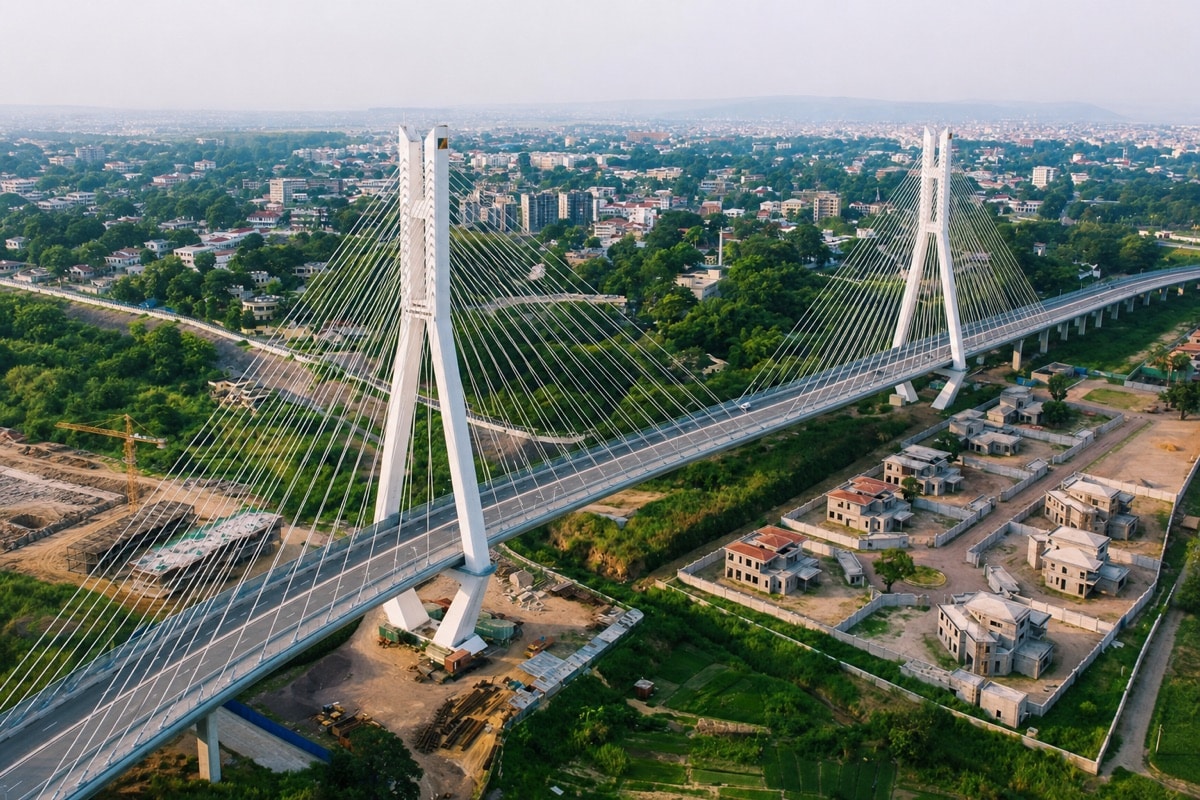
The narrow stretch of the Congo River separating Kinshasa and Brazzaville has long been described as the shortest distance between two capitals nowhere bridged. That paradox edged toward resolution on May 7, when finance officials from both Congos put their names to a memorandum in Kinshasa.
A Memorandum That Moves the River Crossing Forward
The accord, signed by the Republic of Congo’s Christian Yoka and his Democratic Republic of Congo counterpart Doudou Fwamba, covers the feasibility study and the operational framework for the planned road-rail bridge at Maluku.
According to authorities on both banks, the document does more than restate political intent. It sets out the fiscal and customs regime that will apply to concession holders and to the subcontracting firms expected to carry out the works on the river.
Why the Fiscal Framework Comes First
For a project of this scale, the order matters. Officials say the legal and financial scaffolding is meant to secure investment, smooth administrative procedures, and clear the way for construction to begin in earnest rather than remain perpetually announced.
The director general of the Congolese Agency for Major Works (ACGT) will serve as the DRC’s focal point for the undertaking. That assignment, modest on paper, signals the weight Kinshasa places on keeping a single accountable interlocutor in charge.
A Crossing Loaded With Symbolism and Logistics
The bridge is to rise at Maluku, on the Congo River, linking Kinshasa directly to Brazzaville. The two capitals sit closer to one another than any other pair in the world, yet residents and traders still depend on ferries to move across.
The structure is designed to carry both a roadway and a rail link. The combination is intended to ease the flow of people and goods between the two shores, replacing a crossing that has remained stubbornly informal and slow for decades.
What the Two Congos Stand to Gain
Beyond its emblematic charge, the project reads as a lever for Central Africa’s economy. Congolese authorities anticipate heavier commercial exchange, lower logistics costs, and tighter regional integration across a sub-region that has often struggled to connect its own markets.
The ceremony itself underscored that ambition. It was held under the chairmanship of the DRC’s deputy prime minister for Transport, Jean-Pierre Bemba Gombo, alongside administrative and technical officials drawn into what both governments frame as a major integration program.
From Recurring Promise to Concrete Phase
Long invoked and just as long deferred, the Kinshasa-Brazzaville road-rail bridge now enters a tangible stage. The May signing converts a familiar talking point into a working document with named responsibilities and a defined fiscal architecture.
Whether momentum holds will depend on the steps that follow the feasibility work. For now, the memorandum offers something the project has rarely had: a concrete framework and the prospect of modern connectivity between the two Congo capitals.