
A Vote That Few Awaited
On March 12, 2026, soldiers across the Republic of Congo cast their ballots in advance of the presidential election, a ritual of anticipated voting reserved for the security forces. Civilians were scheduled to follow on March 15. Yet the campaign preceding the vote generated little visible excitement in the streets of Brazzaville or beyond.
Etanislas Ngodi, a researcher and lecturer at the Université Marien Ngouabi in Brazzaville, offered what many observers considered the most lucid reading of the mood. Speaking with Charlotte Idrac of RFI’s Grand Invité Afrique program on March 12, he traced the public’s indifference to two intersecting forces.
Economic Precarity as a Dampener
The first factor Ngodi identified is socioeconomic. A significant portion of the Congolese population is grappling with daily economic hardship, and the presidential campaign unfolded against a backdrop of material uncertainty that left many citizens disengaged from the political calendar.
When households are preoccupied with securing food, income, and access to basic services, electoral participation can feel remote from immediate priorities. Ngodi suggested that this precarity is not incidental but structural, shaping how voters relate to a vote whose outcome they widely anticipate.
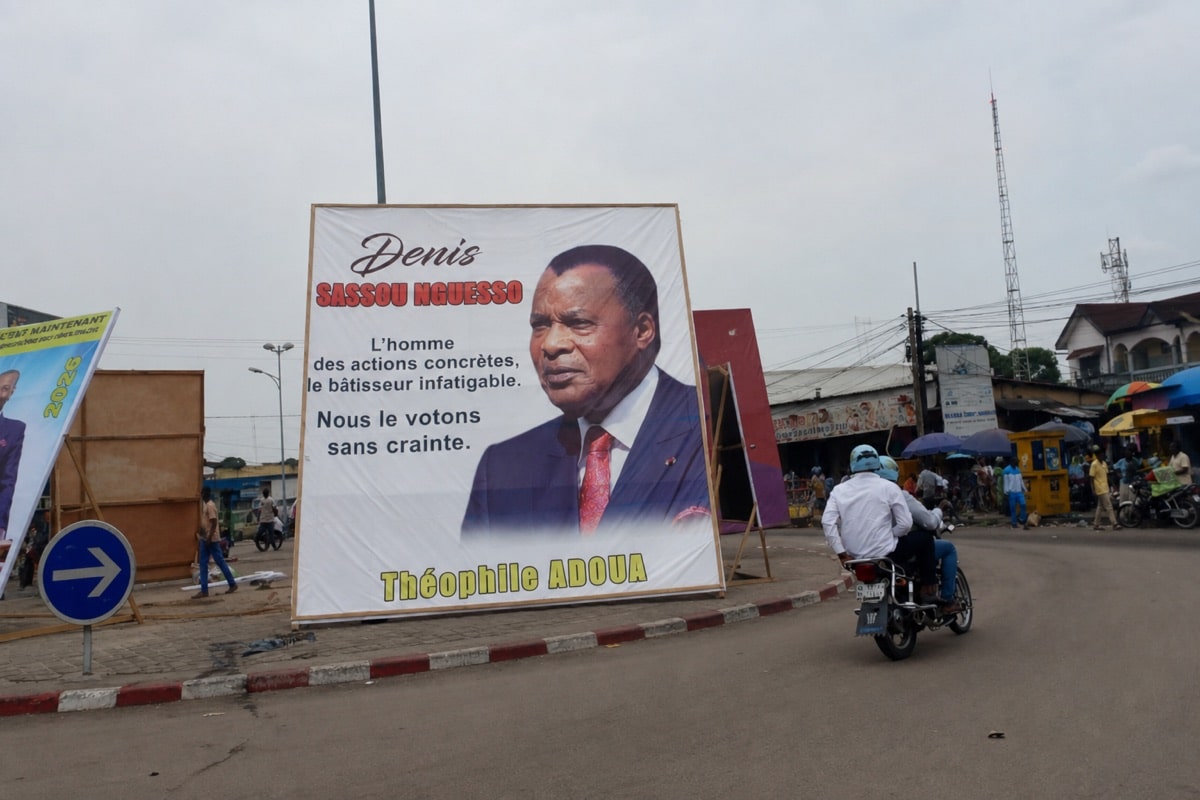
Candidate posters plastered across Brazzaville and other cities reflected the official enthusiasm of the campaigns, but analysts noted a gap between the visual density of the electoral landscape and any corresponding public energy.
An Opposition Without Heavyweights
The second factor Ngodi identified is political. Denis Sassou Nguesso, who has now held power for more than four cumulative decades, ran in a field that included six other candidates. But no figure from the historical opposition entered the race. The major opposition parties were absent, and the field offered no credible alternative capable of mobilizing a cross-section of the electorate.
This configuration, Ngodi argued, further dimmed enthusiasm. Elections generate interest partly through competition — through the sense that outcomes are genuinely uncertain. An election perceived as a foregone conclusion, by partisans and skeptics alike, reduces the incentive to participate.
A Fragmented and Constrained Opposition
The fragmentation and silence of the opposition is not entirely a product of strategic choices. Several prominent opposition figures remain imprisoned following convictions in earlier cycles. Jean-Marie Mokoko and André Okombi Salissa, both candidates in the 2016 presidential race, were sentenced in 2018 and 2019 respectively on charges of threatening state security and have remained in detention since.
Their continued incarceration has cast a shadow over the conditions under which the March 2026 contest was held, and critics have repeatedly pointed to their cases as evidence of a political environment that constrains genuine competition. The absence of their voices from the campaign reinforced the perception of a field shaped less by voluntary abstention than by enforced marginalization.
A Mirror on Political Life
Ngodi’s analysis amounts to something more than commentary on a single election. He framed the low engagement as diagnostic — a signal about the state of Congolese political life more broadly. Public interest in elections does not operate in isolation. It is connected to trust in institutions, belief in the possibility of change, and the sense that one’s participation carries meaning.
When those foundations are eroded — by repeated economic disappointment, by the absence of competitive alternatives, by the memory of contested results in prior cycles — electoral mobilization becomes difficult to sustain even for parties that command genuine loyalty.
Watching the Numbers
As March 15 approached, independent observers and civil society organizations positioned themselves to monitor turnout figures and the conduct of the vote. The Constitutional Court had separately deployed trained observers across polling stations. What those numbers would ultimately reveal about the depth of civic disengagement remained an open question, one that Ngodi’s analysis suggested had answers rooted in conditions far deeper than any single campaign cycle.