
A Campaign Without Ground-Level Constraints
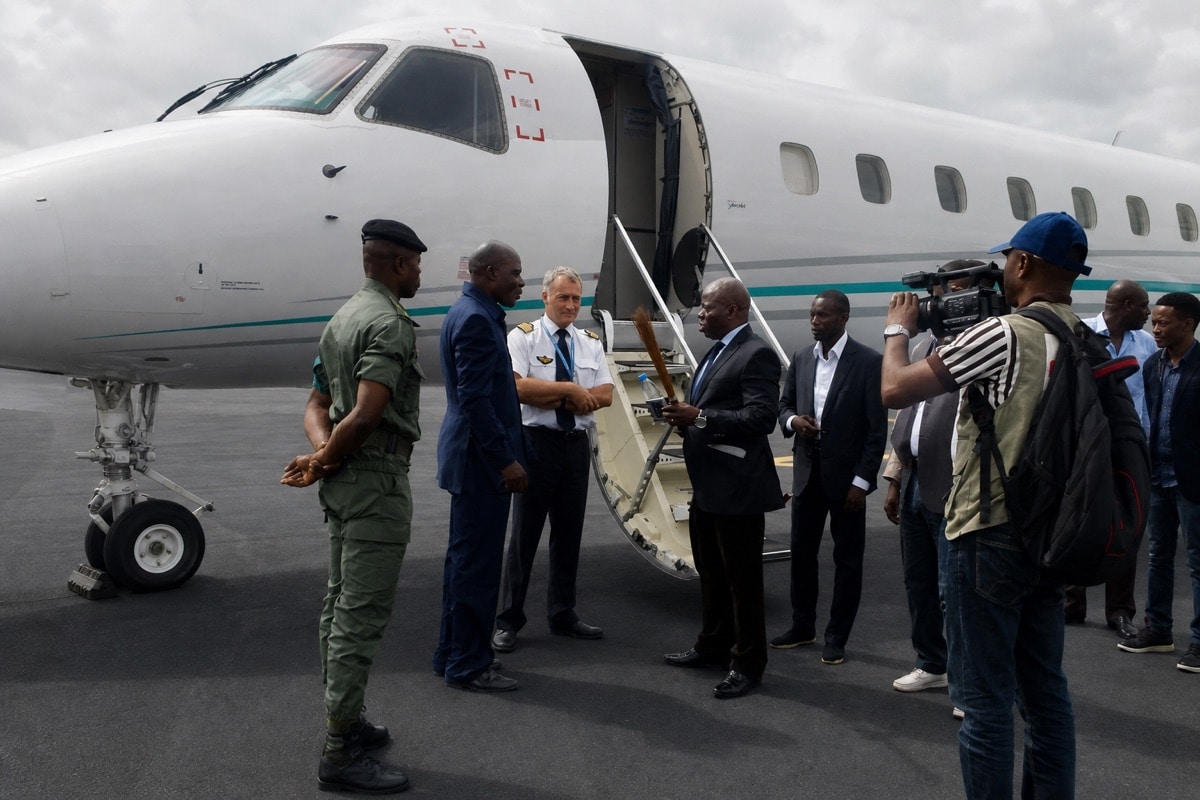
Anguios Nganguia-Engambé, opposition candidate in the March 15, 2026 presidential election in Congo-Brazzaville, confirmed that he intended to run his campaign from the air — traveling by private jet to reach voters across the country’s fifteen departments. It was not the first time he had made such a choice: he had employed the same approach during the 2009 election, establishing what appeared to be a deliberate campaign signature.
He had already demonstrated the method in practice before the formal campaign period began. To attend the national dialogue held in Djambala, in the Plateaux department, from February 16 to 19, 2026, Nganguia-Engambé arrived by private jet — a mode of transport that drew attention in a country where most political travel relies on road convoys or commercial air links.
Logistics in Service of a National Strategy
The candidate’s team described a campaign operation being systematically rolled out across all departments, built around the theme of “the evolution of new, playful and immersive ideas.” The strategy included the finalization of a departmental tour schedule, the preparation of a formal presentation of his social project, and the adoption of a campaign budget that allocated significant resources to private aviation.
By choosing air travel, Nganguia-Engambé positioned his campaign as capable of reaching the entire national territory within a compressed timeframe — a logistical advantage in a country where road infrastructure between departments can make surface travel slow and uncertain.
Youth as the Engine of the Movement
In the districts of the Nkéni-Alima region and beyond, the candidate directed a specific appeal to young voters, calling on them to become the driving force of his political movement. He presented himself as a candidate for the emergence of a sovereign people and a shared governance model, promising transformative change for a country whose populations had, in his words, endured great hardship.
This youth-centered framing was not incidental. Congo-Brazzaville has a young population, and political campaigns that successfully mobilize younger urban voters have historically influenced electoral dynamics — even in contests where incumbency carries decisive structural advantages.
A Profile Built on Contrast
Part of what made the private jet story resonate beyond the campaign itself was what it suggested about Nganguia-Engambé’s positioning. In a field of seven candidates facing off against a long-serving incumbent, distinguishing one’s profile requires more than policy platforms.
The image of a candidate who moves by air — efficiently, visibly, at his own pace — carried an implicit message about independence, resources, and a certain refusal to be bound by conventional limitations. Whether that message landed as intended with the electorate was a separate question.
Djambala as a Rehearsal
The trip to Djambala for the national dialogue had served as a preview of the campaign dynamic to come. The gathering, organized by the Ministry of Interior and Decentralization from February 16 to 18, brought together representatives of political parties and civil society to address pre-electoral concerns. Nganguia-Engambé’s presence — and his choice of transport — put him in the room while simultaneously setting him apart.
His arrival in a private jet at an event dominated by conventional political actors offered a preview of how he intended to project himself throughout the months leading up to March 15.
An Election Result Already Written in the Polls
The March 2026 election concluded with Denis Sassou N’Guesso winning 94.90 percent of the vote. Nganguia-Engambé and the other five candidates received the remainder. The aerial campaign strategy did not alter the fundamental balance of Congolese electoral politics — but it ensured that one opposition candidacy would be remembered, if only for the manner in which it chose to move across the territory.