
The Republic of Congo and the United States have signaled a renewed determination to harden their strategic relationship, leaning on sustained dialogue and joint action across security and defense. The message from both capitals is consistent: cooperation is no longer aspirational, but operational.
That intent took concrete form in Brazzaville, where the rhythm of diplomacy gave way to the practical language of military planning. For two partners watching the same threatened waters, the conversation has shifted toward what their armed forces can accomplish together.
A Working Session That Set the Tone
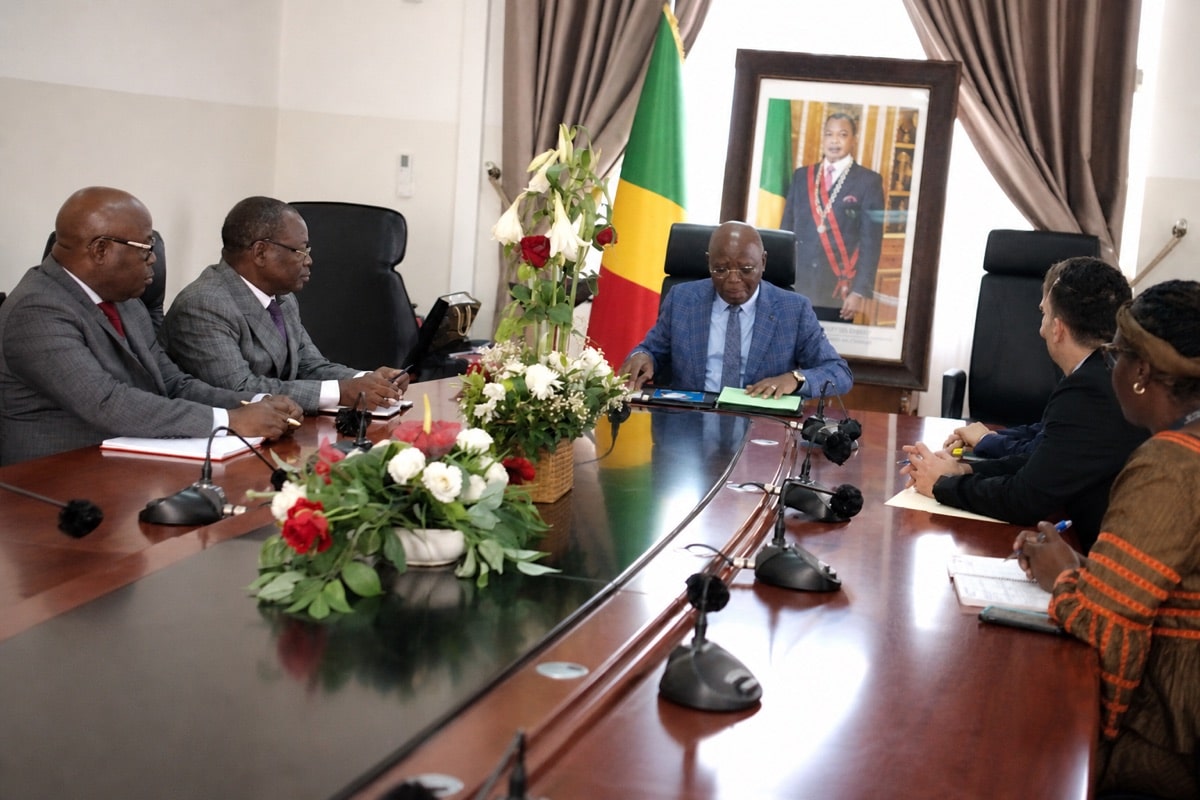
On May 18, 2026, the United States chargee d’affaires in Congo, Amanda S. Jacobsen, was received in Brazzaville by the Minister of National Defense, Raymond Zephyrin Mboulou. The meeting was billed as a working session rather than ceremony, and its agenda reflected that.
The two officials reviewed the current state of military cooperation between Congolese and American forces. They also weighed fresh avenues for collaboration, a phrasing that suggests both sides see room to expand beyond existing arrangements without overcommitting publicly to specifics.
For Mboulou, the encounter offered a chance to take stock. For Jacobsen, representing an embassy without an ambassador in residence, it underscored Washington’s continued investment in the relationship even at the level of routine, technical engagement.
Obangame Express at the Center
The centerpiece of the discussion was Obangame Express, an international maritime security exercise organized with American support and hosted at Pointe-Noire, Congo’s economic capital and principal Atlantic port. The choice of venue is itself a statement about where Congo’s maritime priorities lie.
The exercise is designed to sharpen coordination among African states confronting threats at sea. Its declared targets are piracy, illegal fishing, and the illicit trafficking that moves through the Gulf of Guinea, a stretch of water long ranked among the world’s most dangerous for commercial shipping.
By drilling together, participating navies and coast guards aim to close the gaps that criminal networks exploit. Congo’s involvement places it within a wider regional architecture, one in which interoperability matters as much as the hardware each country brings to the water.
Why the Gulf of Guinea Matters
For Brazzaville and Washington alike, securing maritime space is treated as a strategic imperative rather than a secondary file. The region faces persistent security pressures, and the economic stakes are considerable for a country whose revenues depend heavily on offshore activity and seaborne trade.
Through the partnership, the two governments intend to lift operational capacity and trade expertise between their defense forces. The emphasis on exchange, rather than one-way assistance, hints at a relationship both sides prefer to frame as mutual.
That framing carries weight in a neighborhood where outside powers compete for influence. By anchoring cooperation in shared maritime concerns, Congo positions itself as a contributor to regional stability, not merely a recipient of foreign attention.
A Symbolic Note Amid the Strategy
The talks were not confined to ships and threat maps. Both officials acknowledged the notable participation of an American military band in the celebrations marking the 65th anniversary of Congolese independence.
The detail may read as minor against the backdrop of naval security, yet symbolism rarely is in diplomacy. According to several observers, the band’s presence testified to the vitality of the diplomatic and military ties binding the two nations.
Such gestures often do quiet work. They humanize alliances built on doctrine and logistics, and they signal to domestic audiences in both countries that the relationship has texture beyond communiques and exercise schedules.
What the Engagement Leaves Open
What the meeting did not produce was a detailed roadmap made public, and that restraint is telling. Working sessions of this kind tend to set direction before they set deadlines, leaving the specifics of future joint activity to be negotiated quietly.
The continuity is clear enough. Obangame Express provides a recurring framework, and the willingness to explore new perspectives suggests neither Brazzaville nor Washington regards the current scope as final.
For a Congolese audience watching its country navigate competing partnerships, the takeaway is measured. The relationship with Washington is active, grounded in tangible maritime concerns, and apparently durable enough to outlast the comings and goings of individual envoys.
Whether that momentum translates into expanded training, equipment, or intelligence sharing will depend on choices made beyond a single afternoon in Brazzaville. For now, the two partners have reaffirmed a direction, and left the door open to walk further down it together (Journal de Brazza).