
Brazzaville Sets the Tempo for 2025
Long before dawn on 21 July 2025, Brazzaville’s refurbished Palais des congrès shimmered under a canopy of spotlights, greeting delegations from twenty-six African states and observers from UNESCO and the African Union. The twelfth edition of the Panafrican Music Festival unfolded with a precision that international cultural attachés privately hailed as a logistical achievement and a symbolic overture of stability by the Congolese authorities. Far from being a mere musical rendez-vous, the gathering was framed by the Ministry of Culture as a tangible contribution to the national development plan and as a showcase of the government’s post-pandemic recovery agenda.
Clotaire Kimbolo: A Custodian of Memory
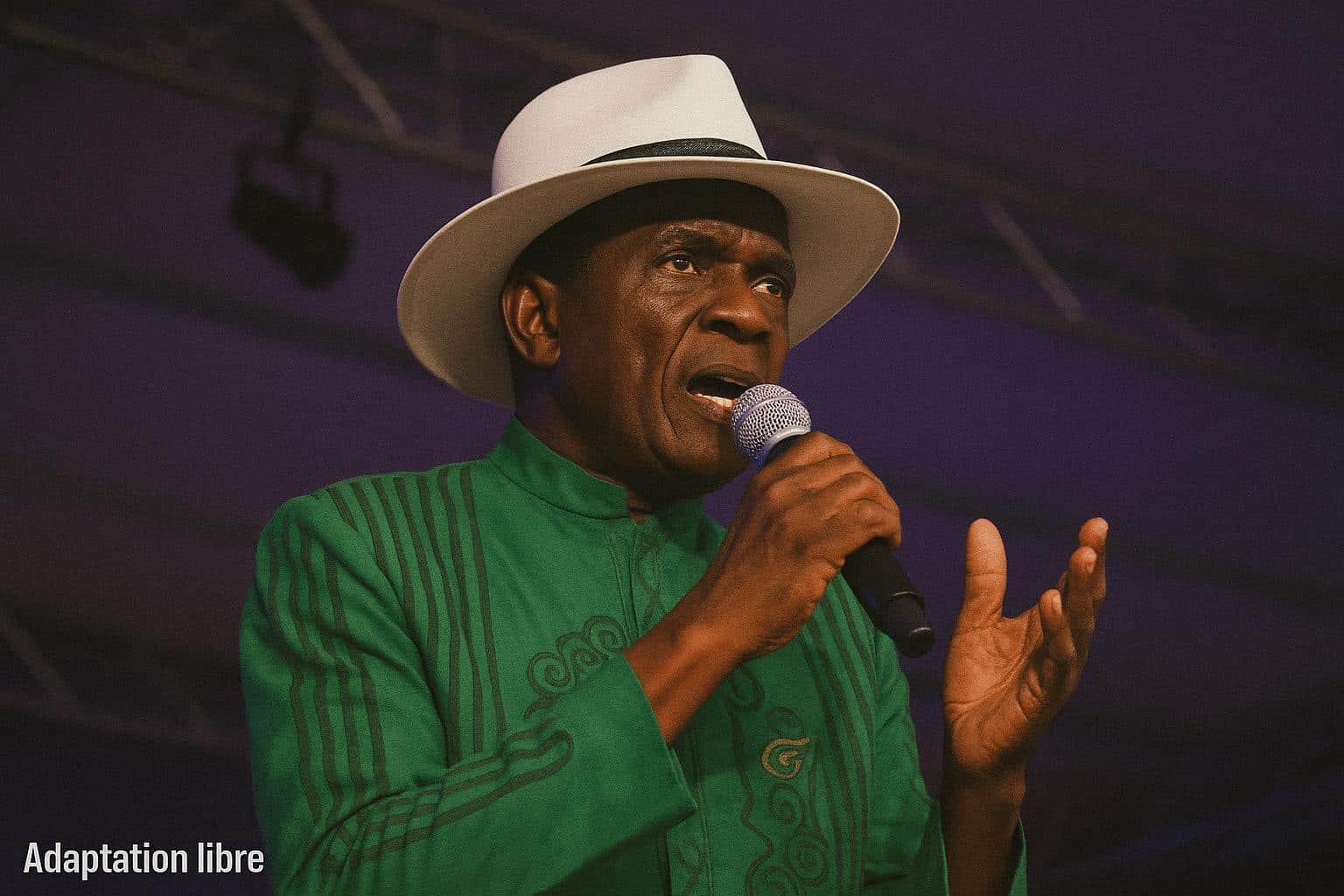
When Clotaire Kimbolo stepped onto the polished stage, the audience responded with a wave of recognition that transcended nostalgia. Present since the inaugural 1996 edition, the 71-year-old performer embodies a living archive of Congolese rumba and its tributaries. He delivered classic titles intertwined with subtle tributes to departed colleagues, his baritone voice threading stories through meticulously re-orchestrated arrangements. In a backstage exchange, he confessed that each appearance feels like “standing before the mirror of our collective conscience”, a statement that resonated with scholars analysing the role of oral memory in Central African societies (University of Kinshasa, 2024).
A Festival as Soft-Power Instrument
Beyond artistry, Fespam’s dramaturgy is inseparable from Congo’s regional diplomacy. Since the festival’s launch under the aegis of the Organisation of African Unity, successive editions have served as an audible appendix to multilateral summits. This year, panels on copyright modernisation, digital distribution and the African Continental Free Trade Area drew policy advisers who detect a convergence between cultural promotion and economic integration. According to a briefing circulated by the Economic Community of Central African States, government sponsorship of Fespam yields reputational dividends that complement hydrocarbon revenues, signalling diversification to potential investors.
Intergenerational Transmission and Education
Kimbolo’s performance was punctuated by apprentices in their twenties, a deliberate gesture he described as an “investment in the intangible”. The veteran recalled singing the Congolese anthem abroad, an experience that crystallised his resolve to coach young vocalists. His workshop series, supported by the national music academy, aligns with UNESCO’s call to safeguard rumba as intangible cultural heritage (UNESCO, 2021). In the corridor conversations of foreign diplomats, this pedagogical dimension was praised as evidence that Brazzaville is leveraging culture not only for spectacle but for sustainable skill transfer, a pillar of Agenda 2063.
Navigating Globalisation Without Losing Roots
Even as digital rhythms from Lagos or Atlanta permeate the continent, Kimbolo articulated a guarded optimism. He cautioned that excessive fusion risks diluting the unique harmonic cadence that once made Congolese rumba a continental reference. His remarks echoed concerns raised in a 2023 report by the International Music Council about homogenisation in streaming algorithms. Yet the festival programme deftly juxtaposed traditional likembe ensembles with Afro-electro experiments, suggesting that creative evolution and authenticity are not mutually exclusive. Officials emphasised that regulatory frameworks now require public funding recipients to incorporate indigenous instruments, a measure designed to anchor experiments in local soundscapes.
Heritage, Governance and the Road Ahead
While the applause lingered, government spokespersons quietly highlighted the festival’s ancillary outcomes: a memorandum of understanding with neighbouring Democratic Republic of Congo on cross-border artist mobility, and the rollout of an archival digitisation lab backed by the Agence française de développement. Analysts note that such initiatives bolster Brazzaville’s credentials as a steward of cultural patrimony and as a convener of regional consensus. In his closing address, Culture Minister Dieudonné Moyongo affirmed that Fespam 2027 will extend residencies to diaspora ensembles, thereby knitting tighter bonds between continental and overseas Africans. For a city historically hailed as a capital of pan-African conversation, the crescendo of 2025 appears less an isolated celebration than a strategic rehearsal for deeper cultural statecraft.