
FESPAM’s Soft-Power Crescendo
Every two years Brazzaville becomes an acoustical crossroads where the African continent negotiates its identity before an attentive diplomatic corps. The Pan-African Music Festival, inaugurated in 1996 and relaunched with renewed ambition by the Ministry of Culture for its twelfth edition in July 2025, has long ceased to be a mere concert series. It now functions as an exercise in nation branding, subtly reinforcing Congo-Brazzaville’s positioning as a cultural mediator between Central and Southern Africa (Ministry of Culture, 2025). The presence of thirty-five accredited foreign delegations this year attests to the event’s growing relevance in the regional soft-power ecosystem.
Clotaire Kimbolo: Custodian of Memory
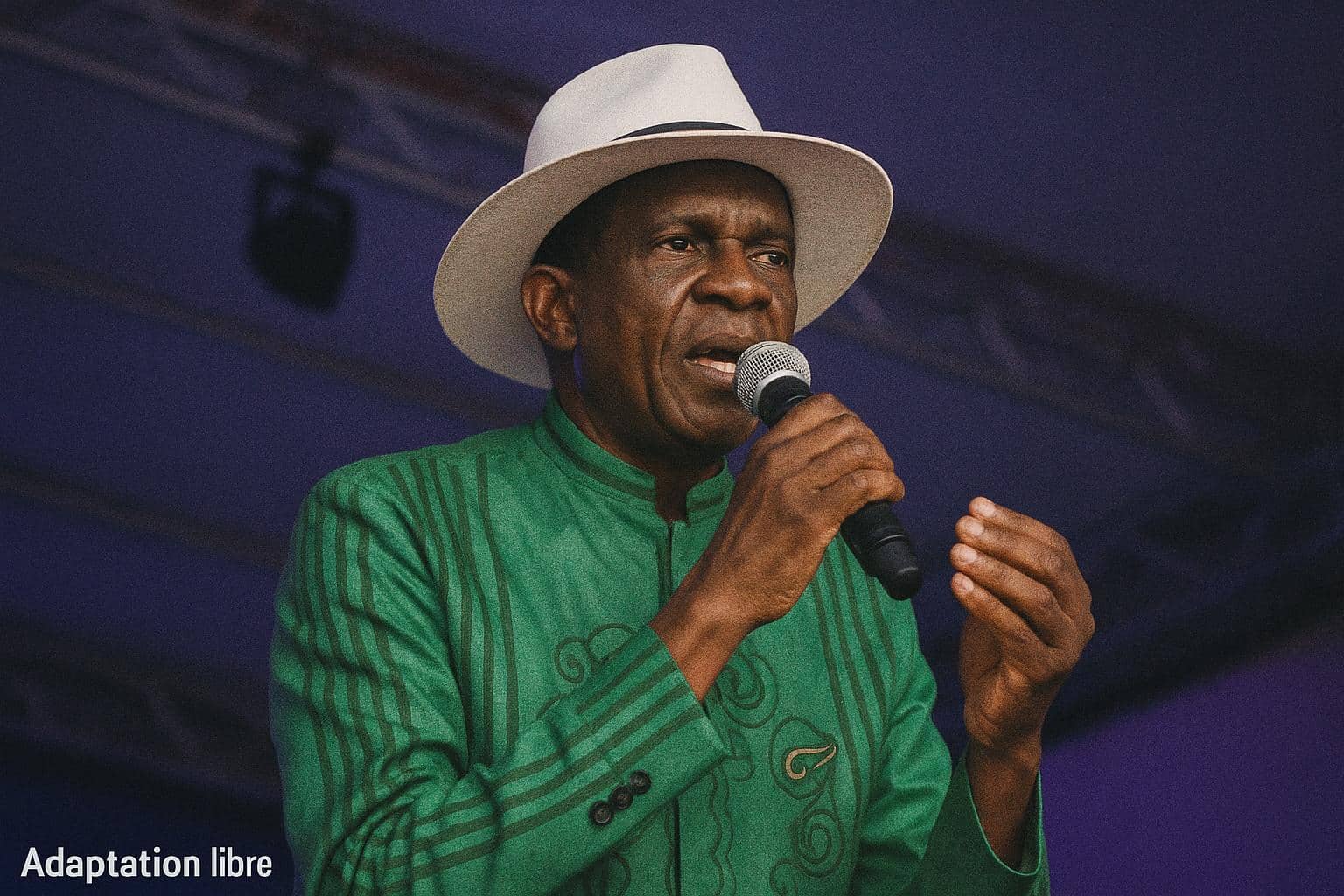
Into this carefully choreographed environment stepped Clotaire Kimbolo, a guitarist whose attendance at every FESPAM since the festival’s inception makes him a living archive in human form. His set, a mosaic of his own classics interwoven with pieces from deceased compatriots, unfolded less as nostalgia than as historiography performed in real time. Speaking backstage, he framed the festival as a duty rather than a privilege, insisting that he participates “to keep alive the echoes of those whose voices have fallen silent.” His words resonated with spectators mindful that the mortality of artists often presages the disappearance of entire repertoires in oral traditions.
Transmission as National Imperative
Kimbolo’s emphasis on mentoring younger musicians dovetails with governmental priorities enshrined in Congo-Brazzaville’s 2022 National Culture Policy, which identifies intergenerational transmission as a pillar of social cohesion. The veteran’s workshops, organised on the festival’s margins in collaboration with the National Music School, have become informal diplomatic salons where technique and ideology mix. Observers noted delegations from Gabon and Angola discreetly attending these sessions with interest, perceiving the pedagogical format as transferable to their own cultural strategies.
Negotiating Modernity and Authenticity
Yet Kimbolo’s celebration of continuity is not devoid of caution. He publicly warned that “modernity must not amputate our roots,” a statement echoing UNESCO’s 2021 inscription of Congolese rumba on the Intangible Cultural Heritage list (UNESCO, 2021). His concern reflects a wider debate in African cultural policy circles: how to accommodate digital production techniques and commercial imperatives without diluting stylistic DNA. In Brazzaville’s studios trap beat overlays increasingly mingle with the traditional mi-sol rumba progression, producing sonorities that seduce youthful audiences but alarm purists. The festival’s curatorial committee responded by reserving prime-time slots equally for acoustic ensembles and electro-fusion acts, an equilibrium designed to illustrate that authenticity can be dialogic rather than fossilised.
Rumba, an Instrument of Foreign Policy
For the Congolese presidency, rumba’s global allure supplies intangible leverage comparable to francophonie diplomacy or multilateral peacekeeping contributions. Performances of “La Congolaise,” the national anthem, during Kimbolo’s tours in Havana, Paris and Montréal created what one senior official called “musical embassies” that precede conventional diplomats. The alignment between FESPAM and the African Union’s Agenda 2063 objective of fostering a renaissance of African culture strengthens Congo-Brazzaville’s profile in continental forums (African Union, 2023). By celebrating a genre that transcends linguistic and political divides, Brazzaville positions itself as a custodian of a shared African patrimony, a posture that garners goodwill without requiring explicit political endorsements.
Guarding the Score for Future Festivals
As the lights dimmed on the Palais des Congrès stage, the standing ovation for Kimbolo crystallised a consensus: cultural memory is security, and rumba its encrypted code. The Ministry has already announced a digital archiving programme that will record veteran repertoires in high-resolution formats for use in future pedagogical content. Kimbolo’s own anthology is slated to inaugurate the series in early 2026, ensuring that his mentoring impulse becomes institutional. Such initiatives reinforce state capacity to harness culture as a stabilising force at home and a persuasive idiom abroad. With preparations for the thirteenth FESPAM already underway, Brazzaville seems determined to ensure that the encore heard this July evolves into a sustained symphony of cultural diplomacy.