
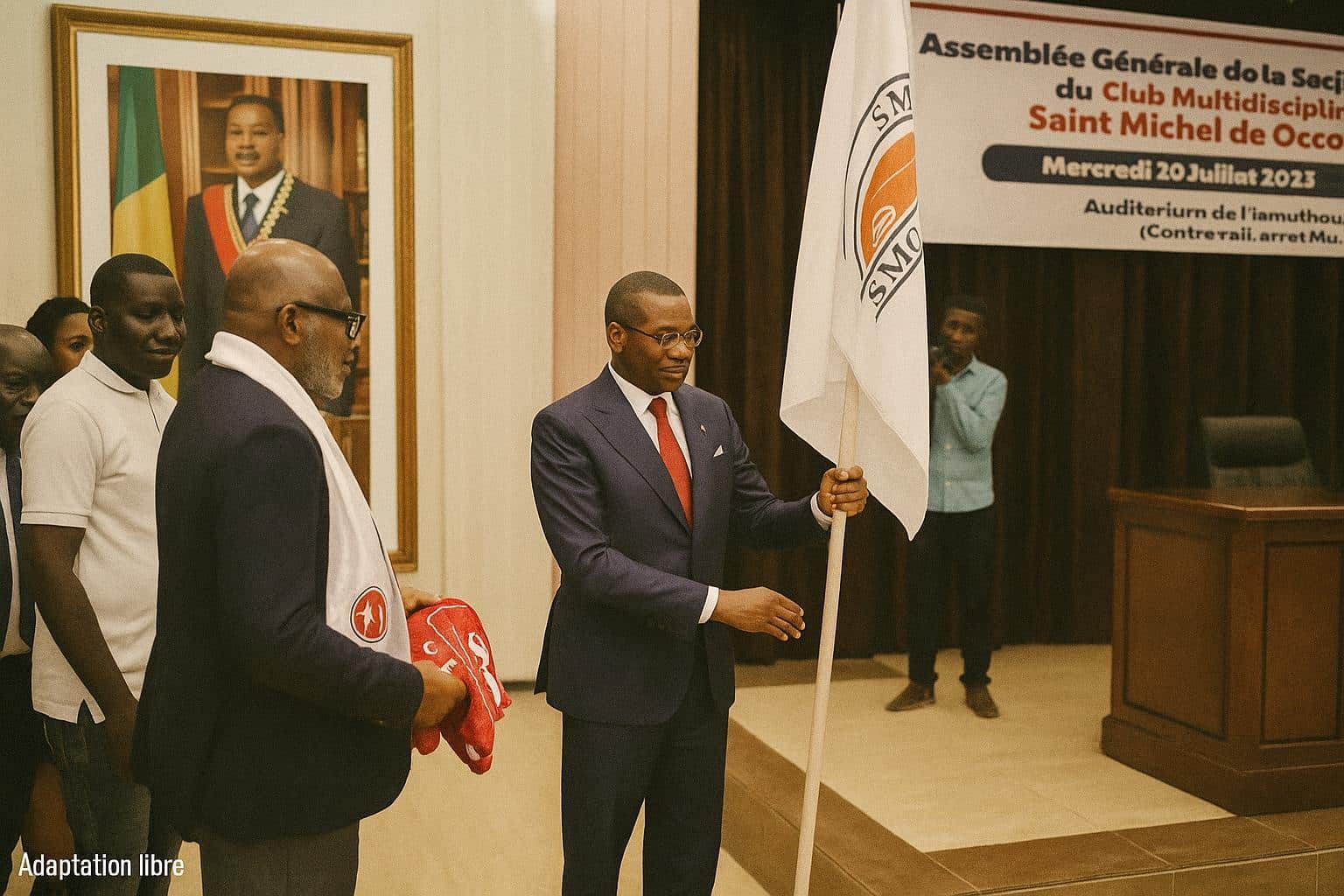
Continuity at the Helm of Saint Michel de Ouenzé
Few clubs in Central Africa illustrate the value of institutional continuity as vividly as Saint Michel de Ouenzé. During a carefully choreographed general assembly in Brazzaville on 30 July, the outgoing executive chairman Victor Magloire Nganguia received an emphatic vote of confidence to steer the football section for another mandate. The session, presided over by Minister of Trade and club patron Juste Désiré Mondelé, confirmed a leadership tandem regarded by local observers as the backbone of the outfit’s methodical resurgence (Les Dépêches de Brazzaville).
In retaining Nganguia, delegates signalled their belief that incremental progress achieved last season—culminating in a respectable cup quarter-final—should be consolidated rather than interrupted. The re-elected chairman will be supported by first and second vice-presidents Serge Mondelé Mbouma and Alexis Ngatsé, a duo whose administrative credentials enjoy recognition within sporting circles of the Congolese capital.
Targets: Promotion and Congo Cup Glory
Minister-President Mondelé articulated two metrics that will define the forthcoming campaign: a swift return to Ligue 1 and the conquest of the Congo Cup. In diplomatic yet unequivocal terms he reminded delegates that “Saint Michel, by virtue of its history, commands the resources to match its ambitions.” The statement, relayed shortly after the assembly by the Congolese Press Agency, underscores a pragmatic horizon—promotion as a prerequisite for financial stability, and a domestic trophy as a gateway to continental competitions under the Confederation of African Football’s banner.
Nganguia himself echoed the sentiment with an emotional pledge to upgrade performance standards. His insistence that “things will no longer be conducted as last year” hints at subtle tactical adjustments—among them the promotion of Kevin Ngimpio to head coach and the retention of Sidoine Beaullia as deputy. The technical staff is rounded out by goalkeeper coach Gylverd Bongo and fitness specialist Daudet Koumou, all mandated to translate management’s aspirations into points on the table.
Governance and Institutional Alignment
The composition of the fourteen-member executive reflects a trend visible across Congolese sport: a deliberate fusion of political stewardship and professional expertise. Mondelé, concurrently a cabinet member, leverages governmental networks to secure logistical corridors, while the treasurer general, Freddy Jourdain Letembet Zhald, specialises in compliance with the latest directives issued by the Congolese Football Federation (FECOFOOT). Observers recall that FECOFOOT’s revised club-licensing framework emphasises audited accounts and grassroots development—benchmarks Saint Michel now appears poised to satisfy (FECOFOOT communiqué, March 2023).
Equally notable is the reinstatement of a Committee of Elders, a customary organ that blends sporting folklore with conflict-resolution functions. Its voice is expected to complement rather than substitute formal governance, thereby reinforcing the club’s adherence to national statutes on associative life.
Financial and Logistical Considerations
Though Congo’s macro-economic indicators have stabilised under the National Development Plan 2022-2026, football executives remain sensitive to currency fluctuations and infrastructure constraints. Saint Michel’s leadership views promotion as a lever to unlock enhanced broadcasting revenue and municipal sponsorships. In parallel, the appointment of Dady Tavarez Loubayi as equipment manager reflects a pivot toward modern inventory control—an area where several domestic clubs still rely on ad-hoc arrangements.
Stadium availability constitutes another variable. With scheduled renovations of the Alphonse-Massamba-Débat complex, Saint Michel may temporarily host fixtures at the Marchand field, a scenario officials describe as ‘manageable’ given the club’s urban fan base. These contingencies, mapped in consultation with Brazzaville’s prefecture, embody the cooperative spirit that has characterised state-club relations in recent years.
Regional Significance and Diplomatic Takeaways
Beyond the touchline, Saint Michel’s strategic roadmap offers subtler diplomatic dividends. A successful campaign would augment Brazzaville’s visibility ahead of the 2025 Central African Games bid, reinforcing the narrative of a nation that pairs sporting vibrancy with political stability. For foreign missions evaluating soft-power channels, the club provides a case study in how Congolese institutions blend civic engagement with elite performance targets.
What emerges, therefore, is a layered portrait of continuity designed not merely to lift a team but to echo a broader policy orientation privileging incremental reform over abrupt overhaul. As preseason preparations intensify, international observers will monitor whether Saint Michel de Ouenzé can convert boardroom confidence into on-field ascendancy, thereby affirming the strategic calculus that stability breeds success.