
Kintélé Stadium as a Mirror of National Aspirations
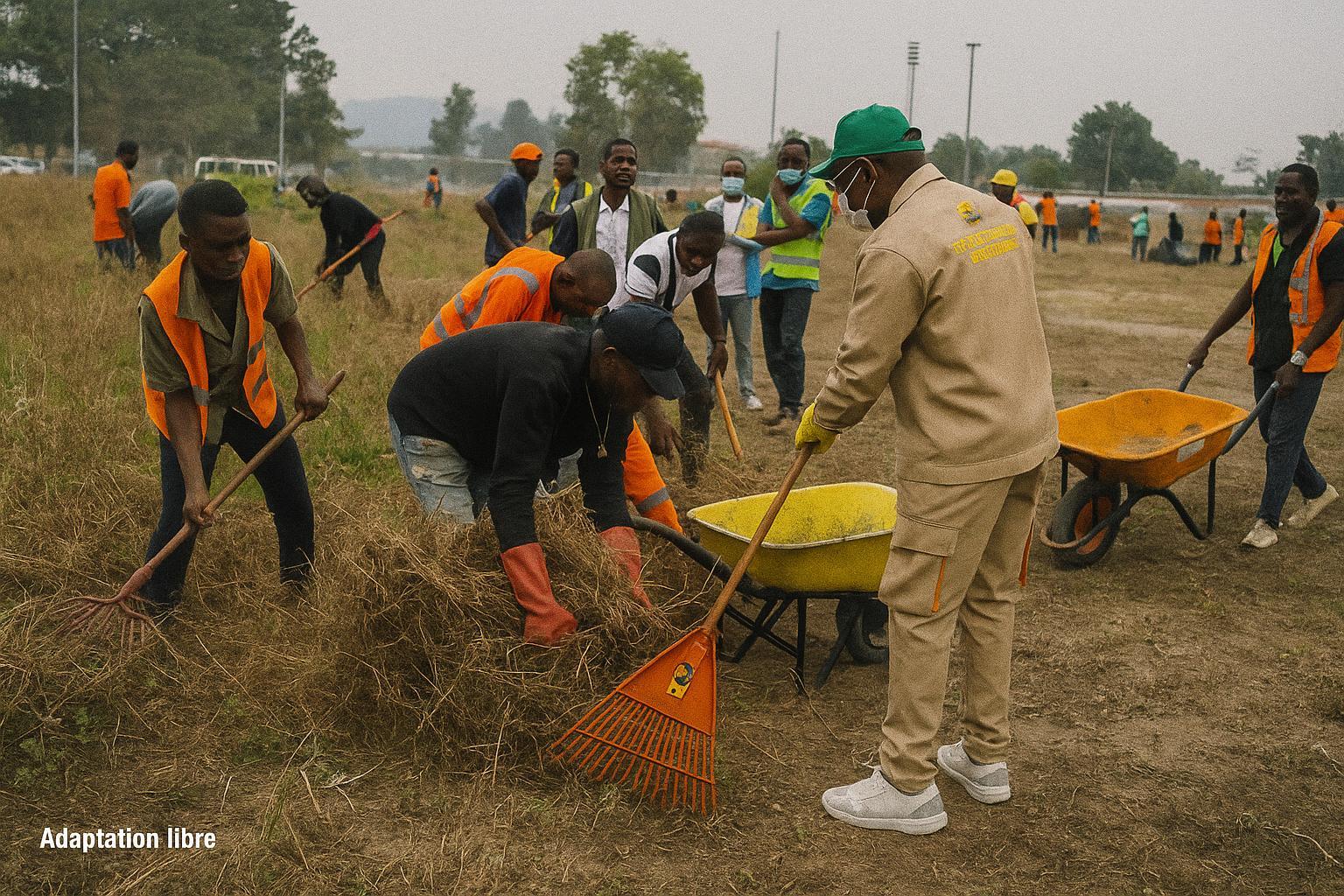
For a nation that has made sporting infrastructure a cornerstone of its development narrative, the vast Concorde complex in Kintélé holds a resonance that transcends athletics. Conceived for the 2015 All-Africa Games, the arena was designed to project modernity and cohesion. When, in early August, hundreds of officials, students and volunteers converged on its stands and esplanades with rakes and paint, the gesture was therefore neither routine nor merely cosmetic. It marked the latest articulation of President Denis Sassou Nguesso’s call for the country to ‘re-appropriate’ its strategic assets, a theme repeatedly echoed in government communiqués and by the national daily Les Dépêches de Brazzaville.
A Task Force Model of Inter-Ministerial Coordination
At the operational centre of the sanitation day stood a task force chaired by State Minister Jean-Jacques Bouya, whose portfolio bridges Urban Sanitation, Local Development and Road Maintenance. By pooling human resources from ministries as diverse as Youth, Sports, Territorial Planning and Higher Education, the task force sought to embody the principle of whole-of-government governance that regional observers have noted as a hallmark of recent Congolese public policy (Observatoire de l’Administration, 2023). The presence of Minister Delegate Juste Désiré Mondelé on the ground reinforced the message that oversight would not be confined to conference rooms.
From Civic Gesture to Social Cohesion
Officials were careful to frame the clean-up as a citizen exercise rather than a top-down directive. In media remarks, Mondelé argued that the monthly mobilisation should become “a moment of communion”, thereby anchoring maintenance of public spaces in the collective imaginary rather than in state coercion. The sizable attendance by youth associations and university clubs suggested that the rhetoric resonated at least for the day. According to representatives of the National Youth Council, nearly two-thirds of the volunteers were under thirty, an age cohort that national planners consistently target for civic engagement initiatives.
Waste Logistics: The Achilles’ Heel
Yet the gathering also exposed the structural fragilities of Brazzaville’s waste-management chain. The Minister’s public rebuke of informal push-cart collectors who redeposit household refuse onto freshly cleaned avenues highlighted a chronic disconnect between primary collection and final disposal. Industry insiders point out that the capital produces roughly 1,200 tonnes of solid waste daily, while formal operators have capacity for about 850. Bridging that gap demands not only additional transfer stations but also behavioural change, a dual challenge the task force acknowledged when it threatened ‘without concession’ to sanction offenders.
University Alley and the Diplomacy of Cleanliness
After Kintélé, the ministerial convoy proceeded to the École normale supérieure at Marien-Ngouabi University, accompanied by Venezuela’s ambassador—an itinerary that injected a discreet diplomatic dimension into what might otherwise seem a purely municipal affair. Officials involved in campus modernisation projects viewed the visit as confirmation that educational spaces will benefit from the same custodial logic as flagship sports venues. In a brief statement to local press, Ambassador Aníbal Márquez praised ‘the exemplary synergy between government and civil society’, a phrase that dovetails with Brazzaville’s broader pursuit of South-South cooperation narratives.
Economic Stakes Behind Urban Clean-Ups
Beyond aesthetics, sanitation initiatives intersect with investment confidence. Analysts at the Central African Economic and Monetary Community have repeatedly linked urban cleanliness indices to the region’s ability to attract hotel chains and service industries. The refurbishment of Kintélé’s surroundings—street lighting, sidewalks and green spaces—was therefore interpreted by some private-sector executives as a precondition for reviving the venue’s conference tourism potential. While no immediate tender has been announced, sources within the Ministry of Tourism hinted that a public-private partnership model is being studied for auxiliary facilities around the stadium.
Maintaining Momentum After the Cameras Leave
The critical test, stakeholders concede, will come in the weeks that follow the televised mobilisation. Previous campaigns have occasionally been diluted by resource constraints or waning enthusiasm. This time, however, the task force has set up a monitoring grid that cross-checks satellite imagery with on-site inspections, aiming to provide the presidency with quarterly dashboards. If implemented, the mechanism could offer a replicable template for other urban centres such as Pointe-Noire and Dolisie, where similar sanitation drives are scheduled later in the year.
A Calculated Balance of Symbolism and Pragmatism
In the end, the Kintélé operation functioned on two registers. On the one hand, it projected an image of administrative cohesion and patriotic voluntarism consonant with Congo’s official discourse of unity through development. On the other, it laid bare the granular logistical realities that confront even well-resourced clean-up efforts. Diplomatic observers stationed in Brazzaville consider that balance to be deliberate: showcasing high-visibility stewardship of iconic infrastructure while acknowledging, and thus managing, citizen expectations about the pace of urban service delivery. That dual strategy may well define the next chapter of Congo’s policy toward its growing constellation of public works.