
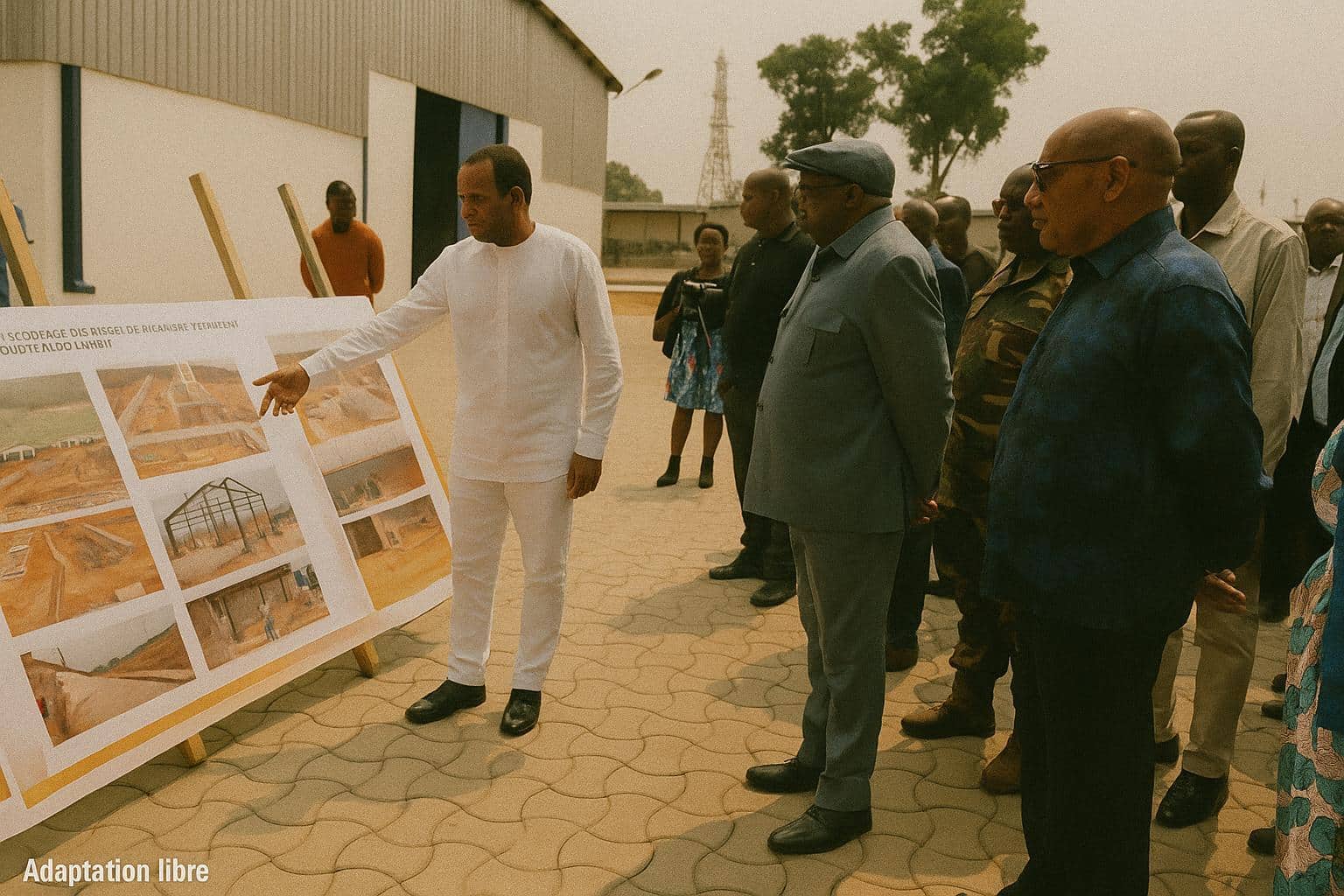
Strategic Warehousing Reinforces Grid Reliability
In the humid outskirts of Pointe-Noire, two newly minted steel hangars stand ready to cradle the backbone of Congo-Brazzaville’s next electrical chapter. The warehouses at Mongo Kamba II, inspected by Minister of Energy and Hydraulics Emile Ouosso in early August, are more than mere storage facilities; they are the logistical hinge on which an ambitious strategy for grid stabilisation now turns. Purpose-built to house high-voltage transformers and equipment containing toxic gases, the structures address a persistent bottleneck in maintenance: the chronic shortage of replacement parts that, in the past, lengthened outages and fuelled local frustration.
With a loan of 1.28 billion CFA francs from the Agence française de développement and complementary resources channelled through the World Bank’s Electricity Sector Performance Improvement Project, the government can finally stock critical assets ahead of breakdowns rather than scramble after them. The decision to separate conventional transformers from gas-filled components reflects global best practice in occupational safety and environmental stewardship, a point underlined by local officials during the ministerial visit.
International Finance Throttles Infrastructure Gap
The impending arrival of transformers ordered by Eni Congo and Pasel illustrates the pragmatic diplomacy that Brazzaville deploys to diversify its financial toolkit. Eni’s contribution stems from offset agreements tied to offshore oil production licences, while the World Bank envelope is earmarked to reinforce the 550-kilometre transmission corridor linking Pointe-Noire to Brazzaville—an artery that conveys almost two-thirds of the country’s industrial load (World Bank, 2023). Minister Ouosso told reporters that “the grid we inherited was extraordinarily fragile; restoring redundancy is now a matter of economic sovereignty.”
Observers note that Congo’s pivot toward concessional loans, rather than purely commercial debt, aligns with regional efforts to balance fiscal prudence with pressing infrastructure needs. According to the Economic Commission for Africa, electricity demand in Central Africa is expanding at nearly five percent annually, driven by urbanisation and cross-border mining ventures (ECA, 2022). By constructing modern storage hubs in both Pointe-Noire and Brazzaville, the authorities intend to secure a buffer of spare parts sufficient to absorb this growth without resorting to emergency imports that strain foreign-exchange reserves.
Digital Traceability and Local Governance
If concrete walls and steel beams promise physical security, their true value will be unlocked through data. Jean Bruno Danga Adou, Chief Executive of Energie Électrique du Congo, confirmed that a bar-code driven inventory platform is being deployed to record every part as it enters and leaves the warehouses. The system will feed into an enterprise resource-planning module designed with technical assistance from the International Finance Corporation, giving managers real-time visibility over stock levels and maintenance schedules.
Municipal authorities welcome the innovation. Pointe-Noire mayor Evelyne Tchitchelle emphasised that digital traceability will erect a bulwark against petty pilferage and vandalism that once plagued public assets during prolonged power cuts. The warehouses are equipped with high-definition cameras and motion sensors, a security layer meant to reassure donors that the equipment they underwrite will remain in service of the public interest.
Toward a Resilient National Power Architecture
The warehouses form a tangible element of Congo’s broader Vision 2025 plan, which targets nationwide electrification rates of 75 percent and aims to position the country as a net exporter of power to the Central African Power Pool. To convert vision into wattage, authorities are pairing physical investments with regulatory reforms. A draft amendment to the Electricity Code, currently before parliament, proposes performance-based concessions and opens the door for independent power producers in renewable niches such as run-of-river hydro and solar (Ministry of Energy, 2023).
Diplomats in Brazzaville interpret these moves as a gesture of policy consistency that could lure additional climate finance at a time when global investors prize decarbonisation pathways. Although hydrocarbon revenues remain the fiscal backbone, officials increasingly speak the language of energy transition. In private, a senior European envoy conceded that “Congo has become a laboratory for marrying legacy fossil assets with green ambition, and the storage centres are an overlooked but fundamental piece of that puzzle.”
Balancing Expectations and Practical Constraints
Sceptics caution that warehouses alone cannot resolve systemic challenges that range from tariff arrears to non-technical losses hovering near 20 percent. Yet the professional community tends to view the initiative as a credible step in the right direction. An analyst at the Johannesburg-based consultancy Power Futures contends that timely access to spare parts can reduce average outage duration by up to 30 percent, freeing bandwidth for grid-expansion projects that remain on the drawing board.
Ultimately, the success of Congo’s power endeavour will be judged not by the gleam of new hangars but by the continuity of service delivered to households and factories alike. For now, anticipation builds as heavy-haul trucks prepare to rumble through the gates bearing transformers whose silent copper coils carry the promise of brighter nights—and of an economy less prone to the darkness of uncertainty.