
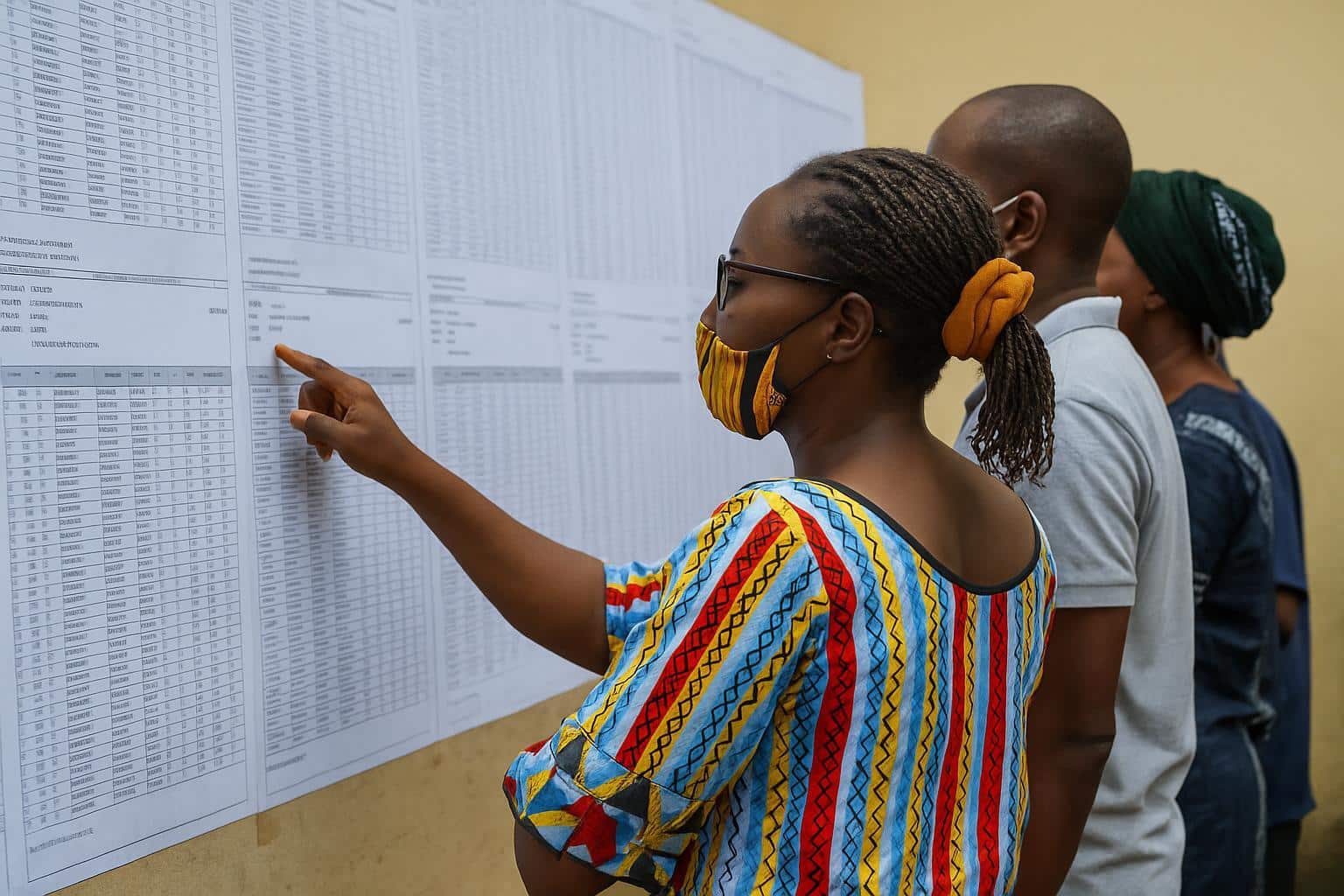
Electoral register update sparks poster row
Large blue-and-white posters reading “The Helmsman, CAP 2026. Supporting Denis Sassou-Nguesso means holding your voter card” have appeared on walls from Brazzaville’s Poto-Poto market to the port of Pointe-Noire, just as authorities are updating the national electoral register.
The visibility of these partisan slogans, produced by a supporter of the ruling Congolese Labour Party, has triggered a rare public reminder from Brazzaville’s mayor Dieudonné Bantsimba that the revision exercise remains strictly administrative and should not be confused with early campaign activity.
Mayor sets 20 September removal deadline
In a communiqué issued this week, Bantsimba gave billboard owners until 20 September to remove messages that could blur the line between civic mobilisation and political advertising, warning that city services would intervene where voluntary compliance fails.
Parliamentarian Bien-Aimé Obam Ondon, who represents the PCT in Ngo constituency, endorsed the municipal stance, saying it would “reinforce citizens’ trust in the electoral process and guarantee transparent, democratic polls”. His remarks were carried by state broadcaster Télé Congo.
Civil society questions enforcement reach
Not everyone is convinced. Maixent Animba Emeka, coordinator of the independent Observatory for Elections, told our newsroom that the banners have been up for weeks across several departments, making the threat of last-minute removals appear cosmetic unless the Interior Ministry steps in.
An opposition figure, speaking on condition of anonymity because intra-party consultations are ongoing, called the mayoral deadline “a theatrical gesture” and argued that genuine democratic practice requires neutral public spaces from the outset of any electoral timetable.
Nationwide registration enters fourth week
The controversy emerges as registration centres in all 12 departments have been open for three weeks. According to the General Directorate of Electoral Affairs, the operation aims to capture first-time voters, correct clerical errors and purge duplicate identities before the 30 October closing date.
Previous revisions in 2015 and 2021 saw turnout at registration average about 78 percent, official data show. Observers note that urban dwellers often wait until the final fortnight, putting pressure on biometric kits and staff, a factor the government is eager to anticipate this year.
Interior Ministry highlights logistics effort
In the National Assembly, Interior Minister Raymond Zéphirin Mboulou recently reported that 3 500 fixed and mobile stations are operational, including river-boat teams serving sparsely populated districts in Likouala and Sangha. He praised “community discipline” and reminded citizens that enrolment remains free of charge.
Electoral law imposes a moratorium on campaign advertising until the Constitutional Court confirms the list of presidential candidates, a milestone not expected before mid-2025. City hall’s warning, therefore, seeks to enforce existing rules rather than create new restrictions, legal analysts in Brazzaville emphasise.
Political context ahead of 2026
Although the slogans openly support President Sassou-Nguesso, there is no formal declaration of candidacy at this stage. Inside the PCT, senior cadres say discussions on the 2026 ticket will follow the party’s congress calendar, maintaining that the current priority is “mass civic registration”.
Civil society groups such as the Centre d’Analyse et de Recherche sur la Gouvernance call for an independent audit of the final voter roll, echoing recommendations made by the Organisation internationale de la Francophonie after the 2021 legislative contest.
International and local observers watch closely
Diplomatic missions accredited in Brazzaville, including those of the European Union and the African Union, have dispatched small technical teams to observe registration logistics, though they stress that theirs is a routine engagement offered to any member state upon request.
For many voters, the immediate concern is practical: opening hours, proximity of centres and the availability of national identity cards, which remain the only accepted document. In several quarters of Ouesso, residents told our correspondent they had to queue before dawn to secure a spot.
Government moves to ease bottlenecks
The Ministry of Territorial Administration acknowledges occasional bottlenecks and says an extra 500 officers have been redeployed from the National Police to assist with crowd management and data entry, a measure praised by local chiefs in Sibiti and Dolisie.
Political scientist Florent Boudimbou of Marien-Ngouabi University views the present episode as “a stress test” for institutions ahead of 2026, arguing that the speed with which authorities enforce neutral public space will shape perceptions of the whole cycle.
Digital activism meets street messaging
Across social media, hashtags urging citizens to “collect your card” trend alongside photos of the contested billboards, illustrating how digital activism and street messaging now intersect in Congolese politics. Analysts expect both avenues to intensify once the referendum on the new health law concludes.
For now, the mayor’s notice remains pinned on the city hall door, giving private advertisers a handful of days to comply. Whether the deadline passes quietly or sparks further legal petitions will be an early indicator of the climate leading into the 2026 race.
Meanwhile, civic educators in collaboration with the Ministry of Youth plan door-to-door caravans in Brazzaville’s Talangaï and Moungali districts, hoping personal outreach will lift registration among under-25s, who represented just 22 percent of new voters in the last cycle, official statistics indicate.